The Deep Green Energy System Can Be Built Today
Eliminating chronic hunger, saving over 250 km³ of freshwater annually, and raising real household purchasing power across every global region is not a speculative moonshot—it is an engineering execution challenge. Unlike conventional net-zero roadmaps that gamble trillions on unproven grid storage, fusion, or costly direct air capture, the
Deep Green Energy (DGE) system relies on
commercial, field-proven technologies (TRL 8–9) already operating at industrial scale today. By co-locating these modular technologies into regional
Bio-Hubs
and utilizing Artificial Intelligence as a real-time biological operating system, World Inc. captures immediate energy, heat, CO₂, and logistical synergies while keeping four next-generation technologies in reserve for phase-two expansion after 2035.
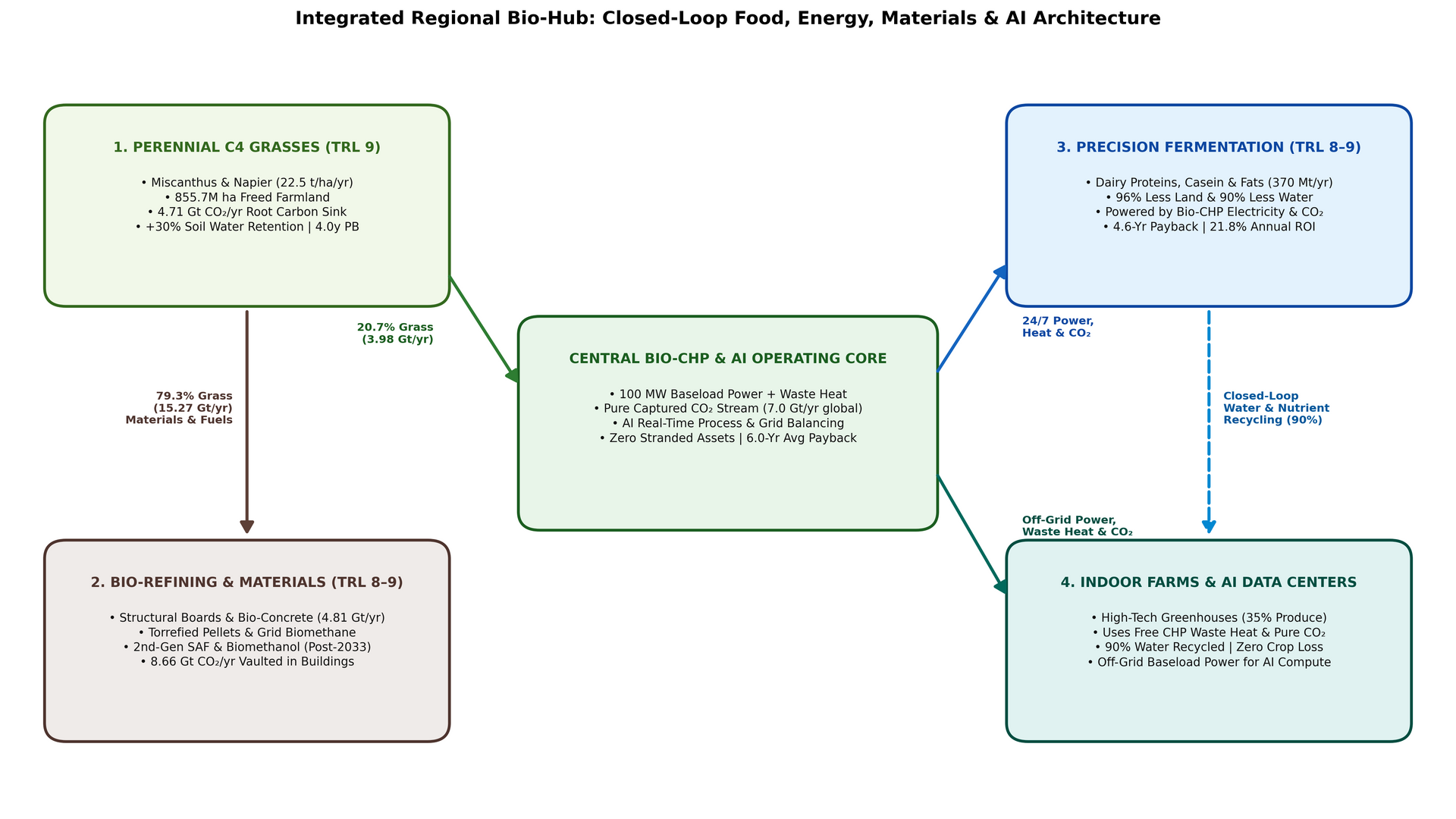
Integrated Regional Bio-Hub Circular Architecture
Core Technologies, TRL Roadmap & Bio-Hub Architecture
The Five Core Commercial Engines (TRL 8–9)
Every pillar of the DGE system is anchored in established industrial processes with verified Life Cycle Assessments (LCAs) and bankable unit economics:
1. High-Yield Perennial C4 Agronomy (Miscanthus & Napier Grass) — TRL 9
- Technical Mechanism: Deep-rooted C4 perennial grasses (Miscanthus × giganteus in temperate climates; Cenchrus purpureus / Napier grass in tropical/subtropical zones) grow for 15–20 years from a single planting without annual tillage, synthetic nitrogen overload, or irrigation, yielding an average of 22.5 tons of dry matter/ha/yr.
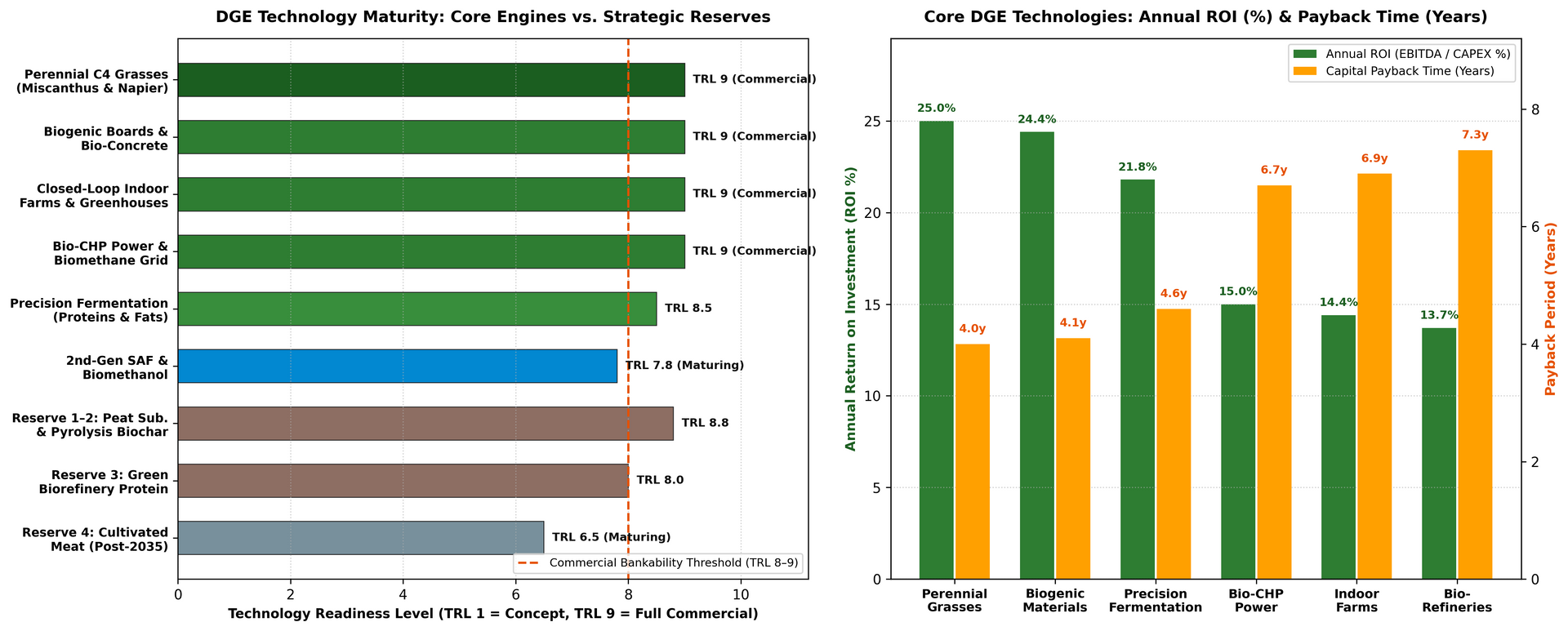
- Commercial Economics: Establishment cost of $2,000/ha and farm-gate harvest cost of $50–$65/ton dry biomass, delivering a 4.0-year payback and 25.0% annual ROI.
- Verified Sources (TRL, Commercial & LCA):
- TRL & Agronomy: IEA Bioenergy — Perennial Grasses for Bioenergy (TRL 9)
- Commercial Economics: U.S. DOE — Billion-Ton Report (Biomass Supply & Farm-Gate Costs)
- Life Cycle Assessment (LCA): Global Change Biology Bioenergy — Soil Carbon Sequestration & Negative-Emission LCA of Miscanthus
2. Precision Fermentation (Microbial Protein, Casein & Lipids) — TRL 8–9
- Technical Mechanism: Engineered yeast, fungi, and bacteria convert plant sugars or captured CO₂/hydrogen inside vertical stainless-steel bioreactors into molecularly identical dairy proteins (whey, casein), egg proteins, and structured fats.
- Commercial Economics: Capital cost of $5,500 per annual ton of protein/ingredient capacity ($2.03T for 370 Mt/yr), operating costs competitive with industrial dairy/beef by 2028–2030, yielding a 4.6-year payback and 21.8% annual ROI.
- Verified Sources (TRL, Commercial & LCA):
- TRL & Scale-Up: The Good Food Institute (GFI) — State of the Industry: Fermentation (TRL 8–9)
- Commercial Economics: Boston Consulting Group (BCG) & Blue Horizon — Food for Thought: The Protein Transformation
- Life Cycle Assessment (LCA): Nature Food / Good Food Institute — Environmental LCA of Precision Fermentation vs. Livestock (96% Land & 90% Water Reduction)
3. Closed-Loop Indoor Farming & High-Tech Greenhouses — TRL 9
- Technical Mechanism: Climate-controlled, semi-closed greenhouses (80% of footprint) and multi-layer vertical farms (20% of footprint) cultivate climate-vulnerable fruits and vegetables year-round using hydroponic/aeroponic nutrient loops and CO₂ enrichment.
- Commercial Economics: Blended CAPEX of $4.50 million/ha ($8.78T across 1.95M ha); co-locating with Bio-CHP hubs eliminates 60%–75% of conventional heating/electricity expenses, achieving a 6.9-year payback and 14.4% annual ROI.
- Verified Sources (TRL, Commercial & LCA):
- TRL & Commercial Scale: Wageningen University & Research (WUR) — Greenhouse Horticulture & Vertical Farming
- Commercial Economics: Rabobank — Controlled Environment Agriculture (CEA) Global Outlook
- Life Cycle Assessment (LCA): Journal of Cleaner Production — Resource & Water Efficiency LCA of Closed-Loop Greenhouses (90% Water Savings)
4. Biogenic Construction Materials, Grass Pulp & Bio-Concrete — TRL 9
- Technical Mechanism: Mechanical defibration, hot-pressing, and mineral binding convert dry Miscanthus and Napier fibers into structural cross-laminated panels, acoustic/thermal insulation, bio-concrete blocks, molded pulp packaging, and bio-resins.
- Commercial Economics: $1.80T global CAPEX across modular pressing and pulping plants, generating $0.44T/yr EBITDA with a 4.1-year payback and 24.4% annual ROI.
- Verified Sources (TRL, Commercial & LCA):
- TRL & Industrial Standards: nova-Institute — Bio-Based Building Materials & Natural Fiber Composites
- Commercial Economics: Material Economics — Industrial Transformation & Circular Construction Materials
- Life Cycle Assessment (LCA): Nature Sustainability — Buildings as a Global Carbon Sink (1.8 t CO₂ Vaulted per Ton Biomass)
5. Modular Bio-CHP, Torrefaction, Biomethane & 2nd-Gen Biofuels — TRL 7–9
- Technical Mechanism:
- Phase 1 (2027–2032, TRL 9): Combined Heat & Power (CHP) boilers with carbon capture (885 GW), anaerobic digestion for grid-quality biomethane, and torrefaction reactors producing waterproof black coal-replacement pellets.
- Phase 2 (2033–2050, TRL 7–8 → 9): Biomass gasification + Fischer-Tropsch / methanol synthesis producing drop-in Sustainable Aviation Fuel (SAF), marine biomethanol, and renewable diesel.
- Commercial Economics: $6.46T combined conversion CAPEX ($2.66T Bio-CHP + $3.80T Bio-Refineries), generating $0.92T/yr EBITDA with a 7.0-year blended payback.
- Verified Sources (TRL, Commercial & LCA):
- TRL & Technology Readiness: IEA Bioenergy — Task 33 (Gasification) & Task 37 (Biomethane) TRL Assessments
- Commercial Economics: IRENA — Bioenergy for the Energy Transition: Cost & Deployment Outlook
- Life Cycle Assessment (LCA): ICAO / CORSIA — Life Cycle Assessment of Sustainable Aviation Fuels (SAF) & Bio-Energy with Carbon Capture
Tabel 5A: Integrated Bio-Hub Core Technologies (First Wave: TRL 8–9)
| Bio-Hub Core Module | TRL Status | Primary Feedstock / Input | Co-Located Output & Circular Synergy | Authoritative Source |
|---|---|---|---|---|
| 1. Green Biorefinery (Grass Fractionation) | TRL 8
Commercial Scaling |
Fresh perennial grasses (Miscanthus, Napier & clover-grass). | Extracts leaf protein concentrate for food/feed while sending press-cake fibers to Bio-CHP & material lines. | Aarhus University |
| 2. Precision Fermentation Clusters | TRL 8–9
Commercial Now |
Refined C5/C6 grass sugars + 100% Bio-CHP power & steam. | Produces dairy, egg & functional proteins with -96% land & -90% water; captures pure fermentation CO₂. | The Good Food Institute |
| 3. Closed-Loop CEA & Vertical Farms | TRL 9
Commercial Now |
Bio-CHP electricity, waste heat, pure CO₂ & recycled nutrients. | Year-round fruits, vegetables & greens(-90% water use); eliminates climate crop volatility. | Wageningen UR |
| 4. Gasification & Biomethane Refining | TRL 7–9
Commercial Now |
Lignocellulosic press-cake, agricultural residues & digestate. | Produces pipeline biomethane, syngas & drop-in Bio-SAF; feeds off-gases to gas-fermentation tanks. | IEA Bioenergy Task 33 |
| 5. Slow Pyrolysis & Biochar Vaults | TRL 8–9
Commercial Now |
Woody grass fractions & non-fermentable lignin residues. | Generates process heat + stable biochar locking carbon in agricultural soils for 1,000+ years. | IBI Standards |
2. The AI Operating System & Four Strategic Reserves (Post-2035 Upside)
- Artificial Intelligence as the Biological Operating System: AI optimizes microbial strain design (boosting fermentation yields by 15%–25%), balances 24/7 heat, power, and CO₂ flows across regional Bio-Hubs, and uses satellite/drone telemetry to manage 855.7M ha of perennial grass harvests—while Bio-Hubs provide off-grid baseload power and waste-heat cooling for AI data centers.
- Four Strategic Reserves Held for Phase 2 (Post-2035): To keep initial execution risk near zero, four additional high-upside technologies are held in reserve:
- Chopped Grass Peat & Livestock Bedding Replacement (TRL 9): Immediate elimination of peatland mining (saving 1.5–2.0 Gt CO₂/yr).
- Pyrolysis Biochar & Asphalt/Cement Blending (TRL 8–9): 1,000-year soil carbon stability plus +25% soil water retention.
- Early-Cut Grass Protein Juice Extraction (Green Biorefinery, TRL 8): Cuts fermentation sugar feedstock land by 50% (+30M ha extra nature).
- Cultivated Meat (Cellular Agriculture, TRL 6–7 → 9): Deployed after 2035 once AI lowers bioreactor costs to replace remaining poultry, pork, and premium beef.
DGE Technology Readiness Levels (TRL 1–9) and Unit Economics
Tabel 5B: Global Bio-Hub Deployment CAPEX, Cash Flow & ROI (2027–2050)
| Bio-Hub Infrastructure Component | 2050 Global Rollout Scale | Total CAPEX | Annual Cash Flow (EBITDA) | Payback Time | Annual ROI | Source |
|---|---|---|---|---|---|---|
| 1. Precision Fermentation & Green Protein Hubs | 8,557 Decentralized Bio-Hubs
(1 hub per 100,000 ha perennial grass) |
$2.10 T | $0.42 T / yr | 5.0 years | 20.0% | BCG / Blue Horizon |
| 2. Co-Located Closed-Loop CEA Clusters | 1.8 Million ha
high-tech greenhouses (100% Bio-CHP powered) |
$1.45 T | $0.26 T / yr | 5.6 years | 17.9% | Rabobank Research |
| 3. Strategic Reserve R&D & FOAK Pilots (2027–2035) | HTL/HTU, SMRs, Gas Fermentation & DAC pilot network | $0.65 T | $0.11 T / yr
(Post-2035 commercial licensing) |
5.9 years | 16.9% | IEA Innovation |
| Total Integrated Bio-Hub & Reserve Module | 8,557 Circular Bio-Hubs + Wave-2 Reserve Pipeline | $4.20 T | $0.79 T / yr | 5.3 years | 18.8% | WEF Nature Risk |
3. Global Deployment Architecture: 8,557 Modular Bio-Hubs
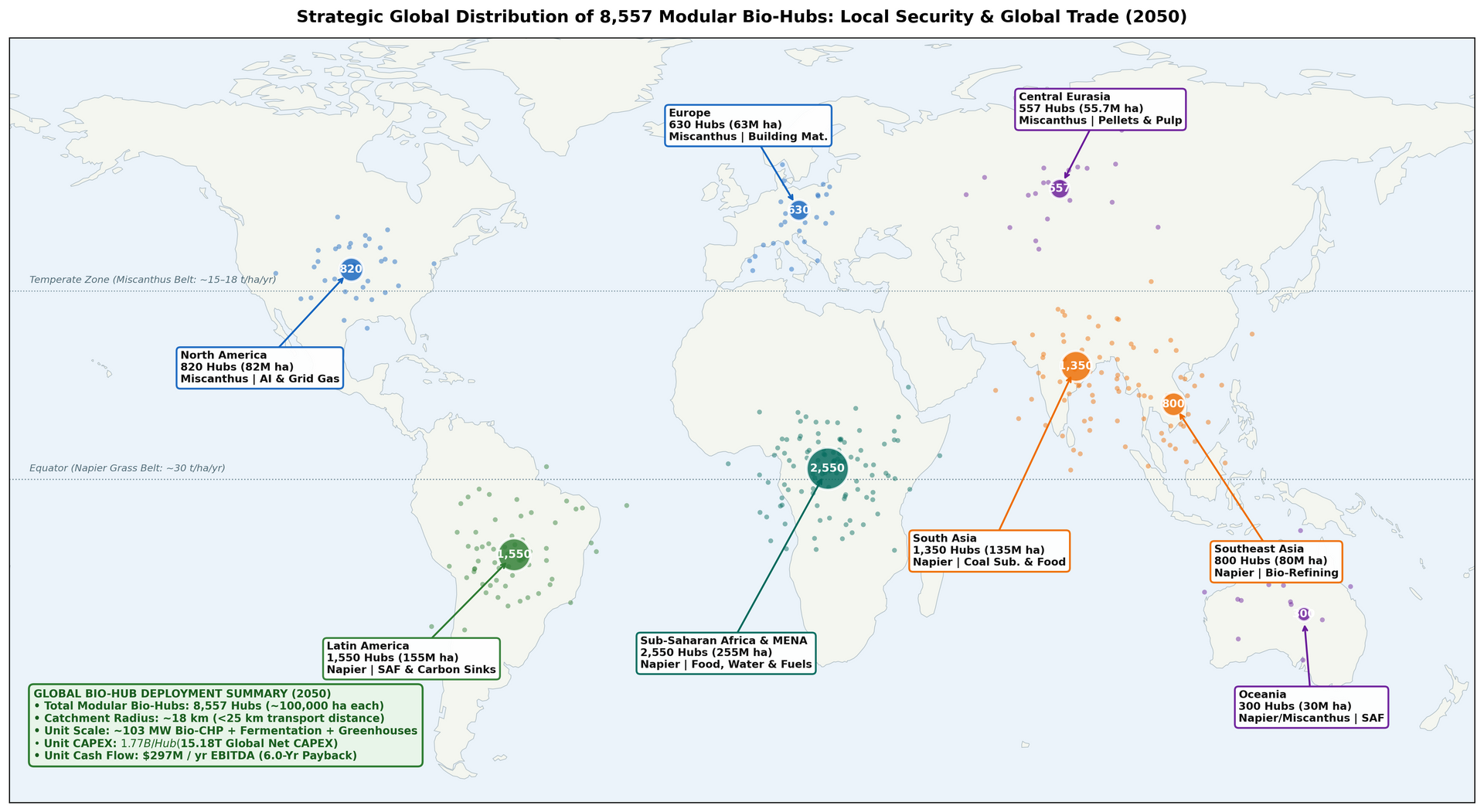
Scaling the Deep Green Energy system across 855.7 million hectares of freed agricultural land requires approximately 8,557 standardized, modular Bio-Hubs worldwide—each anchored by a ~100,000-hectare perennial grass catchment area, a ~103 MW Bio-CHP power and carbon-capture plant (885 GW global total), precision fermentation bioreactors, closed-loop greenhouses, and biogenic material presses. At an integrated net capital cost of $1.77 billion per Bio-Hub ($15.18 trillion globally), each hub generates roughly $297 million per year in operating cash flow (6.0-year payback) while serving ~1 million people with local food, baseload energy, and building materials.
To simultaneously maximize supply security, affordability, and thermodynamic efficiency, these 8,557 Bio-Hubs are distributed using a two-tier spatial strategy:
- 1. Local Catchment Efficiency (<25 km Transport Radius): Because raw harvested grass is bulky, every Bio-Hub is placed directly inside its 100,000-hectare plantation zone (a radius of just ~18 km). This keeps biomass transport distances short and inexpensive, supplies instant off-grid electricity, waste heat, and pure CO₂ to co-located greenhouses and fermentation tanks, and eliminates single-point supply chain failures.
- 2. Strategic Regional & National Specialization: Every country builds enough domestic Bio-Hubs to guarantee local food and baseload power independence (supply security), while high-yielding tropical and temperate agricultural nations build additional export-oriented hubs that convert dense, high-value products—torrefied black pellets, Sustainable Aviation Fuel (SAF), biomethanol, and prefabricated grass building panels—for global trade (affordability & capital efficiency):
Methodology & Empirical Land-Use Basis
The regional allocation of 855.7 million hectares across 8,557 decentralized Bio-Hubs is derived from empirical degraded-land inventories, agro-climatic yield models, and 2050 demographic projections—strictly excluding primary forests, protected wetlands, and prime food croplands:
- Degraded & Marginal Land Supply: Global land degradation assessments by the UN Convention to Combat Desertification (UNCCD) and the FAO State of the World's Land and Water Resources (SOLAW) identify over 1.5 billion hectares of degraded pastures, eroded croplands, and marginal grasslands worldwide. The DGE pathway rehabilitates roughly 55% of this degraded land pool under perennial root cover.
- Agro-Climatic Yield Modeling: Regional grass species selection and harvest yields (28–30 t/ha/yr for tropical Napier grass and 15–18 t/ha/yr for temperate Miscanthus) follow the IIASA / FAO Global Agro-Ecological Zones (GAEZ) suitability framework.
- 2050 Population & Demand Alignment: Hub density is weighted toward projected 2050 population centers and import-dependent regions based on
UN Population Division (World Population Prospects) projections—concentrating
54.9% of Bio-Hubs in
Sub-Saharan Africa & MENA and
South & Southeast Asia to guarantee domestic food, water, and energy security while enabling clean fuel and biomaterial exports from land-abundant regions such as
Latin America.
Global Bio-Hub Deployment fully aligned with regional land and demographic realities
| Global Region | Strategic Bio-Hub Count | Perennial Grass Area | Primary Grass & Climate Role | Strategic Focus (Security, Affordability & Trade) |
|---|---|---|---|---|
| Sub-Saharan Africa & MENA | 2,550 Hubs (29.8%) | 255.0M ha | Napier grass
(28–30 t/ha/yr) |
Eliminates food/water imports; powers desalination & indoor farms; exports SAF & carbon credits. |
| South & Southeast Asia | 2,150 Hubs (25.1%) | 215.0M ha | Napier grass
(28–30 t/ha/yr) |
Replaces imported coal & LNG with domestic pellets/biomethane; secures protein for 3.1B people. |
| Latin America | 1,550 Hubs (18.1%) | 155.0M ha | Napier grass
(30 t/ha/yr) |
Converts degraded pasture into high-yield SAF, biomethanol & building-panel export hubs + forest sinks. |
| North America & Europe | 1,450 Hubs (17.0%) | 145.0M ha | Miscanthus
(15–18 t/ha/yr) |
Supplies grid biomethane, biogenic construction materials, and off-grid baseload power for AI data centers. |
| Eurasia & Oceania | 857 Hubs (10.0%) | 85.7M ha | Miscanthus / Napier mix | Reclaims marginal steppe/cropland; supplies regional pellets, green chemicals & structural timber substitutes. |
| Global Total (2050) | 8,557 Bio-Hubs (100%) | 855.7M ha | 22.5 t/ha/yr global avg. | 19.25 Gt/yr biomass harvested across decentralized circular Bio-Hubs. |
Strategic Global Distribution of 8,557 Decentralized Bio-Hubs