
ADVANCING SUSTAINABLE BIOENERGY DEVELOPMENT
New, advanced technologies make it possible to produce climate neutral fuels from non-forest and non-food energy crops. The benefits of cultivation and use of these energy crops for transport fuels and electricity goes beyond the benefits of reducing greenhouse gas emissions. Terrestrial energy crop cultivation and aquatic energy crop harvesting reverses land and water degradation, increases biodiversity and carbon sequestration and improves land fertility. We call this
Deep Green Biomass. Moreover, deploying these energy crops for the production of advanced biofuels will positively impact social-economic structures and energy independence and reduce the need for involuntary migration and deforestation: Deep Green Energy.
Deep Green Energy Partners works to accelerate deployment of deep green biomass for the production of advanced biofuels and biochemicals, to restore soil and water conditions and to optimize the overall ecological-economic effects of investments in the energy transition.
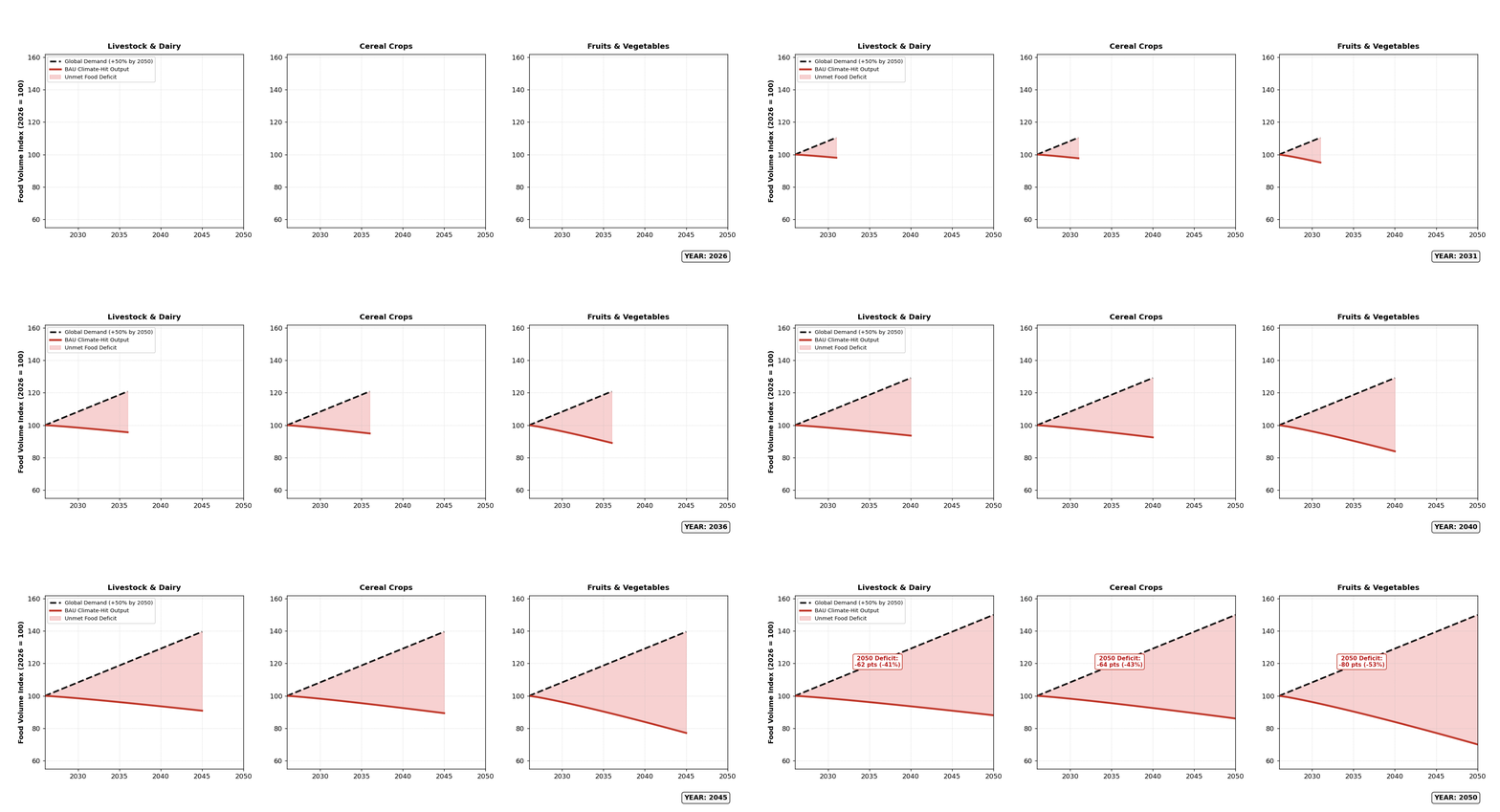
By 2050, population growth and rising global incomes will push global food demand up by 50%. Yet under a Business-As-Usual (BAU) trajectory, climate extremes—heatwaves, droughts, soil degradation, and freshwater depletion—will actively shrink outdoor agricultural output. By mid-century, BAU climate impacts are projected to cut global fruit and vegetable yields by 25%–35%, cereal harvests by 8%–20%, and livestock and dairy output by 7%–17%. Traditional open-field farming, constrained by the 1%–2% solar efficiency of photosynthesis, cannot close a widening 50%–80% supply gap without destroying the world’s remaining forests.
Animation F1: The Looming 2050 Food Deficit Under Business-As-Usual (2026–2050)
Closing the 2050 Food Gap with the Deep Green Energy System
The Deep Green Energy (DGE) Food System resolves this physical deadlock by decoupling staple protein, fat, and produce generation from weather and land limits using two commercial technologies (TRL 8–9):
- Precision Fermentation (35% of Livestock & Dairy; 25% of Cereal Crops): Microorganisms convert plant sugars or captured CO₂ into identical dairy proteins, casein, fats, and functional flours inside vertical bioreactors—using 96% less land and 90% less water than conventional farming, with zero consumer diet change required.
- Indoor Farms & High-Tech Greenhouses (35% of Fruits & Vegetables): Climate-vulnerable produce is moved into controlled, closed-loop facilities powered and heated by local biomass CHP hubs—eliminating weather-driven crop failures while recycling 90% of water and nutrients.
Animation F2: Closing the 2050 Food Gap with the Deep Green Energy System (2026–2050)
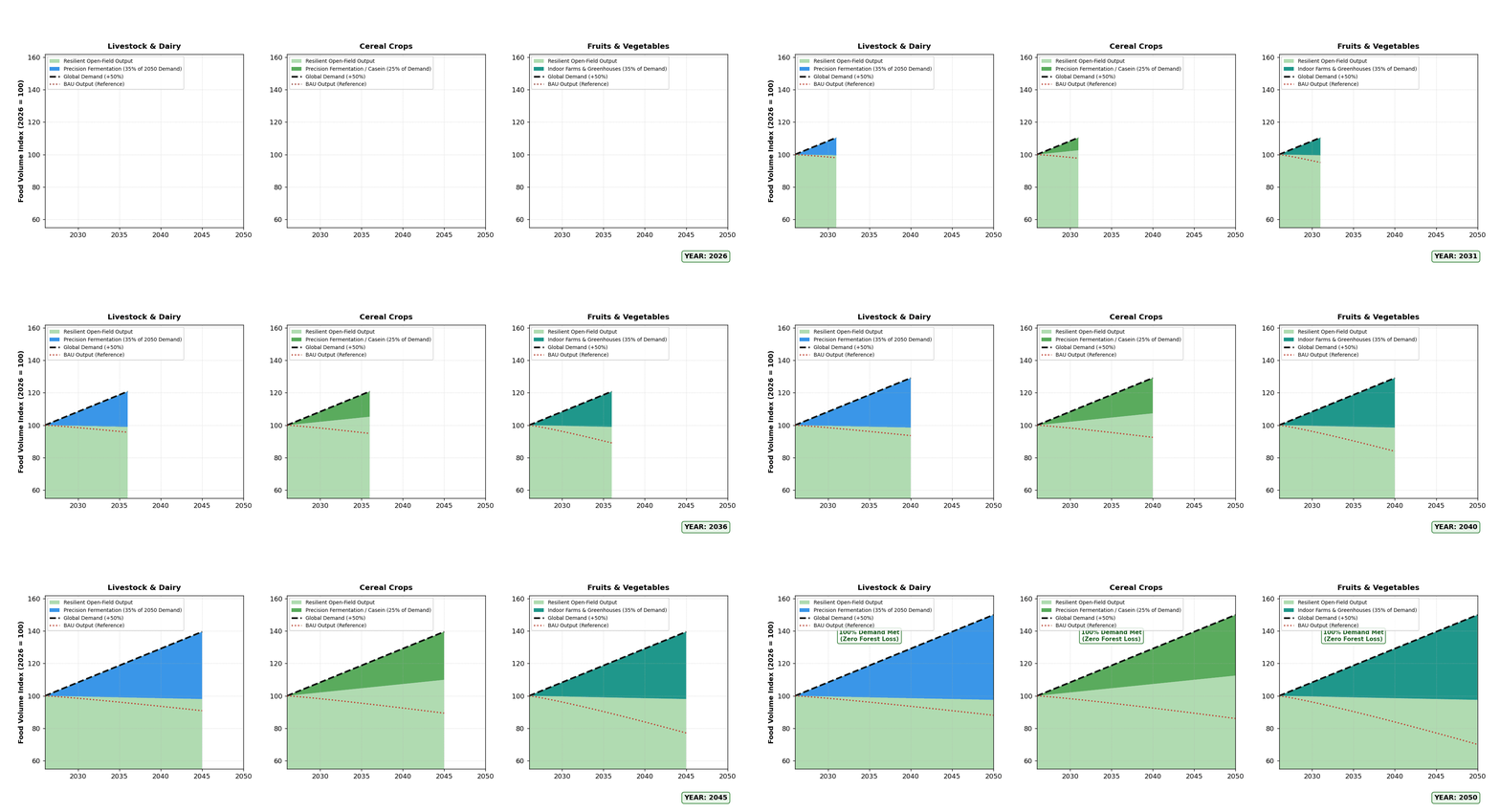
Table: Foodsystem Conversion Pathway
| Food System Segment | 2050 Demand & BAU Climate Shock | DGE Core Technology (TRL 8–9) | Resource & Economic Advantage (DGE vs. BAU) | Authoritative Source |
|---|---|---|---|---|
| Global Food Demand Baseline | +50% Demand Surge
Severe supply deficit & food price inflation (+40% to +80%). |
Integrated Bio-Hubs & Circular Food Systems(TRL 8–9) | Full Price Parity
Decouples calorie & protein supply from arable land expansion. |
FAO Projections |
| Livestock & Dairy Proteins | -7% to -17% Yield Loss
Heat stress, feed scarcity & soaring water/land footprint. |
Precision Fermentation
(TRL 8–9 Commercial Scale) |
-96% Land | -90% Water
Achieves CAPEX & retail cost parity with conventional dairy/proteins. |
GFI/ BCG |
| Horticulture (Fruits & Vegetables) | -25% to -35% Yield Loss
Extreme drought, aquifer depletion & volatile supply chains. |
Closed-Loop High-Tech Greenhouses & CEA(TRL 9) | -90% Water Use
Year-round urban production with 100% nutrient recycling. |
Wageningen UR |
| Staple Cereals & Feed Crops | -8% to -20% Yield Loss
Topsoil erosion (40% degraded) & extreme weather volatility. |
Perennial Grasses & Green Biorefining(TRL 8–9) | 22.5 t/ha | $50–$65/t
Frees up prime farmland while sequestering 5.5 t CO₂/ha/yr. |
UChicago/ IEA |
Closing the +50% Food Gap - Transforming the Global Nutritional Mix (2026–2050)
By 2050, global food demand will surge by +50% to nourish nearly 10 billion people, while Business-as-Usual (BAU) climate shocks—heat stress, drought, and 40% topsoil degradation—slash conventional yields across livestock (-7% to -17%), staple cereals (-8% to -20%), and horticulture (-25% to -35%). Simply expanding conventional agriculture would require clearing hundreds of millions of hectares of remaining forests, shattering planetary boundaries while leaving over 1.1 billion people chronically undernourished.
Rather than relying on dietary rationing, the Dynamic Green Economy (DGE) bridges this Food Gap by redesigning how essential macronutrients (proteins, carbohydrates, lipids) and micronutrients (vitamins, minerals, fiber) are produced. As shown in Animation F1 (Transformation of the Global Food & Nutritional Mix, 2026–2050) and the 2050 Primary Food Source table below, scaling Precision Fermentation (TRL 8–9) and Closed-Loop High-Tech Greenhouses (TRL 9) decouples nutrition from land and climate volatility:
- Complete Proteins & Essential Amino Acids: Precision fermentation supplies 35% of global animal-equivalent protein (bio-identical dairy casein, whey, egg, and functional proteins) while replacing 25% of cereal/soy feed demand—cutting land use by -96% and water consumption by -90%. Ruminant livestock (cattle, sheep, goats) is reduced by -65% to eliminate methane hotspots, while poultry, pork, and aquaculture are sustained using zero-deforestation microbial and grass-extracted proteins.
- Complex Carbohydrates & Dietary Fiber: Open-field staple cereals (wheat, rice, maize, legumes) shift away from inefficient livestock feed toward direct human consumption, maintaining a healthy 50%–55% caloric share of complex carbohydrates while releasing 278.7 million hectares of marginal cropland for forest rewilding.
- Healthy Lipids & Omega Fatty Acids: Precision fermentation and microalgae biorefining supply 30% of global dietary lipids—replacing palm oil deforestation and overfished marine oils with heart-healthy unsaturated fats and omega-3s alongside sustainable plant oils.
- Vitamins, Minerals & Phytonutrients: Expanding closed-loop greenhouses and vertical farms across 1.95 million hectares supplies 35% of global fruits and vegetables
- year-round right next to urban centers, eliminating seasonal shortages and preserving peak vitamin and antioxidant density without pesticide runoff.
Animation F3: Transformation of the Global Food & Nutritional Mix (2026–2050)
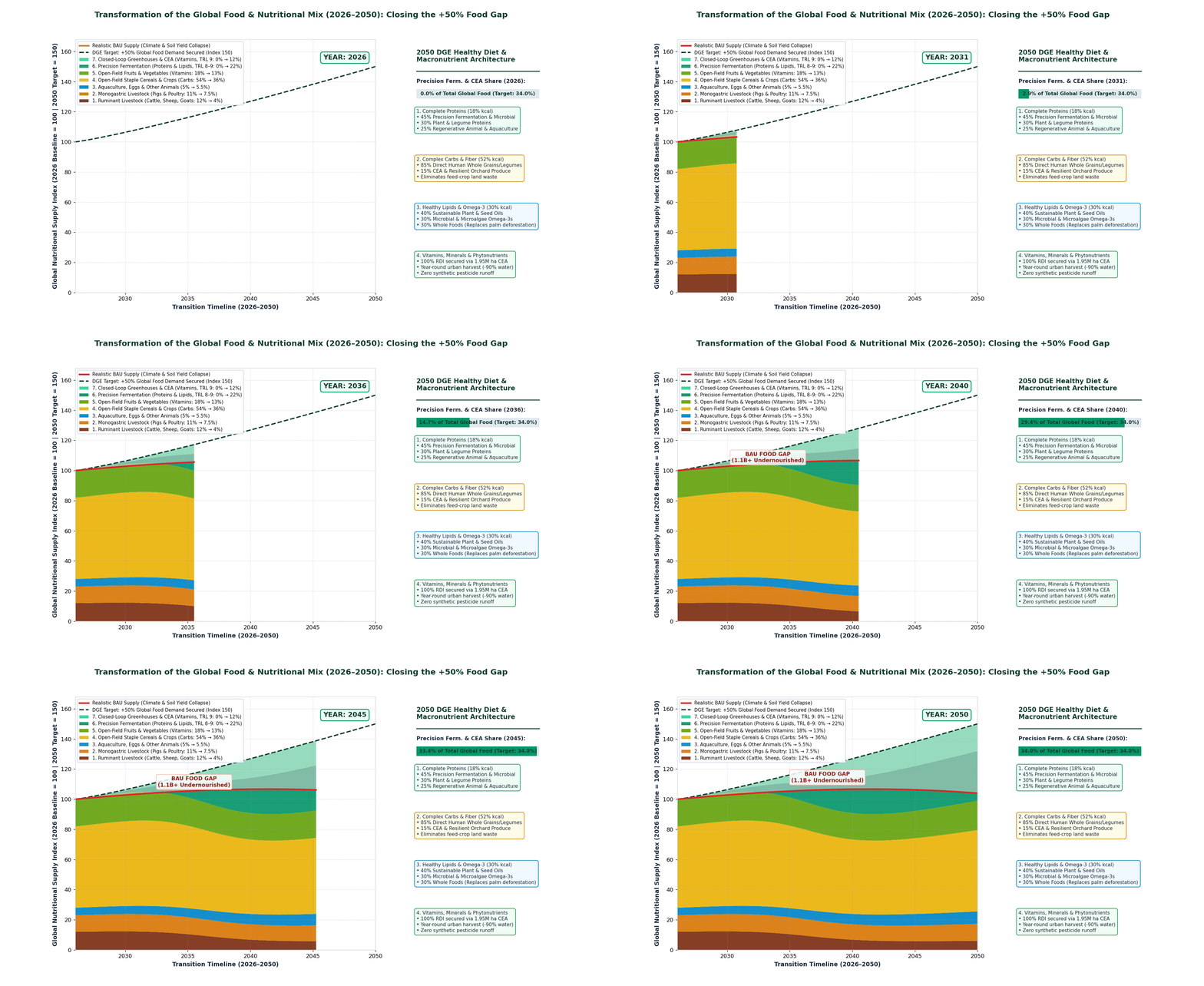
Table: Primary Food Source 2050
| Primary Food Source (2050) | Primary Nutritional Role | 2025/2026 Baseline (100% Demand) |
Realistic BAU 2050 (+50% Demand Gap) |
Deep Green Economy 2050 (150% Secured) |
Health, Land & Climate Impact | Source |
|---|---|---|---|---|---|---|
| 1. Ruminant Livestock
(Cattle, Sheep & Goats) |
Protein, Saturated Lipids, Iron & B12 | 12.0% | 13.5%
(-7% to -17% heat loss) |
4.0%
(-65% herd reduction) |
Slashes agricultural methane & frees 278.7M ha of grazing land for forest rewilding. | FAIRR / IPCC |
| 2. Monogastric Livestock
(Pigs & Poultry) |
Lean Protein, Lipids & B-Vitamins | 11.0% | 12.5%
(Feed-crop bottleneck) |
7.5%
(Circular-fed) |
Fed on green biorefinery grass protein & fermentation co-products instead of soy/maize. | FAO 2050 |
| 3. Aquaculture & Other Animal Sources
(Fish, Eggs & Wild Catch) |
Omega-3 Lipids, Protein & Micronutrients | 5.0% | 4.5%
(Ocean warming decline) |
5.5%
(Regenerative) |
Sustainable aquaculture nourished by microalgae omega-3s & single-cell proteins; relieves wild oceans. | FAO Fisheries |
| 4. Open-Field Staple Cereals & Oil/Feed Crops
(Wheat, Rice, Maize, Soy) |
Complex Carbohydrates, Plant Protein & Lipids | 54.0% | 53.5%
(-8% to -20% yield loss) |
36.0%
(Direct human food) |
Eliminates animal feed waste; meets healthy dietary guidelines (50–55% complex carbs) on less land. | UChicago |
| 5. Open-Field Fruits & Vegetables | Vitamins (A, C, E), Minerals, Fiber & Antioxidants | 18.0% | 14.0%
(-25% to -35% drought loss) |
13.0%
(Climate-resilient) |
Focuses open-field horticulture on resilient orchard & root crops while buffering extreme weather. | Nature Food |
| 6. Precision Fermentation & Microbial Lipids
TRL 8–9 |
Bio-Identical Dairy/Egg Proteins & Healthy Lipids | 0.0% | 1.5%
(Under-invested) |
22.0%
(370 Mt/yr pure output) |
-96% land & -90% water: Delivers 35% of animal protein + 30% of healthy dietary lipids at full price parity. | GFI/ BCG |
| 7. Closed-Loop Greenhouses & Vertical Farms
TRL 9 |
High-Density Vitamins, Minerals & Phytonutrients | 0.0% | 0.5%
(Niche luxury only) |
12.0%
(1.95M ha CEA footprint) |
-90% water use: Supplies 35% of global fruits & vegetables year-round with zero pesticides. | Wageningen UR |
| 8. Natural Capital Balance Sheet Impact
(Land, Water & Biodiversity) |
Ecosystem Services & Biosphere Solvency | -$7.0 T/yr
(Soil & aquifer loss) |
-$21.0 T/yr
(Deforestation & erosion) |
+$7.5 T/yr
(Net ecosystem restoration) |
Frees 278.7M ha for rewilding, restores freshwater aquifers & adds +$300T natural capital by 2050. | UN SEEA/ World Bank |
| Total Global Food & Nutritional Supply | 100% Balanced Macro- & Micronutrients | 100.0% (Baseline) | 100.0% (Severe Deficit / 1.1B+ Hungry) | 100.0% of +50% Demand (Zero Hunger) | Eliminates the 2050 Food Gap, improves global diet quality, and restores 278.7M ha of nature. | FAO SOFI |
Building out the global DGE food infrastructure requires a cumulative capital investment (CAPEX) of
$10.81 trillion between 2027 and 2050 (averaging
$450 billion per year). Because both precision fermentation facilities and CHP-integrated greenhouses generate high-margin, year-round output shielded from weather shocks, the food module achieves an average
payback time of 6.3 years and an annual operating return (EBITDA/CAPEX) of
15.8%:
Figure F3: DGE Food System Capital Investment, Cash Flow Ramp-Up, and Unit Returns (2026–2050)
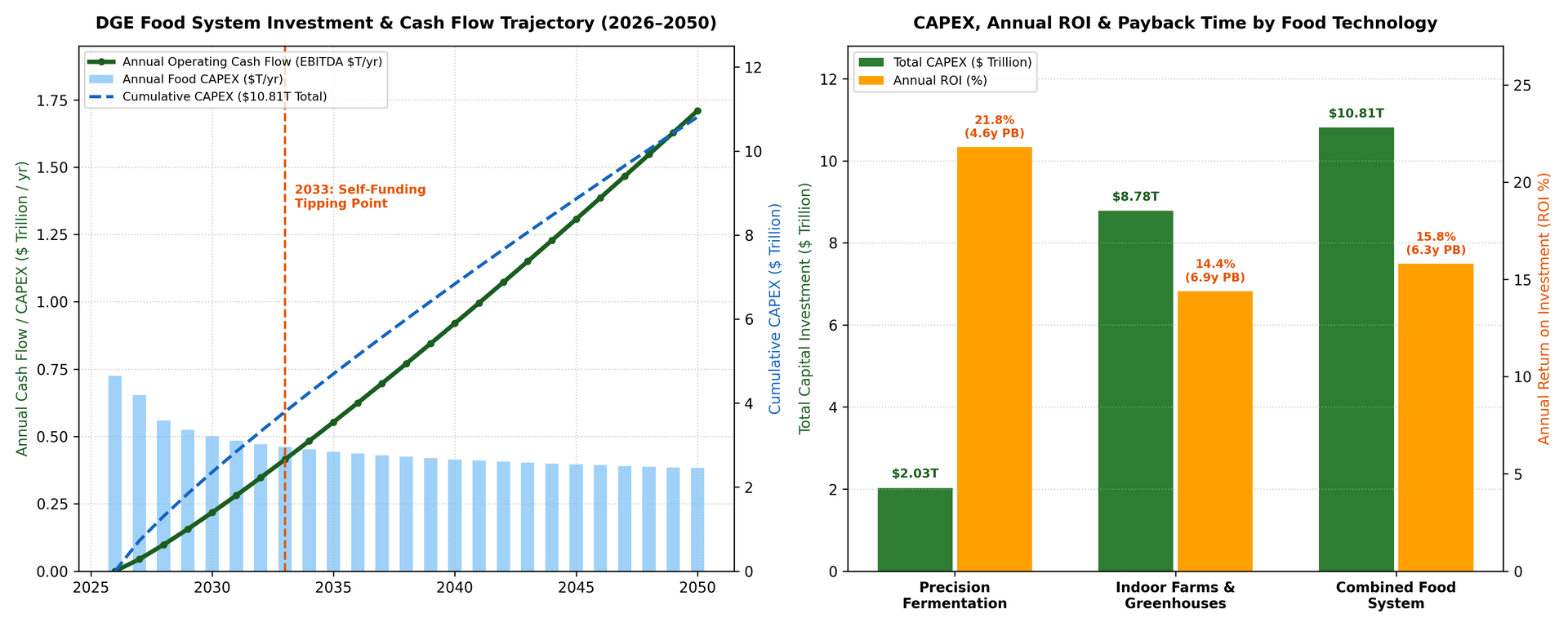
Table: DGE Food Component
| DGE Food Component | 2050 Physical Scale | Total CAPEX | Annual Cash Flow (EBITDA) | Payback Time | Annual ROI | Source |
|---|---|---|---|---|---|---|
| 1. Precision Fermentation Plants
(35% Livestock/Dairy + 25% Cereals) |
370 million tons/yr
of pure proteins, casein & fats ($5,500/t capacity) |
$2.03 T | $0.44 T / yr | 4.6 years | 21.8% | GFI/ BCG |
| 2. Indoor Farms & High-Tech Greenhouses
(35% Fruits & Vegetables) |
1.95 million ha
facility footprint (80% greenhouses, 20% vertical farms) |
$8.78 T | $1.27 T / yr | 6.9 years | 14.4% | WUR/ Rabobank |
| Total DGE Food Module | 100% of +50% global food demand secured | $10.81 T | $1.71 T / yr | 6.3 years | 15.8% | FAO 2050 |
Why Returns Are Protected: In conventional indoor farming, electricity and heating account for 25%–40% of operating costs. In the DGE model, co-located biomass CHP plants supply low-cost 24/7 baseload electricity, free waste heat, and pure captured CO₂ directly into the greenhouses and fermentation tanks—boosting crop yields by 20%–30% while locking in predictable, high-margin cash flows that become self-funding after 2033.
Global Food System Resource Footprint Trajectory (2026–2050)
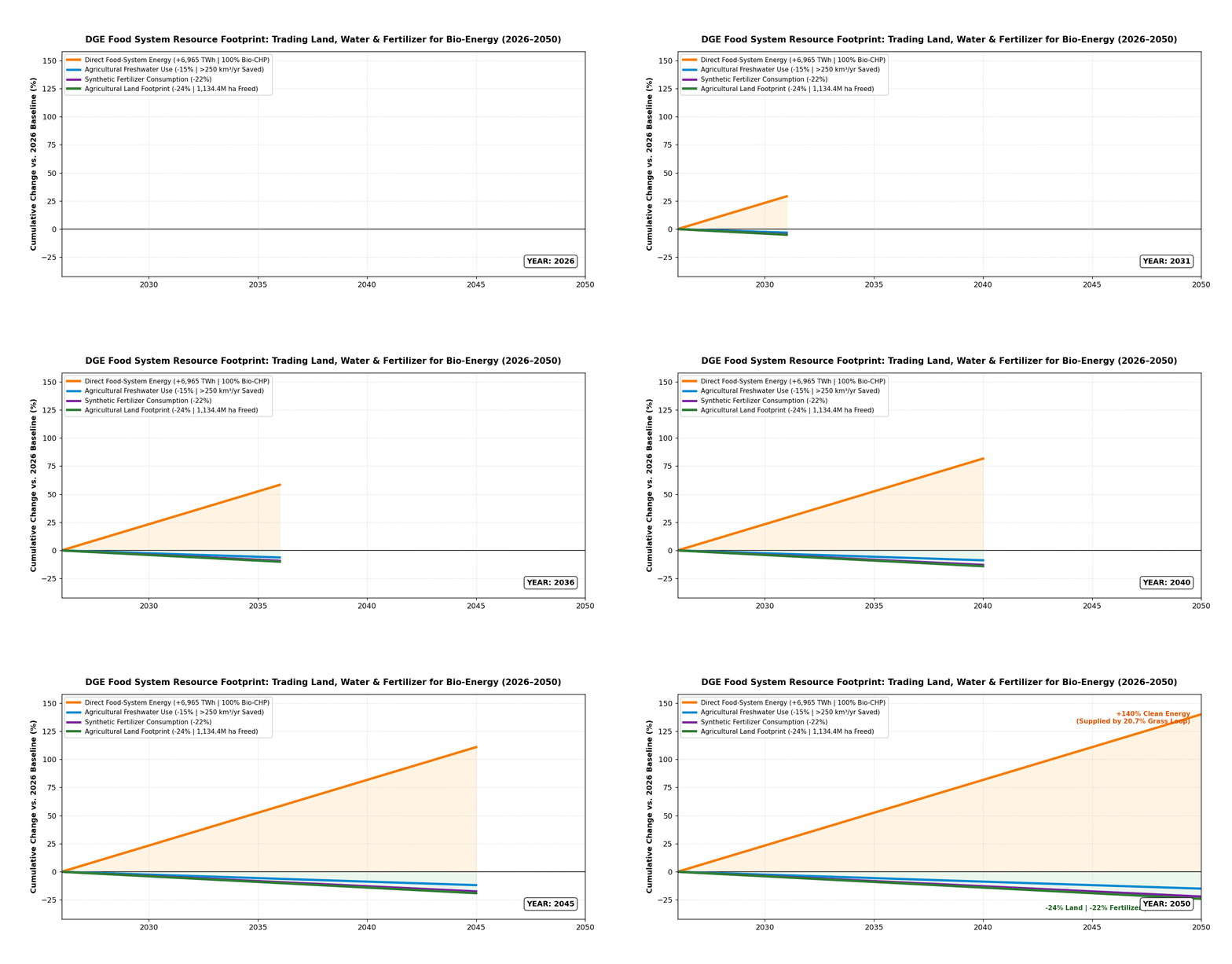
Moving 25%–35% of global food production out of vulnerable open fields into closed-loop facilities fundamentally reshapes agriculture’s planetary footprint. While direct food-system energy consumption increases by +6,965 TWh/yr (+140% above current direct agri-food energy use) to run bioreactors, LED lighting, and climate controls, 100% of that energy is supplied internally by just 20.7% (3.98 Gt/yr) of our perennial grass harvest—delivering massive net reductions in land, freshwater, and synthetic fertilizer use:
- Agricultural Land Use (-24% | -1,134.4 Million Hectares Freed): Frees over 1.13 billion hectares of cropland and pasture—enough to plant 855.7 million hectares of carbon-sequestering perennial grasses and return 278.7 million hectares to wild nature.
- Freshwater Consumption (-15% | >250 km³/yr Saved): Closed-loop irrigation and fermentation cut water use by 90%–96% in shifted categories, relieving acute groundwater depletion across major farming basins.
- Synthetic Fertilizer Use (-22%): Precision nutrient dosing in greenhouses and bioreactors eliminates fertilizer runoff, stopping coastal dead zones and nitrous oxide (N20) emissions.
Turning Freed Farmland into the Global Energy Engine:
Solving the 2050 food crisis through precision fermentation and indoor farming does far more than eliminate hunger: it unlocks
1,134.4 million hectares of surplus agricultural land without cutting down a single tree. By dedicating
855.7 million hectares of this freed land to high-yield perennial C4 grasses (Miscanthus and Napier grass)—while returning the remaining
278.7 million hectares to wild nature—the food transformation directly supplies the biological feedstock needed to decarbonize the global energy and materials system. Just
20.7% (3.98 Gt/yr) of the annual grass harvest powers and heats 100% of the new indoor food infrastructure, leaving
79.3% (15.27 Gt/yr, worth ~275 Exajoules) to replace coal, natural gas, oil, and forest logging across the wider global economy.
Animation F4: Global Food System Resource Footprint Trajectory (2026–2050).
Turning Freed Farmland into the Global Energy Engine:
Solving the 2050 food crisis through precision fermentation and indoor farming does far more than eliminate hunger: it unlocks
1,134.4 million hectares of surplus agricultural land without cutting down a single tree. By dedicating
855.7 million hectares of this freed land to high-yield perennial C4 grasses (Miscanthus and Napier grass)—while returning the remaining
278.7 million hectares to wild nature—the food transformation directly supplies the biological feedstock needed to decarbonize the global energy and materials system. Just
20.7% (3.98 Gt/yr) of the annual grass harvest powers and heats 100% of the new indoor food infrastructure, leaving
79.3% (15.27 Gt/yr, worth ~275 Exajoules) to replace coal, natural gas, oil, and forest logging across the wider global economy.
ADVANCING SUSTAINABLE BIOENERGY DEVELOPMENT
New, advanced technologies make it possible to produce climate neutral fuels from non-forest and non-food energy crops. The benefits of cultivation and use of these energy crops for transport fuels and electricity goes beyond the benefits of reducing greenhouse gas emissions. Terrestrial energy crop cultivation and aquatic energy crop harvesting reverses land and water degradation, increases biodiversity and carbon sequestration and improves land fertility. We call this
Deep Green Biomass. Moreover, deploying these energy crops for the production of advanced biofuels will positively impact social-economic structures and energy independence and reduce the need for involuntary migration and deforestation: Deep Green Energy.
Deep Green Energy Partners works to accelerate deployment of deep green biomass for the production of advanced biofuels and biochemicals, to restore soil and water conditions and to optimize the overall ecological-economic effects of investments in the energy transition.
| Food System Segment | 2050 Demand & BAU Climate Shock | DGE Core Technology (TRL 8–9) | Resource & Economic Advantage (DGE vs. BAU) | Authoritative Source |
|---|---|---|---|---|
| Global Food Demand Baseline | +50% Demand Surge
Severe supply deficit & food price inflation (+40% to +80%). |
Integrated Bio-Hubs & Circular Food Systems(TRL 8–9) | Full Price Parity
Decouples calorie & protein supply from arable land expansion. |
FAO Projections |
| Livestock & Dairy Proteins | -7% to -17% Yield Loss
Heat stress, feed scarcity & soaring water/land footprint. |
Precision Fermentation
(TRL 8–9 Commercial Scale) |
-96% Land | -90% Water
Achieves CAPEX & retail cost parity with conventional dairy/proteins. |
GFI/ BCG |
| Horticulture (Fruits & Vegetables) | -25% to -35% Yield Loss
Extreme drought, aquifer depletion & volatile supply chains. |
Closed-Loop High-Tech Greenhouses & CEA(TRL 9) | -90% Water Use
Year-round urban production with 100% nutrient recycling. |
Wageningen UR |
| Staple Cereals & Feed Crops | -8% to -20% Yield Loss
Topsoil erosion (40% degraded) & extreme weather volatility. |
Perennial Grasses & Green Biorefining(TRL 8–9) | 22.5 t/ha | $50–$65/t
Frees up prime farmland while sequestering 5.5 t CO₂/ha/yr. |
UChicago/ IEA |