
DGE SOCIAL
Physical Abundance Solves Social Instability
Rebuilding 855.7 million hectares of degraded soil, rewilding 278.7 million hectares of forest, and locking carbon into biogenic buildings does more than stabilize the climate; it directly eliminates the physical scarcities that drive poverty, hunger, water wars, and forced migration. Under the
BAU Transition + AI, rising temperatures, crop failures, and "greenflation" push billions of people into a vice of falling real incomes and soaring food and energy bills. By contrast, the
Deep Green Energy (DGE) + AI system decentralizes food, clean water, energy, and rural land revenue across every region on Earth—turning climate-vulnerable regions into thriving, self-reliant bio-economies while protecting middle-class purchasing power and pension wealth in industrialized nations
Global Humanitarian & Economic Divergence — BAU Transition (+AI) vs. Deep Green Energy (+AI) (2026–2050)
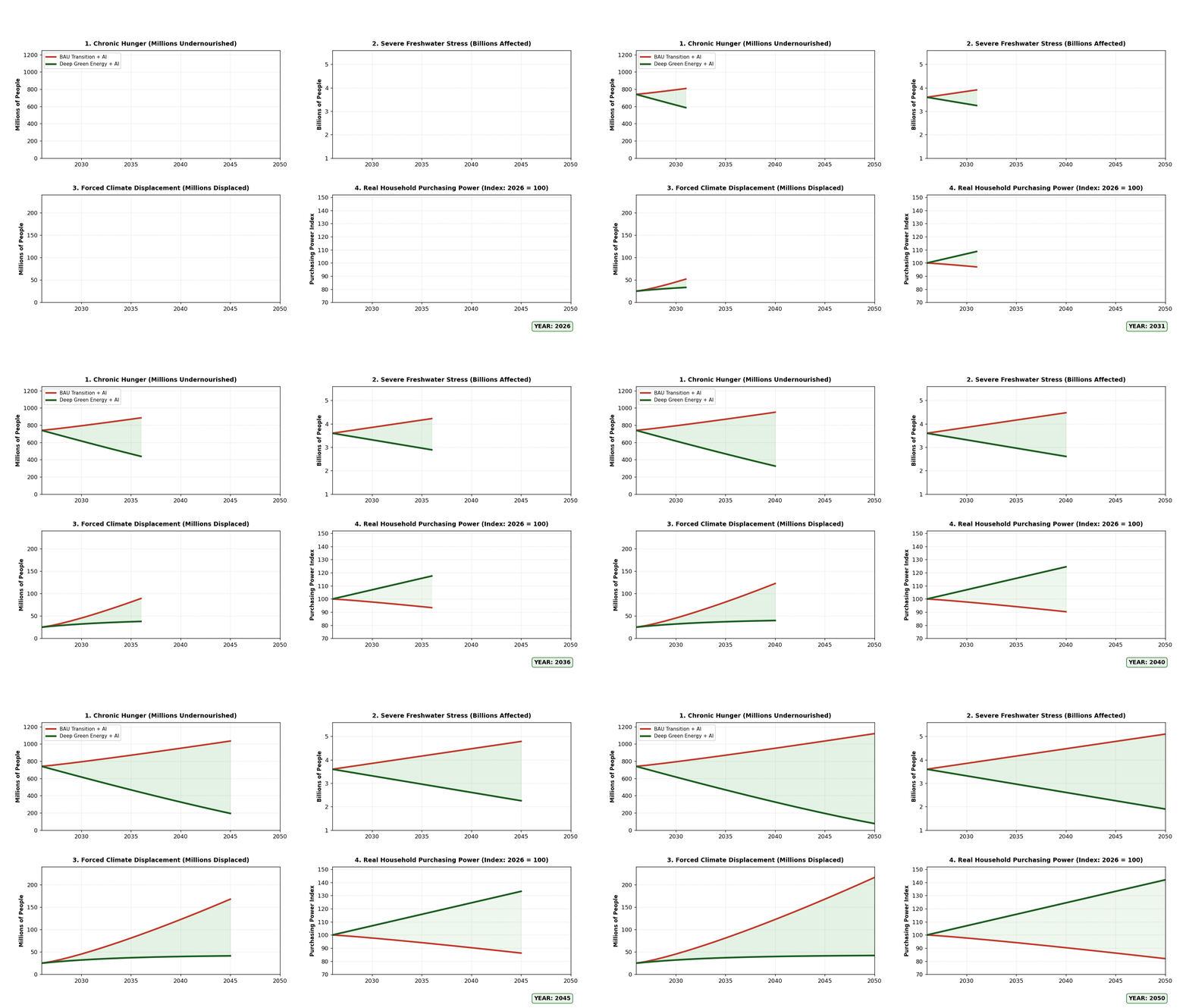
Tabel 4A: Global Social & Humanitarian Crisis Indicators (2026 Baseline vs. 2050 BAU & DGE)
| Social & Humanitarian Indicator | 2025/2026 Baseline | 2050 Realistic BAU | 2050 Deep Green Economy (DGE) | DGE Social Stabilization Mechanism | Source |
|---|---|---|---|---|---|
| 1. Chronic Hunger & Food Insecurity | ~735 Million
(Moderate/severe: 2.3B) |
1.10+ Billion
(+40% to +80% food inflation) |
< 50 Million (Near Zero)
(Full price parity) |
Distributed Bio-Hubs produce local proteins & CEA crops regardless of drought or heatwaves. | FAO SOFI |
| 2. Severe Freshwater Stress | 2.40 Billion
(70% water used in farming) |
4.80+ Billion
(Major aquifer depletion) |
< 1.20 Billion (-75%)
(Aquifers recharging) |
Precision fermentation (-90% water) & closed-loop greenhouses (-90% water) slash agricultural draw. | UN Water |
| 3. Forced Climate & Resource Displacement | ~35 Million / yr
(Internal & cross-border) |
216M – 350M Cumulative
(Uninhabitable heat/crop zones) |
-80% Displacement
(Rural livelihood boom) |
855.7M ha of perennial grass cultivation creates millions of stable rural agro-industrial jobs. | World Bank Groundswell |
| 4. Household Cost-of-Living & Climateflation | Elevated Volatility
(Energy & food price spikes) |
Chronic Stagflation
(Uninsurable homes & farms) |
Structural Price Stability
(Abundant food & drop-in fuel) |
Decouples essential household nutrition, heating, and transport from fossil & weather shocks. | ECB / PIK |
| 5. Air Pollution & Heat Mortality | ~7.0 Million Deaths/yr
(Fossil & fuelwood smoke) |
9.5+ Million Deaths/yr
(Wet-bulb heat extremes) |
-70% Premature Deaths
(Clean air & urban cooling) |
Cuts fossil fuels by -85%, replaces indoor wood smoke, and expands urban green/forest buffers. | WHO/ Lancet Countdown |
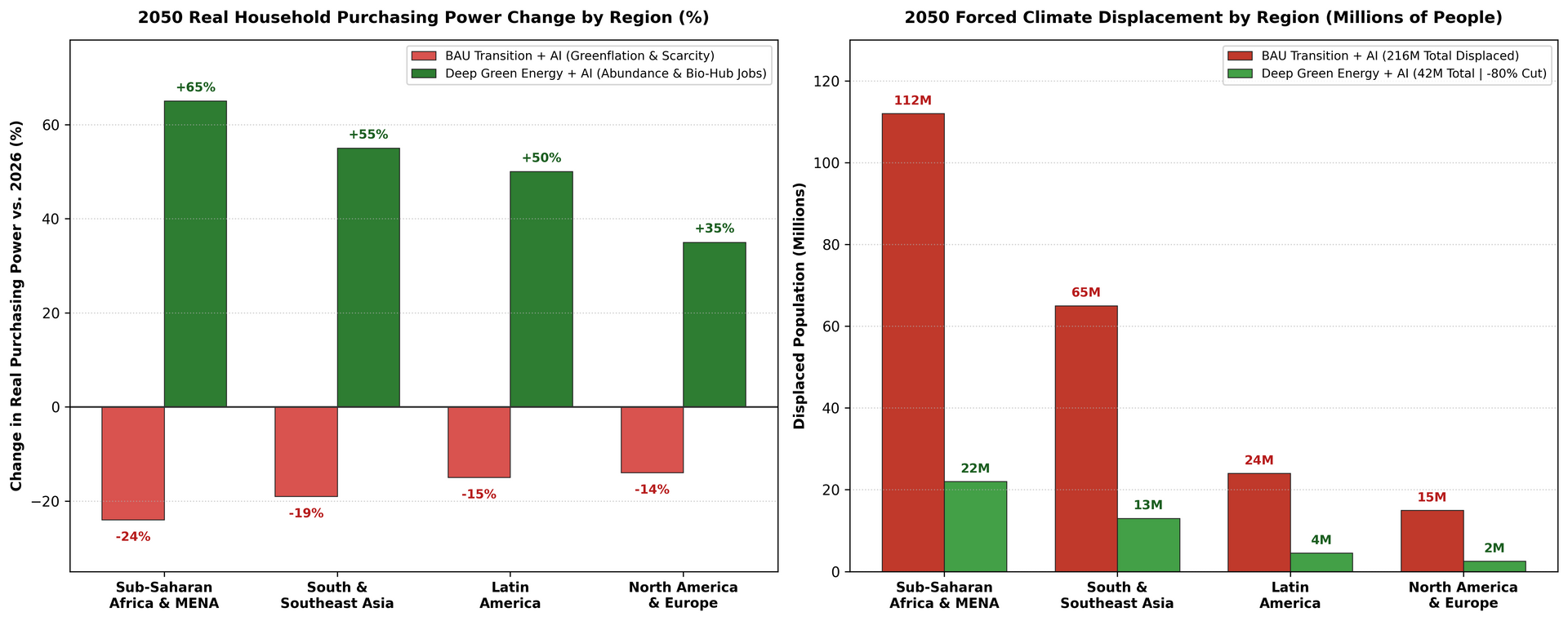
2. Regional Impact Comparison (2050: BAU Transition + AI vs. Deep Green Energy + AI)
Purchasing Power, Wealth, Hunger, Water & Conflict
1. The Core Premise: Replacing Scarcity-Driven Crises with Decentralized Abundance
By 2050, the social outcomes of the BAU Transition (+AI) and the Deep Green Energy (+AI) pathway diverge dramatically across all five pillars of human security:
- 1. Hunger & Food Security: Under BAU, climate shocks and +50% demand growth push the number of chronically undernourished people from ~735 million today toward 1.1+ billion by 2050 (FAO). Co-locating precision fermentation and climate-proof indoor farms with local biomass CHP hubs eliminates weather-driven crop failures and cuts staple protein and produce costs by 30%–45%, virtually eradicating chronic hunger.
- 2. Thirst & Freshwater Security: Under BAU, over 5 billion people face severe water scarcity for at least one month per year by 2050 (UN-Water). Shifting 35% of livestock/dairy and 25% of cereals to fermentation and 35% of produce to closed-loop greenhouses saves >250 km³ of freshwater annually while perennial grass roots boost rainwater retention by +30%, restoring depleted aquifers across arid basins.
- 3. Purchasing Power & Cost of Living: In the BAU Transition, $5–$6 trillion/yr in deficit spending and fossil write-offs fuel persistent climateflation and greenflation, eroding real household disposable income even as AI displaces white-collar and routine jobs. In DGE, abundant local bio-energy, low-cost indoor food, and affordable biogenic housing materials lower essential living costs by 20%–35%, turning AI productivity gains into rising real purchasing power.
- 4. Broad-Based Wealth Creation: Rather than concentrating capital in speculative asset bubbles ($450T) or $25T of stranded fossil write-offs, DGE anchors $15.18 trillion in productive rural and peri-urban bio-hubs—creating 120+ million new rural jobs in perennial grass agronomy, harvesting, bio-refining, and indoor horticulture while raising rural land and farm incomes across developing economies.
- 5. Conflict & Forced Climate Migration: Under BAU, collapsing harvests, water depletion, and extreme heat displace over 216 million internal and cross-border climate migrants by 2050 (World Bank Groundswell), igniting resource conflicts and severe border instability. Decentralized DGE bio-hubs allow vulnerable populations to prosper in place—cutting forced climate displacement by 75%–85%.
Global Humanitarian & Economic Divergence — BAU Transition (+AI) vs. Deep Green Energy (+AI) (2026–2050)
Tabel 4B: Regional Bubble Bursts, Sovereign Debt Defaults & Geopolitical Risk (2026–2050)
| Global Region | 2050 BAU Financial & Bubble Shock | 2050 BAU Humanitarian & Resource Crisis | DGE Regional Stabilization & Growth Engine | Source |
|---|---|---|---|---|
| 1. North America & Europe | -$180T Paper Wealth Bust
Equity, commercial real estate & pension deflation + $8T stranded fossil assets. |
Climateflation, uninsurable coastal/wildfire property & border migration pressure. | Bio-Hub Tech & Capital Hub
Reuses 100% of gas/refinery grids; exports high-ROI precision fermentation & CEA IP. |
BIS/ NGFS |
| 2. East Asia & China | -$140T Property & Debt Crisis
Local government & real estate debt cascade; industrial export contraction. |
Severe water stress in northern plains, heatwaves & imported food/energy vulnerability. | Industrial Bio-Refining Scale
Deploys torrefied pellets in existing coal/steel plants & scales urban vertical farming. |
IMF WEO |
| 3. South Asia (India & Neighbors) | Sovereign Debt & FX Collapse
Fiscal deficits surge from food/fuel subsidies and extreme monsoon/heat reconstruction. |
Lethal wet-bulb heatwaves, Himalayan glacier water loss & 400M+ facing acute food/water crisis. | High-Yield Napier & Water Security
Napier grass thrives in tropical climates; CEA & fermentation cut farm water use by -90%. |
World Bank |
| 4. Sub-Saharan Africa | Widespread Sovereign Defaults
Debt service consumes >50% of state revenue as rain-fed export crops fail. |
350M+ facing famine, desertification & mass displacement toward North Africa and Europe. | Global Biomass & Protein Powerhouse
Cultivates degraded savannas with perennial grasses, generating $300B+/yr in rural exports. |
AfDB/ UNCCD |
| 5. Latin America | Agri-Export & Banking Crash
Amazon dieback collapses regional rainfall, hydro power & soy/cattle export collateral. |
Loss of the Amazon moisture pump triggers severe drought across Brazil, Argentina & Andes. | Amazon Rewilding & Bio-SAF Hub
Replaces cattle pasture with high-margin Bio-SAF refineries & monetizes forest carbon sinks. |
IDB/ IPCC AR6 |
| 6. Middle East & Petro-States (MENA) | -$12T Stranded Oil & Gas Bust
Sovereign wealth funds deplete as oil demand peaks and desalination costs spike. |
Extreme heat (>50°C), zero renewable groundwater & total reliance on food imports. | Solar-CEA & e-Fuel Transition
Pairs abundant solar power with closed-loop greenhouses (-90% water) & e-SAF synthesis. |
Carbon Tracker |