
ADVANCING SUSTAINABLE BIOENERGY DEVELOPMENT
New, advanced technologies make it possible to produce climate neutral fuels from non-forest and non-food energy crops. The benefits of cultivation and use of these energy crops for transport fuels and electricity goes beyond the benefits of reducing greenhouse gas emissions. Terrestrial energy crop cultivation and aquatic energy crop harvesting reverses land and water degradation, increases biodiversity and carbon sequestration and improves land fertility. We call this
Deep Green Biomass. Moreover, deploying these energy crops for the production of advanced biofuels will positively impact social-economic structures and energy independence and reduce the need for involuntary migration and deforestation: Deep Green Energy.
Deep Green Energy Partners works to accelerate deployment of deep green biomass for the production of advanced biofuels and biochemicals, to restore soil and water conditions and to optimize the overall ecological-economic effects of investments in the energy transition.
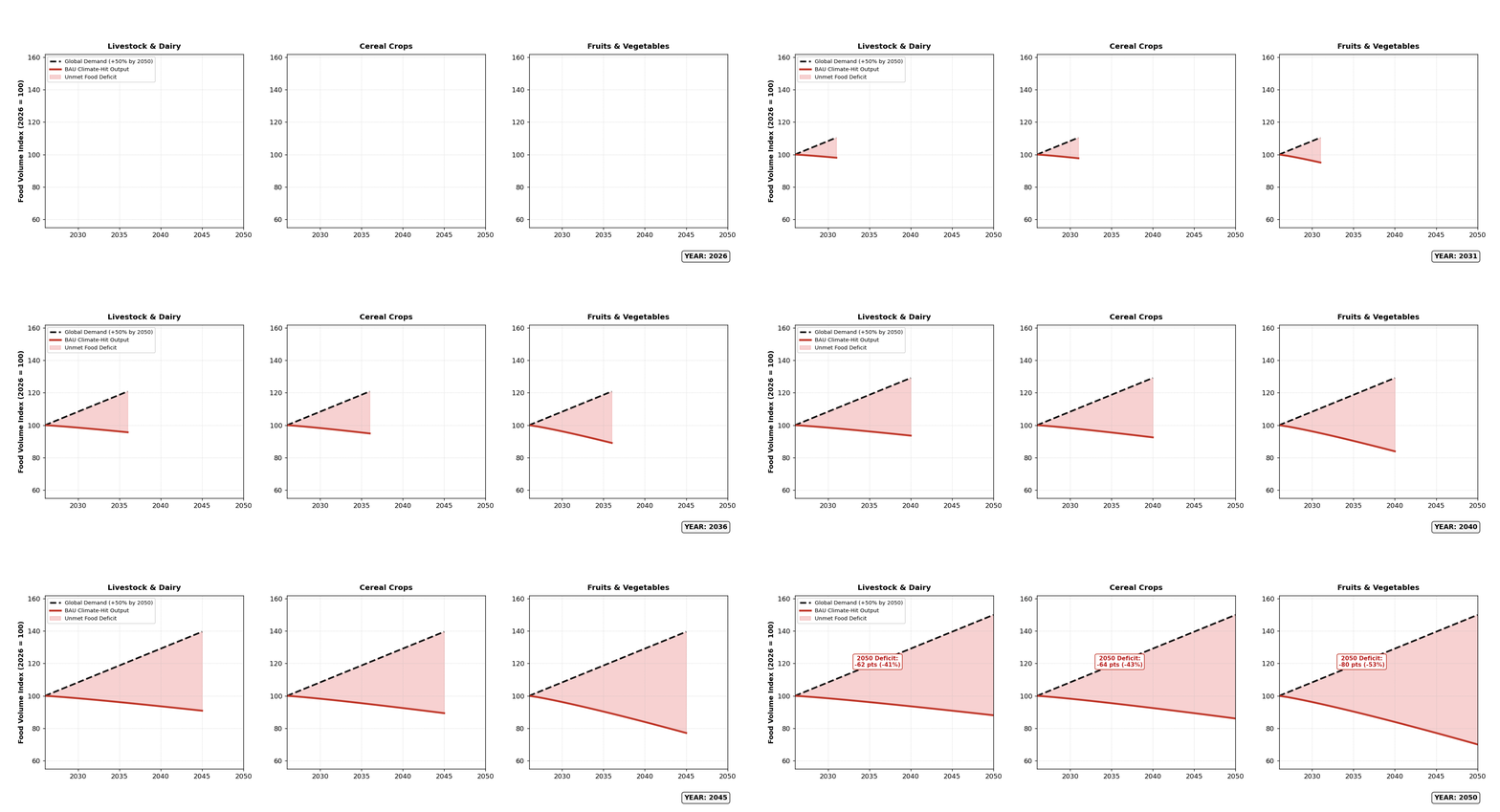
By 2050, population growth and rising global incomes will push global food demand up by 50%. Yet under a Business-As-Usual (BAU) trajectory, climate extremes—heatwaves, droughts, soil degradation, and freshwater depletion—will actively shrink outdoor agricultural output. By mid-century, BAU climate impacts are projected to cut global fruit and vegetable yields by 25%–35%, cereal harvests by 8%–20%, and livestock and dairy output by 7%–17%. Traditional open-field farming, constrained by the 1%–2% solar efficiency of photosynthesis, cannot close a widening 50%–80% supply gap without destroying the world’s remaining forests.
Animation F1: The Looming 2050 Food Deficit Under Business-As-Usual (2026–2050)
Closing the 2050 Food Gap with the Deep Green Energy System
The Deep Green Energy (DGE) Food System resolves this physical deadlock by decoupling staple protein, fat, and produce generation from weather and land limits using two commercial technologies (TRL 8–9):
- Precision Fermentation (35% of Livestock & Dairy; 25% of Cereal Crops): Microorganisms convert plant sugars or captured CO₂ into identical dairy proteins, casein, fats, and functional flours inside vertical bioreactors—using 96% less land and 90% less water than conventional farming, with zero consumer diet change required.
- Indoor Farms & High-Tech Greenhouses (35% of Fruits & Vegetables): Climate-vulnerable produce is moved into controlled, closed-loop facilities powered and heated by local biomass CHP hubs—eliminating weather-driven crop failures while recycling 90% of water and nutrients.
Animation F2: Closing the 2050 Food Gap with the Deep Green Energy System (2026–2050)
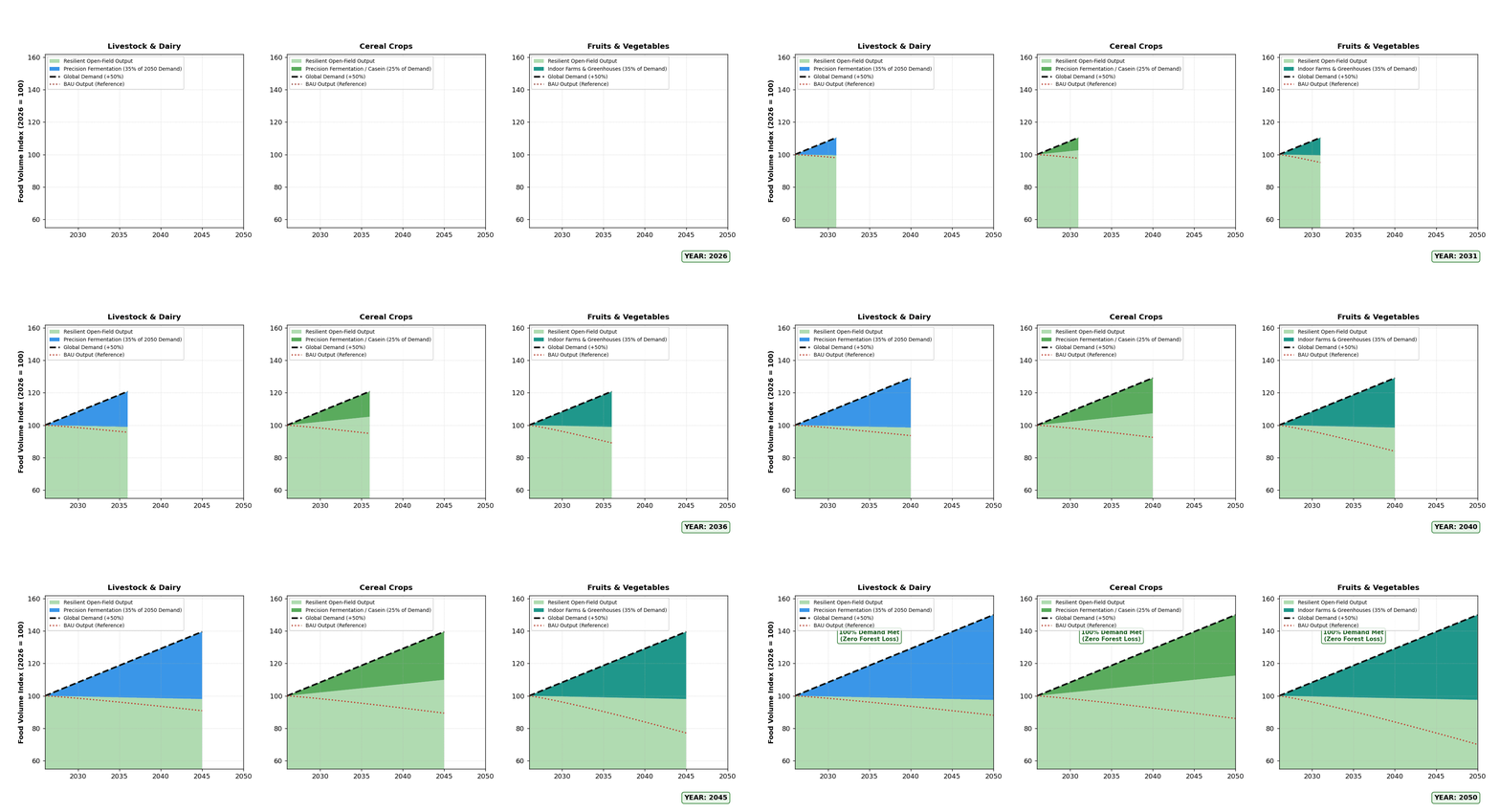
Table: Foodsystem Conversion Pathway
| Food System Segment | 2050 Demand & BAU Climate Shock | DGE Core Technology (TRL 8–9) | Resource & Economic Advantage (DGE vs. BAU) | Authoritative Source |
|---|---|---|---|---|
| Global Food Demand Baseline | +50% Demand Surge
Severe supply deficit & food price inflation (+40% to +80%). |
Integrated Bio-Hubs & Circular Food Systems(TRL 8–9) | Full Price Parity
Decouples calorie & protein supply from arable land expansion. |
FAO Projections |
| Livestock & Dairy Proteins | -7% to -17% Yield Loss
Heat stress, feed scarcity & soaring water/land footprint. |
Precision Fermentation
(TRL 8–9 Commercial Scale) |
-96% Land | -90% Water
Achieves CAPEX & retail cost parity with conventional dairy/proteins. |
GFI/ BCG |
| Horticulture (Fruits & Vegetables) | -25% to -35% Yield Loss
Extreme drought, aquifer depletion & volatile supply chains. |
Closed-Loop High-Tech Greenhouses & CEA(TRL 9) | -90% Water Use
Year-round urban production with 100% nutrient recycling. |
Wageningen UR |
| Staple Cereals & Feed Crops | -8% to -20% Yield Loss
Topsoil erosion (40% degraded) & extreme weather volatility. |
Perennial Grasses & Green Biorefining(TRL 8–9) | 22.5 t/ha | $50–$65/t
Frees up prime farmland while sequestering 5.5 t CO₂/ha/yr. |
UChicago/ IEA |
Closing the +50% Food Gap - Transforming the Global Nutritional Mix (2026–2050)
By 2050, global food demand will surge by +50% to nourish nearly 10 billion people, while Business-as-Usual (BAU) climate shocks—heat stress, drought, and 40% topsoil degradation—slash conventional yields across livestock (-7% to -17%), staple cereals (-8% to -20%), and horticulture (-25% to -35%). Simply expanding conventional agriculture would require clearing hundreds of millions of hectares of remaining forests, shattering planetary boundaries while leaving over 1.1 billion people chronically undernourished.
Rather than relying on dietary rationing, the Dynamic Green Economy (DGE) bridges this Food Gap by redesigning how essential macronutrients (proteins, carbohydrates, lipids) and micronutrients (vitamins, minerals, fiber) are produced. As shown in Animation F1 (Transformation of the Global Food & Nutritional Mix, 2026–2050) and the 2050 Primary Food Source table below, scaling Precision Fermentation (TRL 8–9) and Closed-Loop High-Tech Greenhouses (TRL 9) decouples nutrition from land and climate volatility:
- Complete Proteins & Essential Amino Acids: Precision fermentation supplies 35% of global animal-equivalent protein (bio-identical dairy casein, whey, egg, and functional proteins) while replacing 25% of cereal/soy feed demand—cutting land use by -96% and water consumption by -90%. Ruminant livestock (cattle, sheep, goats) is reduced by -65% to eliminate methane hotspots, while poultry, pork, and aquaculture are sustained using zero-deforestation microbial and grass-extracted proteins.
- Complex Carbohydrates & Dietary Fiber: Open-field staple cereals (wheat, rice, maize, legumes) shift away from inefficient livestock feed toward direct human consumption, maintaining a healthy 50%–55% caloric share of complex carbohydrates while releasing 278.7 million hectares of marginal cropland for forest rewilding.
- Healthy Lipids & Omega Fatty Acids: Precision fermentation and microalgae biorefining supply 30% of global dietary lipids—replacing palm oil deforestation and overfished marine oils with heart-healthy unsaturated fats and omega-3s alongside sustainable plant oils.
- Vitamins, Minerals & Phytonutrients: Expanding closed-loop greenhouses and vertical farms across 1.95 million hectares supplies 35% of global fruits and vegetables
- year-round right next to urban centers, eliminating seasonal shortages and preserving peak vitamin and antioxidant density without pesticide runoff.
Animation F3: Transformation of the Global Food & Nutritional Mix (2026–2050)
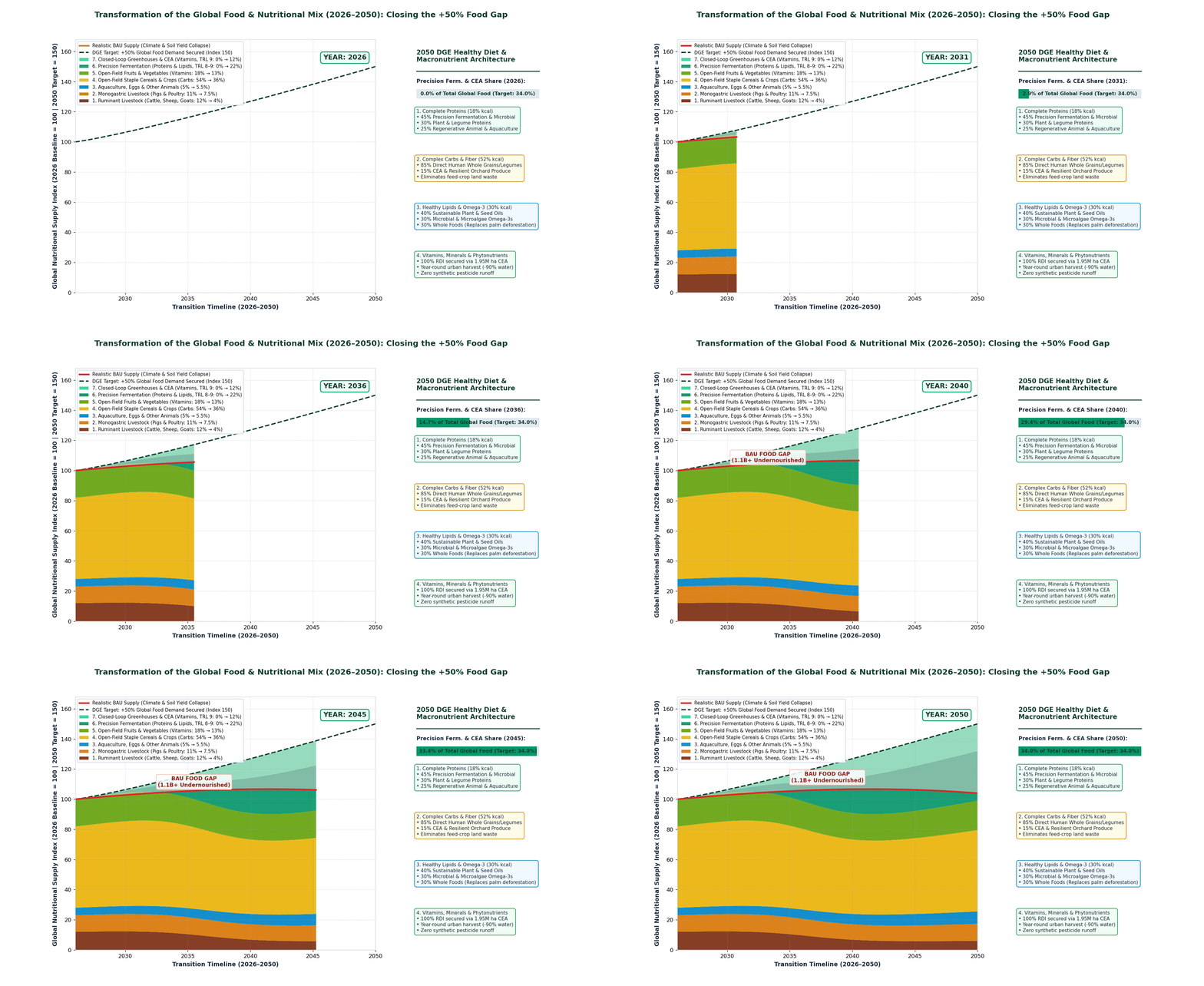
Table: Primary Food Source 2050
| Primary Food Source (2050) | Primary Nutritional Role | 2025/2026 Baseline (100% Demand) |
Realistic BAU 2050 (+50% Demand Gap) |
Deep Green Economy 2050 (150% Secured) |
Health, Land & Climate Impact | Source |
|---|---|---|---|---|---|---|
| 1. Ruminant Livestock
(Cattle, Sheep & Goats) |
Protein, Saturated Lipids, Iron & B12 | 12.0% | 13.5%
(-7% to -17% heat loss) |
4.0%
(-65% herd reduction) |
Slashes agricultural methane & frees 278.7M ha of grazing land for forest rewilding. | FAIRR / IPCC |
| 2. Monogastric Livestock
(Pigs & Poultry) |
Lean Protein, Lipids & B-Vitamins | 11.0% | 12.5%
(Feed-crop bottleneck) |
7.5%
(Circular-fed) |
Fed on green biorefinery grass protein & fermentation co-products instead of soy/maize. | FAO 2050 |
| 3. Aquaculture & Other Animal Sources
(Fish, Eggs & Wild Catch) |
Omega-3 Lipids, Protein & Micronutrients | 5.0% | 4.5%
(Ocean warming decline) |
5.5%
(Regenerative) |
Sustainable aquaculture nourished by microalgae omega-3s & single-cell proteins; relieves wild oceans. | FAO Fisheries |
| 4. Open-Field Staple Cereals & Oil/Feed Crops
(Wheat, Rice, Maize, Soy) |
Complex Carbohydrates, Plant Protein & Lipids | 54.0% | 53.5%
(-8% to -20% yield loss) |
36.0%
(Direct human food) |
Eliminates animal feed waste; meets healthy dietary guidelines (50–55% complex carbs) on less land. | UChicago |
| 5. Open-Field Fruits & Vegetables | Vitamins (A, C, E), Minerals, Fiber & Antioxidants | 18.0% | 14.0%
(-25% to -35% drought loss) |
13.0%
(Climate-resilient) |
Focuses open-field horticulture on resilient orchard & root crops while buffering extreme weather. | Nature Food |
| 6. Precision Fermentation & Microbial Lipids
TRL 8–9 |
Bio-Identical Dairy/Egg Proteins & Healthy Lipids | 0.0% | 1.5%
(Under-invested) |
22.0%
(370 Mt/yr pure output) |
-96% land & -90% water: Delivers 35% of animal protein + 30% of healthy dietary lipids at full price parity. | GFI/ BCG |
| 7. Closed-Loop Greenhouses & Vertical Farms
TRL 9 |
High-Density Vitamins, Minerals & Phytonutrients | 0.0% | 0.5%
(Niche luxury only) |
12.0%
(1.95M ha CEA footprint) |
-90% water use: Supplies 35% of global fruits & vegetables year-round with zero pesticides. | Wageningen UR |
| 8. Natural Capital Balance Sheet Impact
(Land, Water & Biodiversity) |
Ecosystem Services & Biosphere Solvency | -$7.0 T/yr
(Soil & aquifer loss) |
-$21.0 T/yr
(Deforestation & erosion) |
+$7.5 T/yr
(Net ecosystem restoration) |
Frees 278.7M ha for rewilding, restores freshwater aquifers & adds +$300T natural capital by 2050. | UN SEEA/ World Bank |
| Total Global Food & Nutritional Supply | 100% Balanced Macro- & Micronutrients | 100.0% (Baseline) | 100.0% (Severe Deficit / 1.1B+ Hungry) | 100.0% of +50% Demand (Zero Hunger) | Eliminates the 2050 Food Gap, improves global diet quality, and restores 278.7M ha of nature. | FAO SOFI |
Building out the global DGE food infrastructure requires a cumulative capital investment (CAPEX) of
$10.81 trillion between 2027 and 2050 (averaging
$450 billion per year). Because both precision fermentation facilities and CHP-integrated greenhouses generate high-margin, year-round output shielded from weather shocks, the food module achieves an average
payback time of 6.3 years and an annual operating return (EBITDA/CAPEX) of
15.8%:
Figure F3: DGE Food System Capital Investment, Cash Flow Ramp-Up, and Unit Returns (2026–2050)
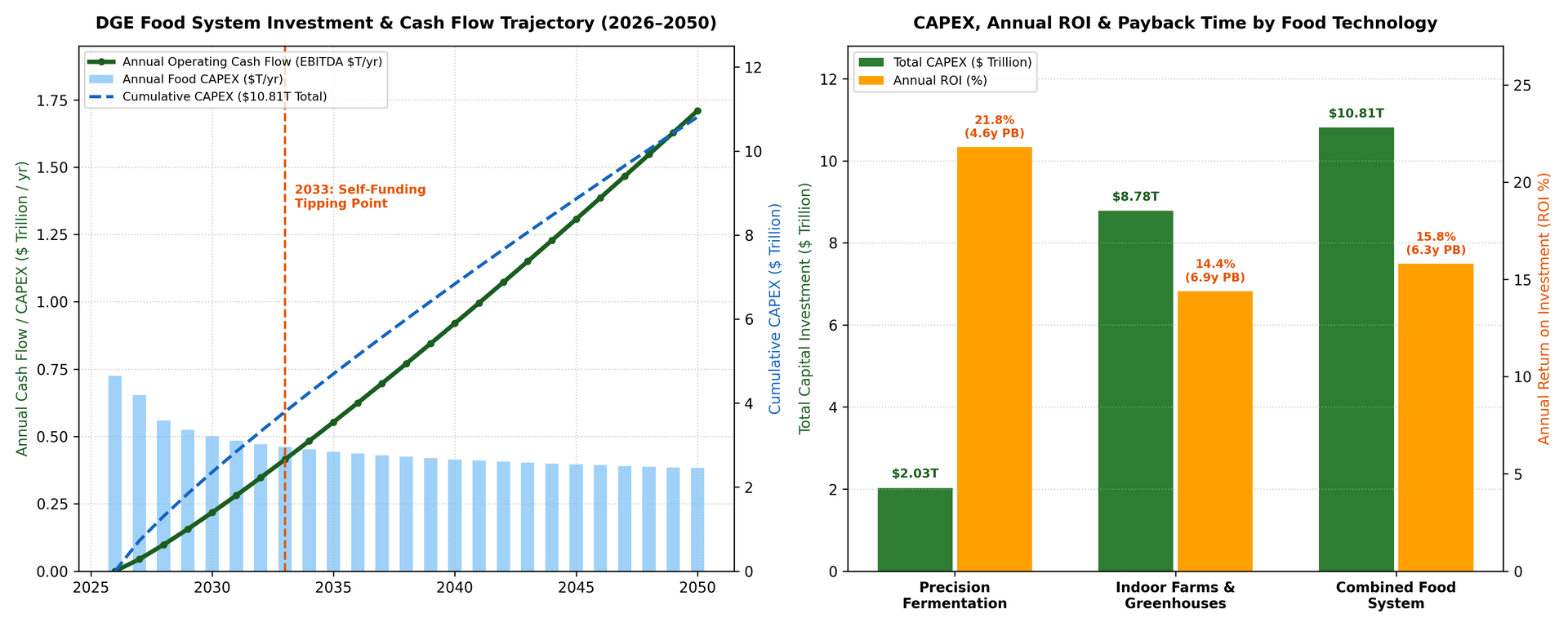
Table: DGE Food Component
| DGE Food Component | 2050 Physical Scale | Total CAPEX | Annual Cash Flow (EBITDA) | Payback Time | Annual ROI | Source |
|---|---|---|---|---|---|---|
| 1. Precision Fermentation Plants
(35% Livestock/Dairy + 25% Cereals) |
370 million tons/yr
of pure proteins, casein & fats ($5,500/t capacity) |
$2.03 T | $0.44 T / yr | 4.6 years | 21.8% | GFI/ BCG |
| 2. Indoor Farms & High-Tech Greenhouses
(35% Fruits & Vegetables) |
1.95 million ha
facility footprint (80% greenhouses, 20% vertical farms) |
$8.78 T | $1.27 T / yr | 6.9 years | 14.4% | WUR/ Rabobank |
| Total DGE Food Module | 100% of +50% global food demand secured | $10.81 T | $1.71 T / yr | 6.3 years | 15.8% | FAO 2050 |
Why Returns Are Protected: In conventional indoor farming, electricity and heating account for 25%–40% of operating costs. In the DGE model, co-located biomass CHP plants supply low-cost 24/7 baseload electricity, free waste heat, and pure captured CO₂ directly into the greenhouses and fermentation tanks—boosting crop yields by 20%–30% while locking in predictable, high-margin cash flows that become self-funding after 2033.
Global Food System Resource Footprint Trajectory (2026–2050)
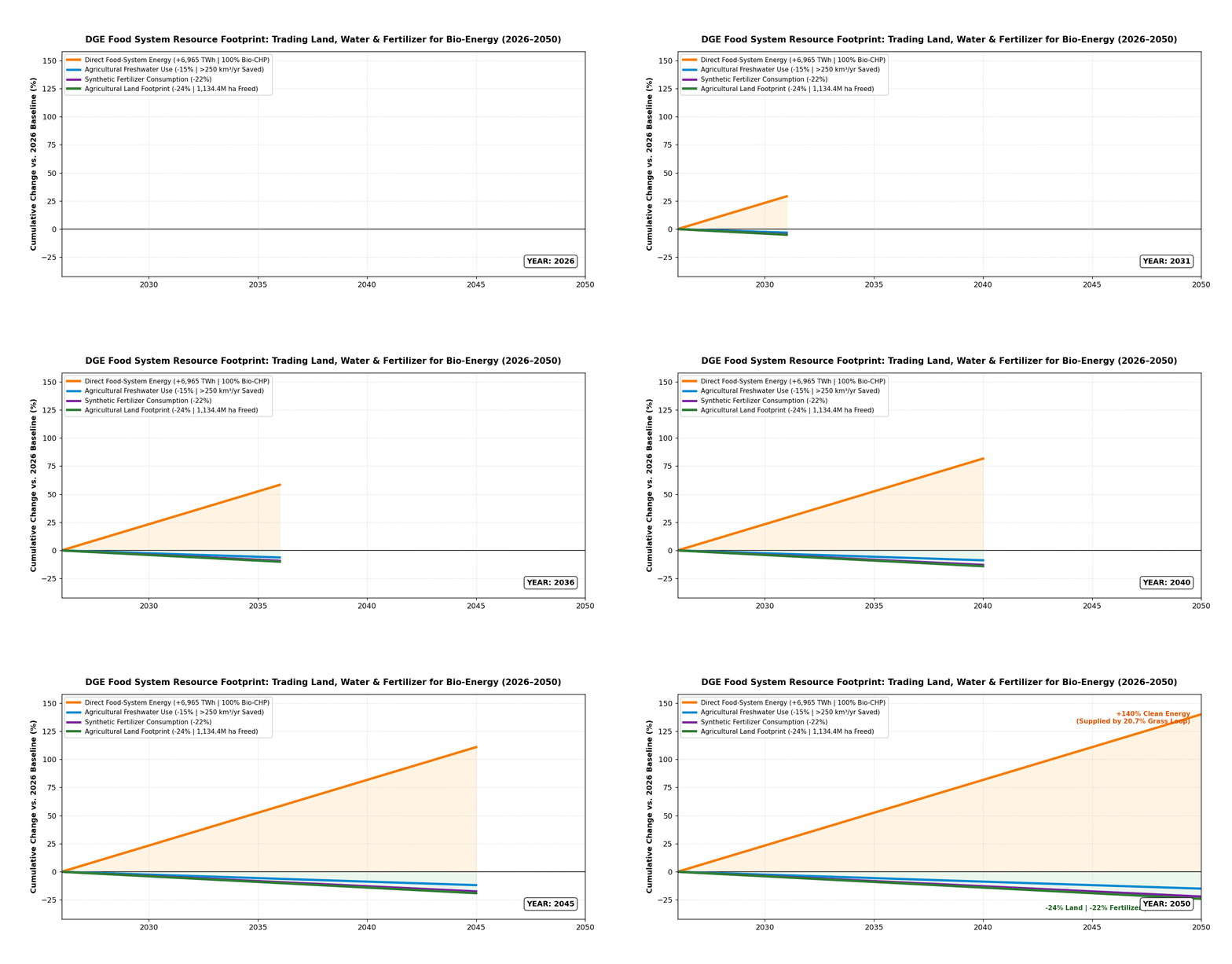
Moving 25%–35% of global food production out of vulnerable open fields into closed-loop facilities fundamentally reshapes agriculture’s planetary footprint. While direct food-system energy consumption increases by +6,965 TWh/yr (+140% above current direct agri-food energy use) to run bioreactors, LED lighting, and climate controls, 100% of that energy is supplied internally by just 20.7% (3.98 Gt/yr) of our perennial grass harvest—delivering massive net reductions in land, freshwater, and synthetic fertilizer use:
- Agricultural Land Use (-24% | -1,134.4 Million Hectares Freed): Frees over 1.13 billion hectares of cropland and pasture—enough to plant 855.7 million hectares of carbon-sequestering perennial grasses and return 278.7 million hectares to wild nature.
- Freshwater Consumption (-15% | >250 km³/yr Saved): Closed-loop irrigation and fermentation cut water use by 90%–96% in shifted categories, relieving acute groundwater depletion across major farming basins.
- Synthetic Fertilizer Use (-22%): Precision nutrient dosing in greenhouses and bioreactors eliminates fertilizer runoff, stopping coastal dead zones and nitrous oxide (N20) emissions.
Turning Freed Farmland into the Global Energy Engine:
Solving the 2050 food crisis through precision fermentation and indoor farming does far more than eliminate hunger: it unlocks
1,134.4 million hectares of surplus agricultural land without cutting down a single tree. By dedicating
855.7 million hectares of this freed land to high-yield perennial C4 grasses (Miscanthus and Napier grass)—while returning the remaining
278.7 million hectares to wild nature—the food transformation directly supplies the biological feedstock needed to decarbonize the global energy and materials system. Just
20.7% (3.98 Gt/yr) of the annual grass harvest powers and heats 100% of the new indoor food infrastructure, leaving
79.3% (15.27 Gt/yr, worth ~275 Exajoules) to replace coal, natural gas, oil, and forest logging across the wider global economy.
Animation F4: Global Food System Resource Footprint Trajectory (2026–2050).
Turning Freed Farmland into the Global Energy Engine:
Solving the 2050 food crisis through precision fermentation and indoor farming does far more than eliminate hunger: it unlocks
1,134.4 million hectares of surplus agricultural land without cutting down a single tree. By dedicating
855.7 million hectares of this freed land to high-yield perennial C4 grasses (Miscanthus and Napier grass)—while returning the remaining
278.7 million hectares to wild nature—the food transformation directly supplies the biological feedstock needed to decarbonize the global energy and materials system. Just
20.7% (3.98 Gt/yr) of the annual grass harvest powers and heats 100% of the new indoor food infrastructure, leaving
79.3% (15.27 Gt/yr, worth ~275 Exajoules) to replace coal, natural gas, oil, and forest logging across the wider global economy.
ADVANCING SUSTAINABLE BIOENERGY DEVELOPMENT
New, advanced technologies make it possible to produce climate neutral fuels from non-forest and non-food energy crops. The benefits of cultivation and use of these energy crops for transport fuels and electricity goes beyond the benefits of reducing greenhouse gas emissions. Terrestrial energy crop cultivation and aquatic energy crop harvesting reverses land and water degradation, increases biodiversity and carbon sequestration and improves land fertility. We call this
Deep Green Biomass. Moreover, deploying these energy crops for the production of advanced biofuels will positively impact social-economic structures and energy independence and reduce the need for involuntary migration and deforestation: Deep Green Energy.
Deep Green Energy Partners works to accelerate deployment of deep green biomass for the production of advanced biofuels and biochemicals, to restore soil and water conditions and to optimize the overall ecological-economic effects of investments in the energy transition.
Increasing carbon sequestration and reversing land degradation by food/feed crop cultivation on existing cropland or pastures might be technically possible but comes with lower yields, yields that are already under pressure from nutrients and water depletion and climate change. Increasing food and fe ed crop production on open fields or more livestock grazing on pastures therefore equals more deforestation, grassland conversion, land degradation and desertification. Improved agricultural management practises could reduce incremental carbon losses but absolute in absolute terms carbon sequestration by agricultural land use will still decrease.
ADVANCING SUSTAINABLE BIOENERGY DEVELOPMENT
New, advanced technologies make it possible to produce climate neutral fuels from non-forest and non-food energy crops. The benefits of cultivation and use of these energy crops for transport fuels and electricity goes beyond the benefits of reducing greenhouse gas emissions. Terrestrial energy crop cultivation and aquatic energy crop harvesting reverses land and water degradation, increases biodiversity and carbon sequestration and improves land fertility. We call this
Deep Green Biomass. Moreover, deploying these energy crops for the production of advanced biofuels will positively impact social-economic structures and energy independence and reduce the need for involuntary migration and deforestation: Deep Green Energy.
Deep Green Energy Partners works to accelerate deployment of deep green biomass for the production of advanced biofuels and biochemicals, to restore soil and water conditions and to optimize the overall ecological-economic effects of investments in the energy transition.
| Food System Segment | 2050 Demand & BAU Climate Shock | DGE Core Technology (TRL 8–9) | Resource & Economic Advantage (DGE vs. BAU) | Authoritative Source |
|---|---|---|---|---|
| Global Food Demand Baseline | +50% Demand Surge
Severe supply deficit & food price inflation (+40% to +80%). |
Integrated Bio-Hubs & Circular Food Systems(TRL 8–9) | Full Price Parity
Decouples calorie & protein supply from arable land expansion. |
FAO Projections |
| Livestock & Dairy Proteins | -7% to -17% Yield Loss
Heat stress, feed scarcity & soaring water/land footprint. |
Precision Fermentation
(TRL 8–9 Commercial Scale) |
-96% Land | -90% Water
Achieves CAPEX & retail cost parity with conventional dairy/proteins. |
GFI/ BCG |
| Horticulture (Fruits & Vegetables) | -25% to -35% Yield Loss
Extreme drought, aquifer depletion & volatile supply chains. |
Closed-Loop High-Tech Greenhouses & CEA(TRL 9) | -90% Water Use
Year-round urban production with 100% nutrient recycling. |
Wageningen UR |
| Staple Cereals & Feed Crops | -8% to -20% Yield Loss
Topsoil erosion (40% degraded) & extreme weather volatility. |
Perennial Grasses & Green Biorefining(TRL 8–9) | 22.5 t/ha | $50–$65/t
Frees up prime farmland while sequestering 5.5 t CO₂/ha/yr. |
UChicago/ IEA |
ADVANCING SUSTAINABLE BIOENERGY DEVELOPMENT
New, advanced technologies make it possible to produce climate neutral fuels from non-forest and non-food energy crops. The benefits of cultivation and use of these energy crops for transport fuels and electricity goes beyond the benefits of reducing greenhouse gas emissions. Terrestrial energy crop cultivation and aquatic energy crop harvesting reverses land and water degradation, increases biodiversity and carbon sequestration and improves land fertility. We call this
Deep Green Biomass. Moreover, deploying these energy crops for the production of advanced biofuels will positively impact social-economic structures and energy independence and reduce the need for involuntary migration and deforestation: Deep Green Energy.
Deep Green Energy Partners works to accelerate deployment of deep green biomass for the production of advanced biofuels and biochemicals, to restore soil and water conditions and to optimize the overall ecological-economic effects of investments in the energy transition.
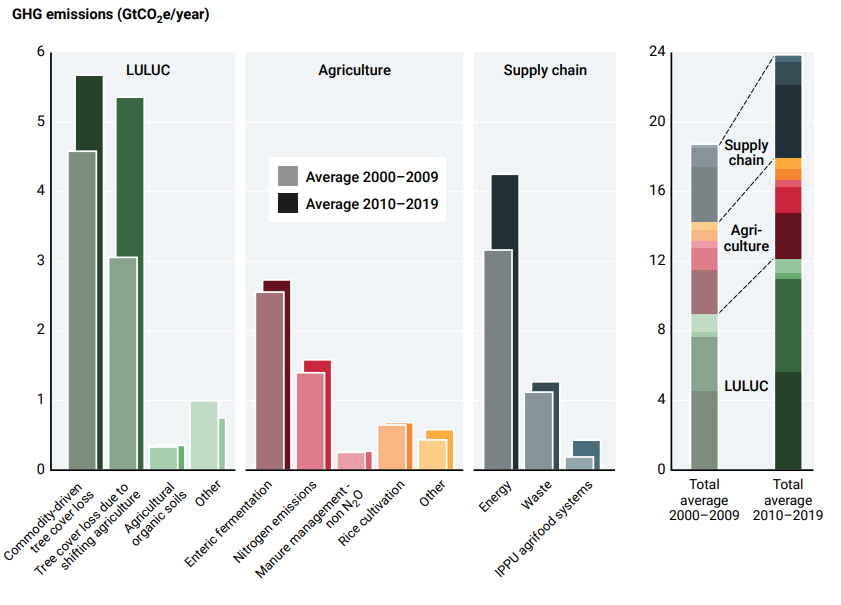
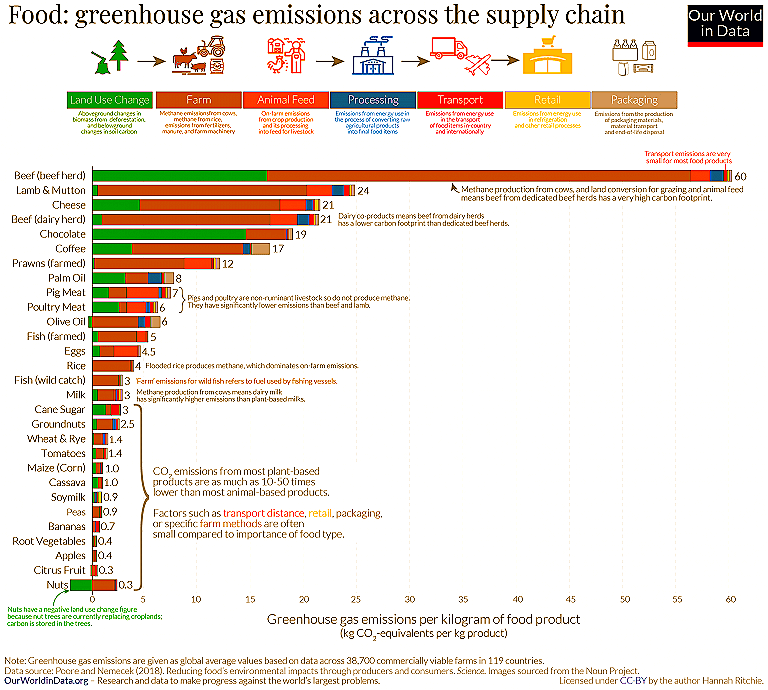
Projected food system emissions and mitigation for 2C GW
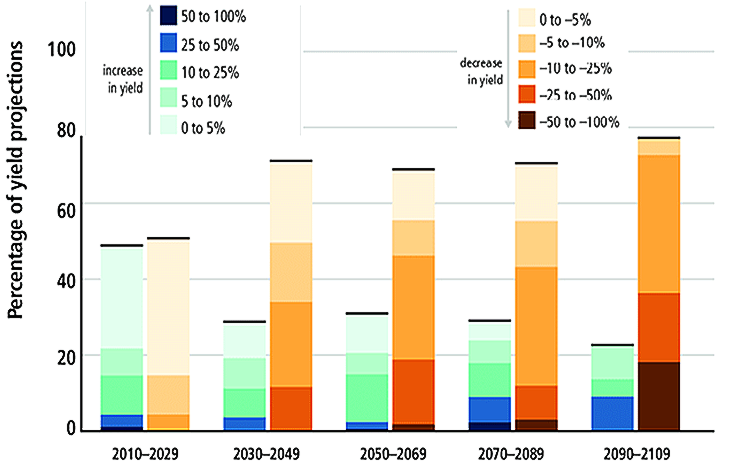
Projected losses in crop yields
ADVANCING SUSTAINABLE BIOENERGY DEVELOPMENT
New, advanced technologies make it possible to produce climate neutral fuels from non-forest and non-food energy crops. The benefits of cultivation and use of these energy crops for transport fuels and electricity goes beyond the benefits of reducing greenhouse gas emissions. Terrestrial energy crop cultivation and aquatic energy crop harvesting reverses land and water degradation, increases biodiversity and carbon sequestration and improves land fertility. We call this
Deep Green Biomass. Moreover, deploying these energy crops for the production of advanced biofuels will positively impact social-economic structures and energy independence and reduce the need for involuntary migration and deforestation: Deep Green Energy.
Deep Green Energy Partners works to accelerate deployment of deep green biomass for the production of advanced biofuels and biochemicals, to restore soil and water conditions and to optimize the overall ecological-economic effects of investments in the energy transition.
are already incompatible with the land and water required to maintain the minimal levels of ecosystem services for our survival. It
Indoor food farming is however energy intensive as it requires optimized climatic and process conditions. And just as for electric cars actual emissions and pollution reductions are as efficient as the source of their energy, hence bioenergy from energy crops provides the logical circular solution. Indoor food production, be it voluntary or climate/economically forced will also leave at least another several hundred million hectares of current arable land in danger of falling prey to abandonment and erosion. Using that land for carbon and energy farming to provide the CO2,
nutrients and electricity for indoor food production will turn our food system from self-destructive to restorative and offer a new livelihood to many small farmers around the world.
Today the world produces sufficient food to feed the world and hunger is not so much an issue of availability but of distribution, storage, spillage and affordability issues. f distances, modes and refrigeration needs. Switching to local supply reduces long-distance food transportation, which relies heav-ily on maritime shipping (0.01–0.02 kgCO2e tkm−1), but increases domestic food supply dominated by road transport, which in turn features a much higher emission intensity per tkm than shipping (0.2–0.66 kgCO2e tkm−1)Future food production will unavoidably have to move increasingly indoors and become many times more efficient in land and water use vis-a-vis as today's food systems to meet 2050 global food demand. Many items of our diets, proteins, carbs, fats, starch, vitamines and vegetables, fruits and meat can be produced indoors from basically electricity, heat, CO2, water and abundantly available nutrients. Indoor food production comes with many positive effects besides climate independence: drastically increased water, land and time efficiencies as well as food nutritiousness and security, less food losses, pollution, eutrophication, animal suffering and emissions.
Just as openfield agriculture, indoor food productions requires carbon, nutrients, water, light and other energy/heat sources. All of these will have to be delivered to the bio-refineries and greenhouses from where the product is distributed to either end-users or for further processing. In the optimal situation bio-refineries and greenhouses would therefore be built near their clients (e.g. in or close to cities or regional hubs like breweries used to be) and the carbon and nutrient supply comes from organic waste streams (e.g. food and other bio-waste or waste water) or CO2 captured at power/heat plants, factories or refineries in the neighborhood while the energy/heath comes from these same plants and factories or from renewable sources. Thus we could have an (almost) climate neutral and resilient food system.
Cleaning large waste streams to food processing standards is happening but it will take time to become before technologies are steady and approved for human food applications.
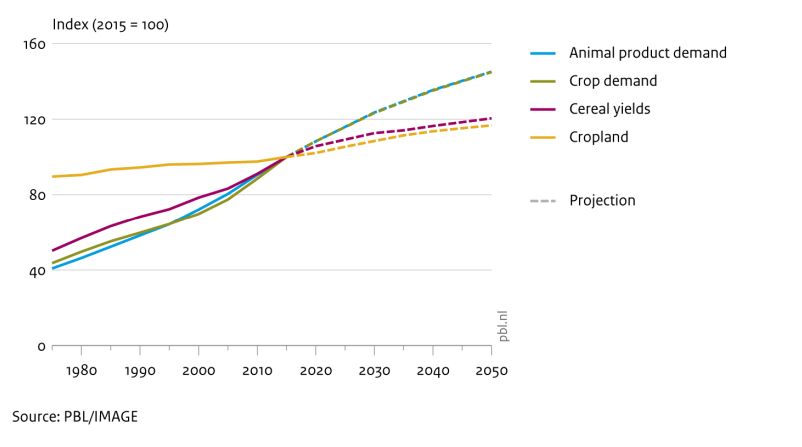
The world needs about 50% more food in 2050 which will result in a projected 300 to 500 million hectares
of forests and wild grass lands to be converted to crop land. Land hunger is however not the only problem of our food systems. For at least 4 of the 6 planet boundaries crossings our food systems are the biggest culprit. Agriculture uses
70%
of global freshwater withdrawals (Green Water boundaries), causes
80-90%
of deforestation (Biosphere integrity, Land-use change),
78%
of global ocean and freshwater eutrophication (fertilizers ( P+N), Ocean and Freshwater acidification), most of all biodiversity losses and about
40%
of all emissions (land-use, agriculture and supply chain). As the world warms, freshwater gets scarcer and seas are rising average agricultural yields, misharvests and livestock productivity will decrease due to extreme weather events and (vector-borne) diseases. Future food security and planetary health therefore heavily depends on decoupling a large part of the world's food production from land, water, emissions, eutrophication and climatic conditions, i.e. moving it into controlled environments.
ADVANCING SUSTAINABLE BIOENERGY DEVELOPMENT
New, advanced technologies make it possible to produce climate neutral fuels from non-forest and non-food energy crops. The benefits of cultivation and use of these energy crops for transport fuels and electricity goes beyond the benefits of reducing greenhouse gas emissions. Terrestrial energy crop cultivation and aquatic energy crop harvesting reverses land and water degradation, increases biodiversity and carbon sequestration and improves land fertility. We call this
Deep Green Biomass. Moreover, deploying these energy crops for the production of advanced biofuels will positively impact social-economic structures and energy independence and reduce the need for involuntary migration and deforestation: Deep Green Energy.
Deep Green Energy Partners works to accelerate deployment of deep green biomass for the production of advanced biofuels and biochemicals, to restore soil and water conditions and to optimize the overall ecological-economic effects of investments in the energy transition.
FOOD PRODUCTION IN BELOW 2C GLOBAL WARMING SCENARIOS
ADVANCING SUSTAINABLE BIOENERGY DEVELOPMENT
New, advanced technologies make it possible to produce climate neutral fuels from non-forest and non-food energy crops. The benefits of cultivation and use of these energy crops for transport fuels and electricity goes beyond the benefits of reducing greenhouse gas emissions. Terrestrial energy crop cultivation and aquatic energy crop harvesting reverses land and water degradation, increases biodiversity and carbon sequestration and improves land fertility. We call this
Deep Green Biomass. Moreover, deploying these energy crops for the production of advanced biofuels will positively impact social-economic structures and energy independence and reduce the need for involuntary migration and deforestation: Deep Green Energy.
Deep Green Energy Partners works to accelerate deployment of deep green biomass for the production of advanced biofuels and biochemicals, to restore soil and water conditions and to optimize the overall ecological-economic effects of investments in the energy transition.
In a 2050, 9.2 billion world population, 1.5-1.7C global warming scenario and disregarding misharvests from extreme weather events To asses if and how the growing demand from the world population could be satisfied and combined simultaneously with
land restoration the Dutch PBL has developed three scenarios assuming 1.5-1.7C global warming scenario and disregarding misharvests
from extreme weather events (as specific impacts are unpredictable).
ADVANCING SUSTAINABLE BIOENERGY DEVELOPMENT
New, advanced technologies make it possible to produce climate neutral fuels from non-forest and non-food energy crops. The benefits of cultivation and use of these energy crops for transport fuels and electricity goes beyond the benefits of reducing greenhouse gas emissions. Terrestrial energy crop cultivation and aquatic energy crop harvesting reverses land and water degradation, increases biodiversity and carbon sequestration and improves land fertility. We call this
Deep Green Biomass. Moreover, deploying these energy crops for the production of advanced biofuels will positively impact social-economic structures and energy independence and reduce the need for involuntary migration and deforestation: Deep Green Energy.
Deep Green Energy Partners works to accelerate deployment of deep green biomass for the production of advanced biofuels and biochemicals, to restore soil and water conditions and to optimize the overall ecological-economic effects of investments in the energy transition.
In the Baseline scenario no land restoration measures are taken and land management negatively affects soil and biomass productivity on an estimated 1.8 billion hectares of the global land area. Agricultural productivity is projected to increase by around 42% while land management practices have an average negative land effect of between 2-10% depending on region. Cropland expands by about 20% (300 million hectares), at the expense of natural lands (forests and grass lands) and managed grass lands will expand at the expense of forests and other natural vegetation and an additional 169 Gt carbon is emitted by 2050 due to land-use change and soil degradation.
In the restoration scenarios around 5 billion hectares (35% of the global land area) are restored using measures such as agroforestry, grazing management, and assisted natural regeneration. In these scenarios by 2050: crop yields will increase by 5% to 10% in most developing countries, compared to the baseline (yield increase in developed nations is more difficult). Soil water holding capacity of rainfed croplands will increase by 4%, biodiversity will continue to decline, but not as quickly. Loss of soil carbon stocks are reduced to close to zero over the period and an additional 0.4 billion hectares of nature areas will be established.
ADVANCING SUSTAINABLE BIOENERGY DEVELOPMENT
New, advanced technologies make it possible to produce climate neutral fuels from non-forest and non-food energy crops. The benefits of cultivation and use of these energy crops for transport fuels and electricity goes beyond the benefits of reducing greenhouse gas emissions. Terrestrial energy crop cultivation and aquatic energy crop harvesting reverses land and water degradation, increases biodiversity and carbon sequestration and improves land fertility. We call this
Deep Green Biomass. Moreover, deploying these energy crops for the production of advanced biofuels will positively impact social-economic structures and energy independence and reduce the need for involuntary migration and deforestation: Deep Green Energy.
Deep Green Energy Partners works to accelerate deployment of deep green biomass for the production of advanced biofuels and biochemicals, to restore soil and water conditions and to optimize the overall ecological-economic effects of investments in the energy transition.
FOOD PRODUCTION IN A CURENT TRAJECTORY SCENARIO
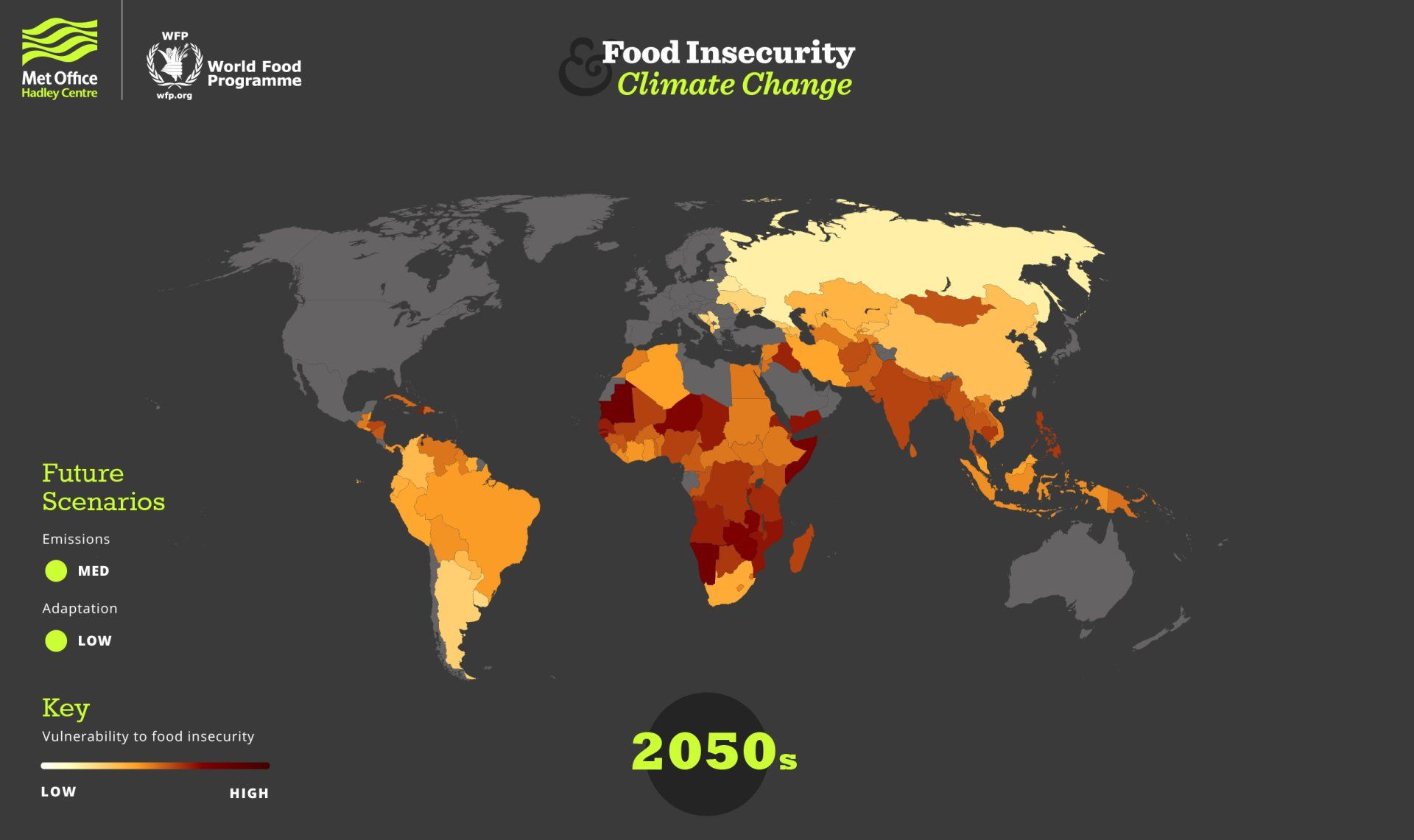
Theoretically, provided that the world minimizes food losses and global warming, traditional food production might be able to feed the world by 2050. Food production is however unequally spread around the world. And climate change will further widen the existing mismatch between food production location and consumption. To increase food security in most of the world, the world would need to show an unprecedented solidarity by sharing available food resources at lowest affordable prices. An already unlikely scenario becoming more unlikely as increasing average temperatures, water stress and
extreme weather cause ad hoc food shortages and steep price rises.
The chances of changing course from the Baseline to Restoration scenarios will heavily depend on money flows from developed to developing nations and the effects of climate change in the coming 30 years. Considering the
current trackrecord
of fund flows to developing nations for climate change mitigation and the limited commitments to do so it is hard to imagine that there will be much deviation from the Baseline scenario. The cocktail of global warming, world population growth and agriculture expansion is likely to intensify animal and human disease as well as pandemics posing an increased risk to food production, in parallel water scarcity and climatic conditions will decrease yields further or even prohibit any open field food production in large parts of the world.
ADVANCING SUSTAINABLE BIOENERGY DEVELOPMENT
New, advanced technologies make it possible to produce climate neutral fuels from non-forest and non-food energy crops. The benefits of cultivation and use of these energy crops for transport fuels and electricity goes beyond the benefits of reducing greenhouse gas emissions. Terrestrial energy crop cultivation and aquatic energy crop harvesting reverses land and water degradation, increases biodiversity and carbon sequestration and improves land fertility. We call this
Deep Green Biomass. Moreover, deploying these energy crops for the production of advanced biofuels will positively impact social-economic structures and energy independence and reduce the need for involuntary migration and deforestation: Deep Green Energy.
Deep Green Energy Partners works to accelerate deployment of deep green biomass for the production of advanced biofuels and biochemicals, to restore soil and water conditions and to optimize the overall ecological-economic effects of investments in the energy transition.
Climate change is the primary cause of low production of most of the vegetables worldwide; reducing average yields for most of the major vegetables. Moreover, increasing temperatures, reduced irrigation-water availability, flooding, and salinity will be the major limiting factors in sustaining and increasing vegetable productivity. Under changing climatic situations crop failures, shortage of yields, reduction in quality and increasing pest and disease problems are common and they render the vegetable production unprofitable
ADVANCING SUSTAINABLE BIOENERGY DEVELOPMENT
New, advanced technologies make it possible to produce climate neutral fuels from non-forest and non-food energy crops. The benefits of cultivation and use of these energy crops for transport fuels and electricity goes beyond the benefits of reducing greenhouse gas emissions. Terrestrial energy crop cultivation and aquatic energy crop harvesting reverses land and water degradation, increases biodiversity and carbon sequestration and improves land fertility. We call this
Deep Green Biomass. Moreover, deploying these energy crops for the production of advanced biofuels will positively impact social-economic structures and energy independence and reduce the need for involuntary migration and deforestation: Deep Green Energy.
Deep Green Energy Partners works to accelerate deployment of deep green biomass for the production of advanced biofuels and biochemicals, to restore soil and water conditions and to optimize the overall ecological-economic effects of investments in the energy transition.
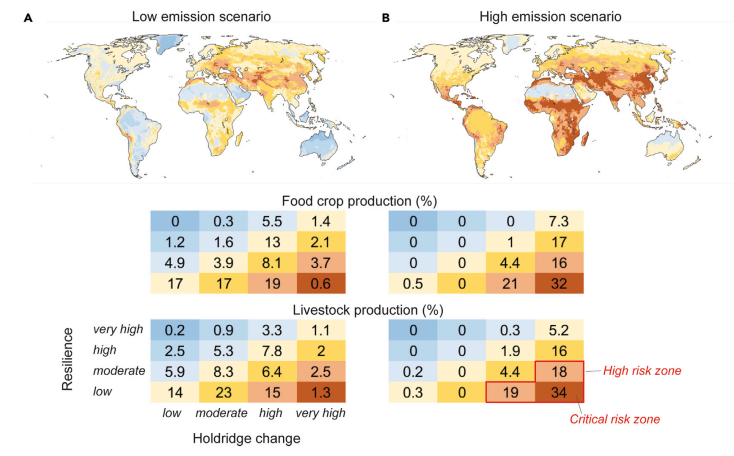
The figure on the left shows the safe climatic space (SCS). It shows that a rapid and unhalted growth of greenhouse gas emissions in a high emissions scenario, the world's current trajectory, could gradually force 31% of the global food crop and 34% of livestock production beyond the SCS by 2081–2100. If e.g temperatures exceeded 35 degrees Celsius two of the most widely grown varieties of rice, these plants would become sterile, offering little to no grains. Many tropical and Asian countries where rice is the main staple food already lie on the very edge of this temperature zone and any As the chances of increasing food production by conventional measures are minimal and climate change becomes a growing threat to food security we have to consider less conventional options: moving food production indoors and cutting greenhouse gas emissions, pollution
and eutrophication.
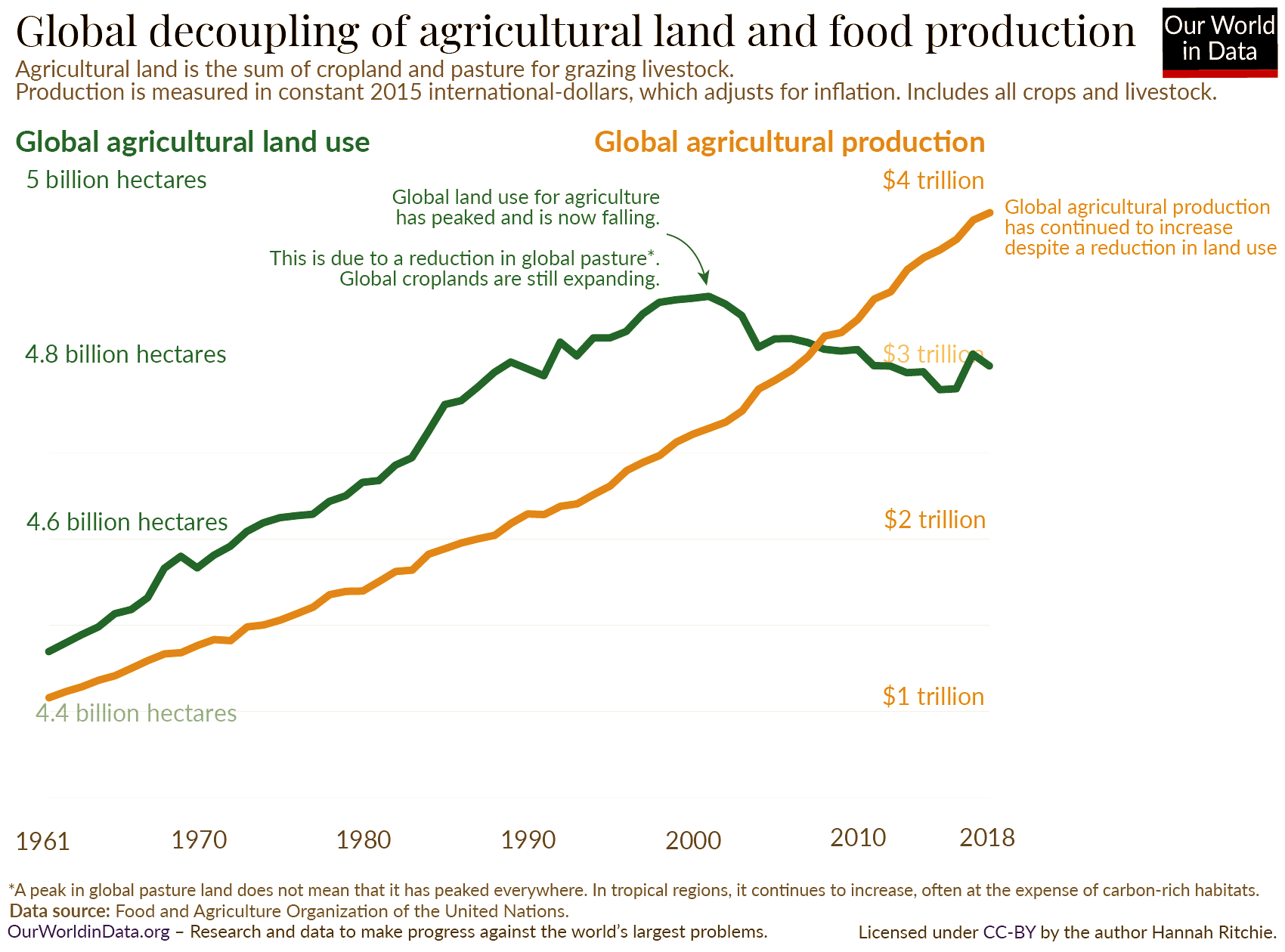
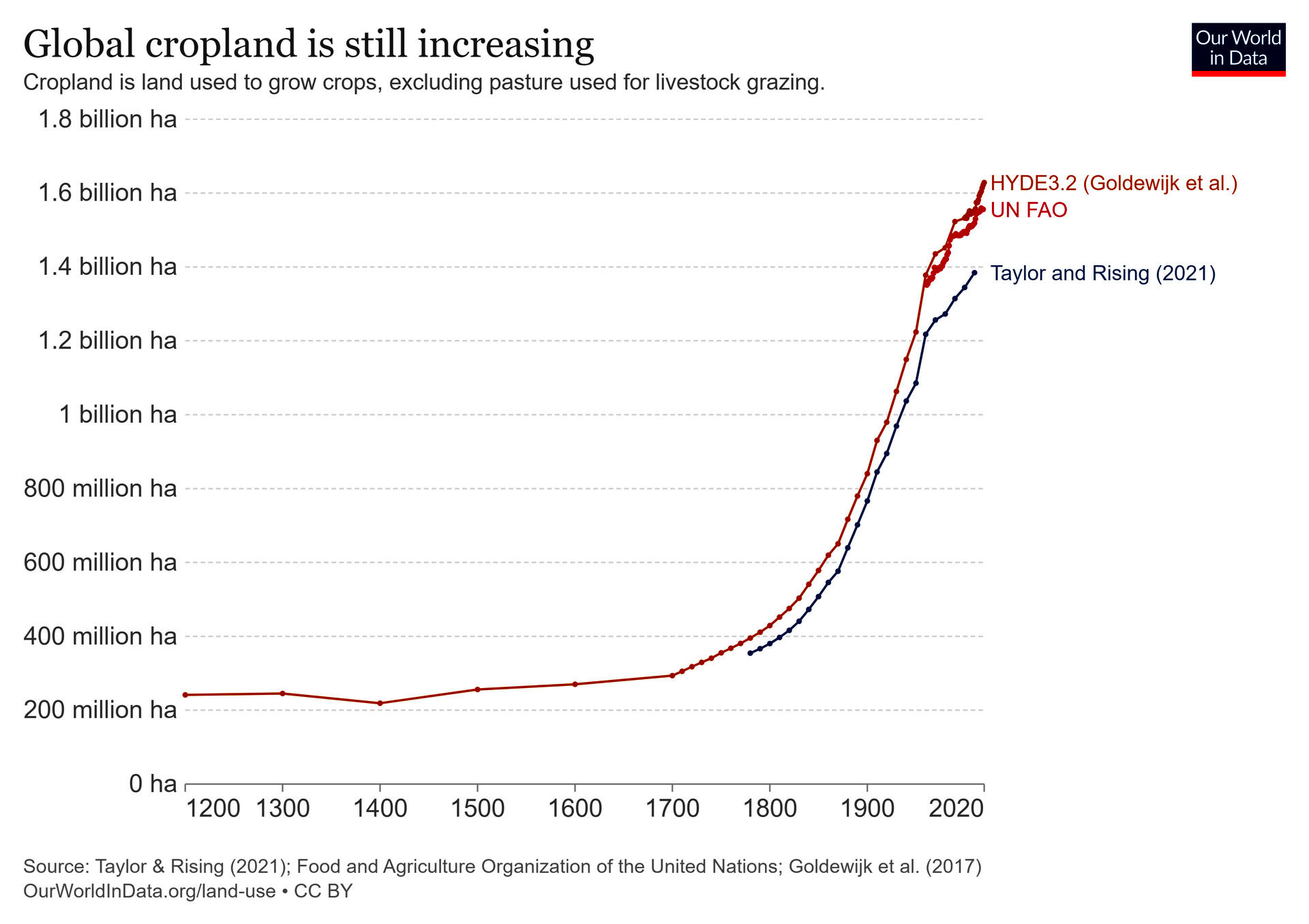
After millennia of agricultural land expansion overall land-use for agriculture reached about half of all global arable land. Over the last two decades total global land use for agriculture has however been
declining while still producing more crops and livestock as shown below. There are however a few catches to these numbers and there is no guarantee that this trend will continue. Croplands are still expanding globally and reductions in pastureland have occurr ed mainly in arid and temperate regions due livestock farming intensification (e.g. indoors), while it is still growing in tropical regions. Part of the growth in crop land is the result of the increased demand for feed crops for livestock (meat and dairy), that is no longer grazed but fed indoors.
Between 1961 and 2006, yield losses due to droughts and changes in precipitation and droughts were estimated at
25%. As the world warms faster, the number of misharvests increases, freshwater gets scarcer, seas are rising and average agricultural yields and livestock productivity decrease. World food demand is projected to have increased by 50% in 2050 so demand for food and feed cropland will increase and more tropical forests and wild grass lands disappear, unless we further decouple food production from land.
Besides deforestation and climate impacts there are more reasons to decouple food from land-use. For crossing at least
4 of the 6 planet boundaries our food systems are the biggest culprit. Agriculture uses
70%
of global freshwater withdrawals, causes
80-90%
of deforestation,
78%
of global ocean and freshwater eutrophication, most of all land degradation and biodiversity losses and about
30-40%
of all emissions (land-use, agriculture, transport, processing, transport, storage, distribution, waste).
Future food security and planetary health therefore depend on a combination of more sustainable agricultural practices, relocating crop farming to the most suitable land and decoupling part of the world's proteins, carbs, vitamines, meats and dairy production from land by moving it into bio-refineries where the can produced using a fraction of land and other resources. More sustainable openfield food production will in most cases result into declining yields per ha, which in turn leads to more land-use unless yield differences are offset by either concentration food production on more suitable lands or indoor production. We therefore focus here on the last two options.
A recent estimate for relocating current croplands to optimal locations, whilst allowing ecosystems in then-abandoned areas to regenerate, could simultaneously decrease the current carbon, biodiversity, and irrigation water footprint of global crop production by 71%, 87%, and 100%, respectively, assuming high-input farming on newly established sites as shown below. The total worldwide area used for agriculture in the optimised scenario would be less than half (48%) of the current area and overlaps with only 0.2% of areas classified as tropical forest biomes, representing a reduction of 98% in the tropical forest area that is currently being used for crop production. As moving agricultural production, and thus labour and capital, across national borders poses political and socio-economic challenges that may be difficult to resolve in the near future the authors repeated their analysis whilst requiring that, in the optimised scenario, the total production of each crop in each country remain identical to the one at present.
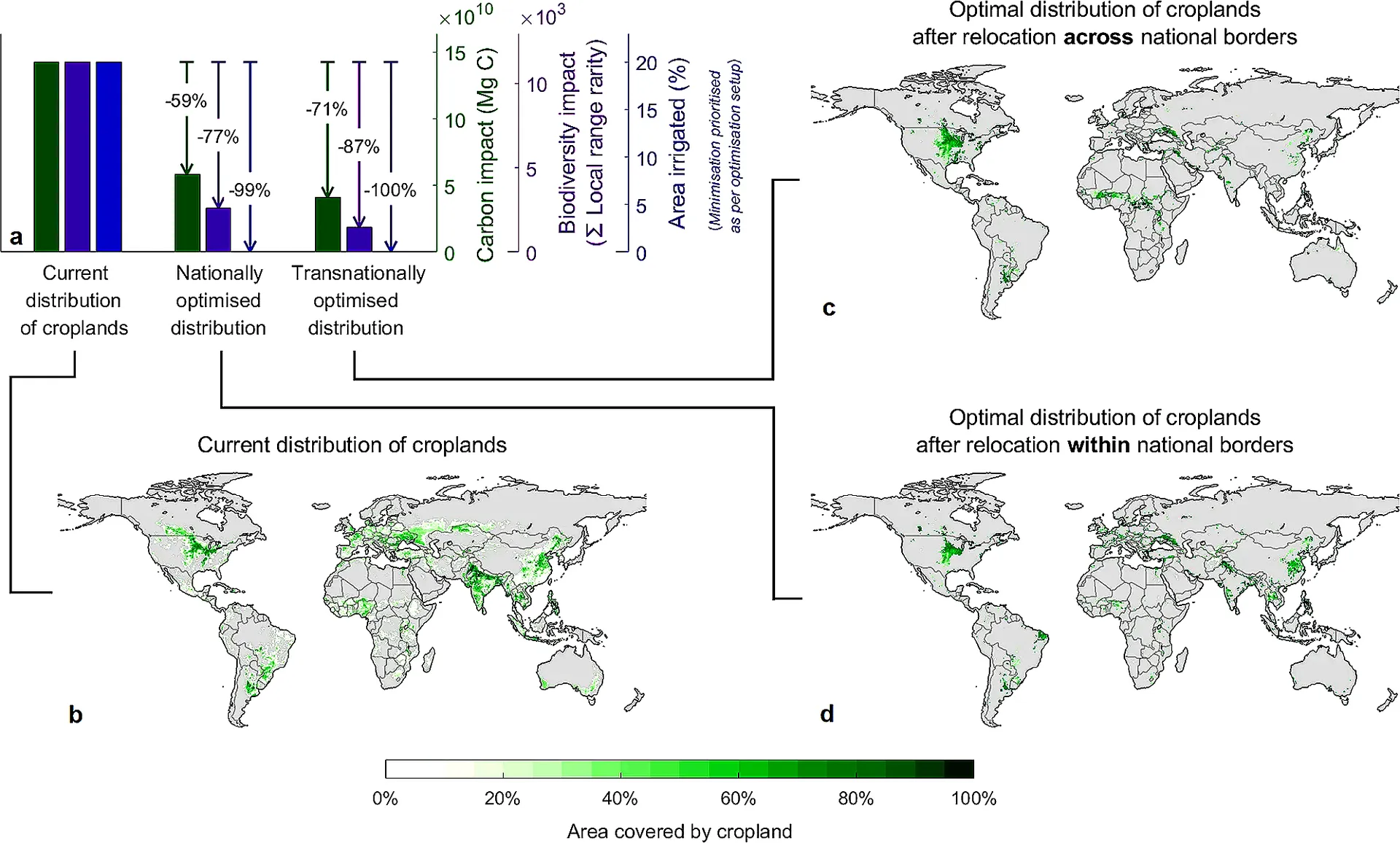
Assuming high-input crop management on relocated sites, the authors estimate that if each country independently optimised its distribution of croplands, the resulting worldwide carbon and biodiversity impacts would be 59% and 77% lower than they are currently. The vast majority of production, corresponding to 99.4% of global croplands, could be nationally relocated so that rainfall provides sufficient water supply; however, some countries produce crops for which natural agro-ecological conditions within their borders are not suitable, and thus some irrigation or greenhouse cultivation remains needed to maintain the current national production levels of each crop.
Development of livestock production in many parts of the world has shown to be growing more towards an industrialised type of farm animal rearing operations. These involve raising farm animals in densely populated environment, commonly termed as a factory livestock farming. Factory livestock requires far less rangeland but has more negative effects than just increased demand for feed crops. Poor living conditions and hygiene for livestock,
amplified impact of diseases due to the high density, genetic proximity, increased immunodeficiency, and live transport of farmed animals.
Centralization of food production however causeClimate change has already affected livestock production, both directly through heat stress affecting animal mortality and productivity, and indirectly through effects on grassland, species distribution and diseases.
ADVANCING SUSTAINABLE BIOENERGY DEVELOPMENT
New, advanced technologies make it possible to produce climate neutral fuels from non-forest and non-food energy crops. The benefits of cultivation and use of these energy crops for transport fuels and electricity goes beyond the benefits of reducing greenhouse gas emissions. Terrestrial energy crop cultivation and aquatic energy crop harvesting reverses land and water degradation, increases biodiversity and carbon sequestration and improves land fertility. We call this
Deep Green Biomass. Moreover, deploying these energy crops for the production of advanced biofuels will positively impact social-economic structures and energy independence and reduce the need for involuntary migration and deforestation: Deep Green Energy.
Deep Green Energy Partners works to accelerate deployment of deep green biomass for the production of advanced biofuels and biochemicals, to restore soil and water conditions and to optimize the overall ecological-economic effects of investments in the energy transition.
FROM OPEN FIELD TO INDOOR FOOD & FEED
Indoor food production uses three main techniques: greenhouse for fruits and vegetables (soil based and soil-less), indoor meat production (cultured real meats, animal cells grown in bioreactors) and fermentation for a range of products. Fermentation comes in different forms, traditional (for e.g. cheese, beer, wine and tempeh), plant fermentation for food additives (e.g. vitamines, proteins, flavor, cosmetics, ) and microbal precision fermentation (or cell-factories) for additives and substitutes (e.g. proteins, real meats components, fats and carbohydrates) made from microorganisms. Hybrid products combine various plant-based and cultured ingredients to develop tasty, sustainable products that can replace animal sourced meats.
All indoor food techniques are taken place in a more or less controlled environments, decrease average land-use and water consumption as well as emissions vis-a-vis open field farming or concentrated indoor livestock farming. Emissions from agriculture account for 24-26% of all emissions and the total food supply chain causes 37% of all emissions of which most comes from livestock. Global food-miles account for nearly 20% of total food-systems emissions if all upstream emissions are included. Vegetable and fruits account for 36% of all food transport emissions allthough they account for only
ADVANCING SUSTAINABLE BIOENERGY DEVELOPMENT
New, advanced technologies make it possible to produce climate neutral fuels from non-forest and non-food energy crops. The benefits of cultivation and use of these energy crops for transport fuels and electricity goes beyond the benefits of reducing greenhouse gas emissions. Terrestrial energy crop cultivation and aquatic energy crop harvesting reverses land and water degradation, increases biodiversity and carbon sequestration and improves land fertility. We call this
Deep Green Biomass. Moreover, deploying these energy crops for the production of advanced biofuels will positively impact social-economic structures and energy independence and reduce the need for involuntary migration and deforestation: Deep Green Energy.
Deep Green Energy Partners works to accelerate deployment of deep green biomass for the production of advanced biofuels and biochemicals, to restore soil and water conditions and to optimize the overall ecological-economic effects of investments in the energy transition.
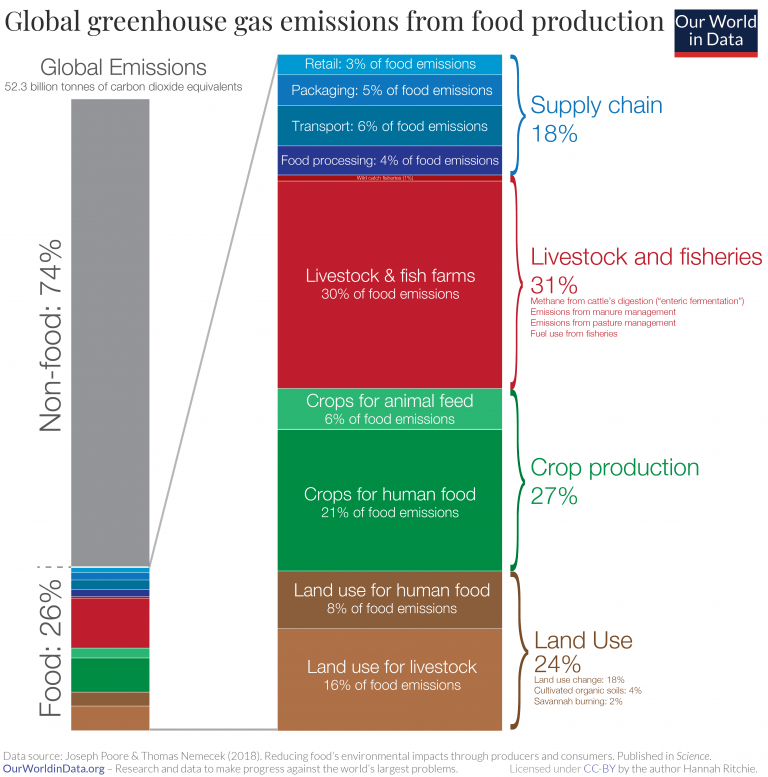
Livestock & fish farming account for 31% of all food system emissions and for two thirds of all agriculture land use. Crop production accounts for 27% of all food emissions, of which 21% comes from crop production for direct human consumption, and 6% comes from the production of crops for animal feed (already included for livestock). Land use accounts for 24% of food emissions. Twice as many emissions result from land use for livestock (16%) as for crops for human consumption (8%). Supply chains account for 18% of food emissions. Food processing (converting produce from the farm into final products), transport, refrigerating, packaging and retail all require energy and resource inputs. If we would allocate the supply chain emissions to crops and livestock production, livestock would account to around 60-65% of all greenhouse gas emissions from our food supply system. Beef production cause of 41% of all deforestation, palm oil and soybeans are responsible for 18%.
ADVANCING SUSTAINABLE BIOENERGY DEVELOPMENT
New, advanced technologies make it possible to produce climate neutral fuels from non-forest and non-food energy crops. The benefits of cultivation and use of these energy crops for transport fuels and electricity goes beyond the benefits of reducing greenhouse gas emissions. Terrestrial energy crop cultivation and aquatic energy crop harvesting reverses land and water degradation, increases biodiversity and carbon sequestration and improves land fertility. We call this
Deep Green Biomass. Moreover, deploying these energy crops for the production of advanced biofuels will positively impact social-economic structures and energy independence and reduce the need for involuntary migration and deforestation: Deep Green Energy.
Deep Green Energy Partners works to accelerate deployment of deep green biomass for the production of advanced biofuels and biochemicals, to restore soil and water conditions and to optimize the overall ecological-economic effects of investments in the energy transition.
As the livestock supply chain is responsible for more than 60% of all agricultural emissions and demand for meat and dairy is expected to grow stronger than that for other foods (between 1970 and 2020 global livestock quadrupled). Meat production for protein is extremely inefficient: 77% off all agricultural is used for livestock grazing and animal feed crops while in only produces .... of our proteins. Indoor non-animal meat production could avoid part of today's annual deforestation, 5 million hectares of which 95% of this occurs in the tropics. It could also reduce the 1.75 billion tonnes of annual animal waste and reduces the resources needed for feed production including 75% of global maize production, a third of all grains, and two thirds of all soya, as well as 20% of freshwater withdrawals.
ADVANCING SUSTAINABLE BIOENERGY DEVELOPMENT
New, advanced technologies make it possible to produce climate neutral fuels from non-forest and non-food energy crops. The benefits of cultivation and use of these energy crops for transport fuels and electricity goes beyond the benefits of reducing greenhouse gas emissions. Terrestrial energy crop cultivation and aquatic energy crop harvesting reverses land and water degradation, increases biodiversity and carbon sequestration and improves land fertility. We call this
Deep Green Biomass. Moreover, deploying these energy crops for the production of advanced biofuels will positively impact social-economic structures and energy independence and reduce the need for involuntary migration and deforestation: Deep Green Energy.
Deep Green Energy Partners works to accelerate deployment of deep green biomass for the production of advanced biofuels and biochemicals, to restore soil and water conditions and to optimize the overall ecological-economic effects of investments in the energy transition.
CULTURED (CELL BASED) MEATS
Meat, as we know it can be cultivated in a petri dish providing the same nutrients as its animal grown counter parts. Cultured meat (also referred to as cell-based meat, cultivated meat, artificial meat, clean meat, labgrown meat or in-vitro meat) are animal cells grown in cell culture in bioreactors, as opposed to on an animal. Stem cells acquired from animals are grown in bioreactors in an oxygen-rich cell culture medium. They go through maturation and differentiation into the skeletal muscle, fat, or connective tissues that make up meat. The differentiated cells are then harvested, prepared and packaged into final products where the layers or sheets of animal cells that are produced need assembly into a 3D structure (in depth analysis go to link). Cultured meat and seafood is made of the same cell types arranged in the same or similar structure as animal tissues, thus replicating the sensory and nutritional profiles of conventional meat and therefore has the potential to be a "meat identical substitute".
ADVANCING SUSTAINABLE BIOENERGY DEVELOPMENT
New, advanced technologies make it possible to produce climate neutral fuels from non-forest and non-food energy crops. The benefits of cultivation and use of these energy crops for transport fuels and electricity goes beyond the benefits of reducing greenhouse gas emissions. Terrestrial energy crop cultivation and aquatic energy crop harvesting reverses land and water degradation, increases biodiversity and carbon sequestration and improves land fertility. We call this
Deep Green Biomass. Moreover, deploying these energy crops for the production of advanced biofuels will positively impact social-economic structures and energy independence and reduce the need for involuntary migration and deforestation: Deep Green Energy.
Deep Green Energy Partners works to accelerate deployment of deep green biomass for the production of advanced biofuels and biochemicals, to restore soil and water conditions and to optimize the overall ecological-economic effects of investments in the energy transition.
ADVANCING SUSTAINABLE BIOENERGY DEVELOPMENT
New, advanced technologies make it possible to produce climate neutral fuels from non-forest and non-food energy crops. The benefits of cultivation and use of these energy crops for transport fuels and electricity goes beyond the benefits of reducing greenhouse gas emissions. Terrestrial energy crop cultivation and aquatic energy crop harvesting reverses land and water degradation, increases biodiversity and carbon sequestration and improves land fertility. We call this
Deep Green Biomass. Moreover, deploying these energy crops for the production of advanced biofuels will positively impact social-economic structures and energy independence and reduce the need for involuntary migration and deforestation: Deep Green Energy.
Deep Green Energy Partners works to accelerate deployment of deep green biomass for the production of advanced biofuels and biochemicals, to restore soil and water conditions and to optimize the overall ecological-economic effects of investments in the energy transition.
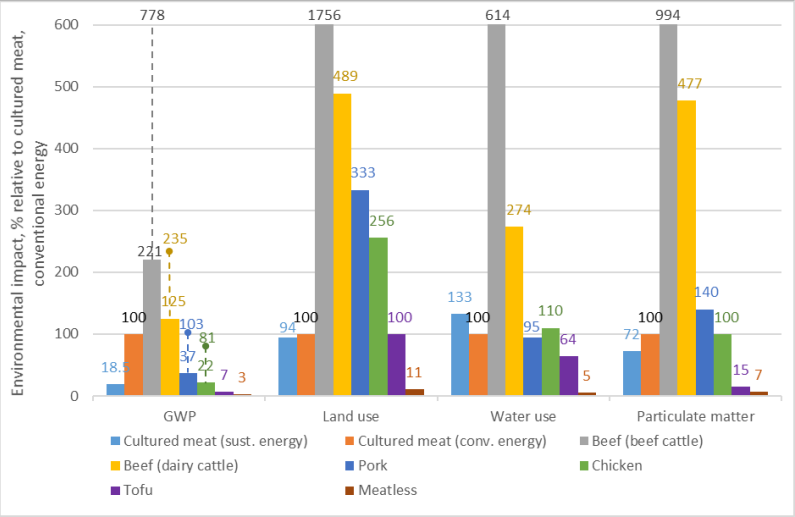
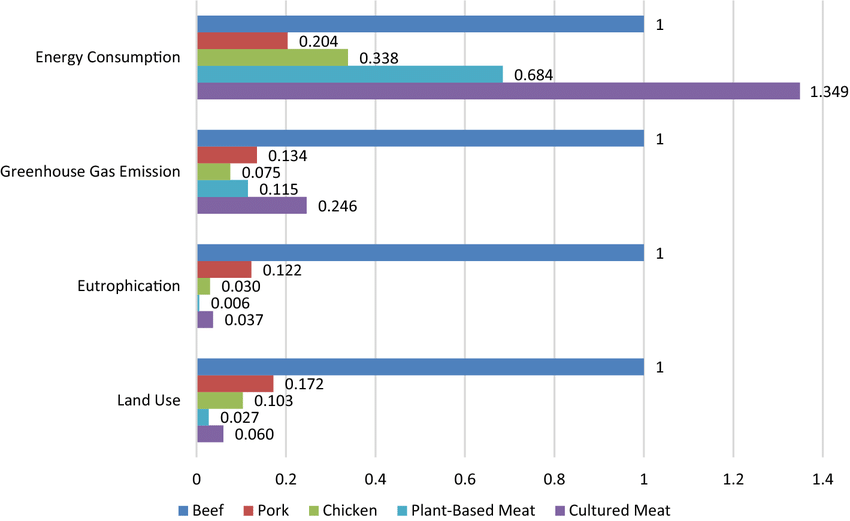
Cultured meats can be healthier and contain higher nutritional density as they are produced in controlled environments where supplements can be added (e.g.
vitamin B12 and iron) to the complex of growth ingredients. Compared to beef the environmental benefits are considerable, energy use is however the major downside of cultured meat as shown on the left. Replicating all of the features (taste, colour, smell, texture, cooking properties) of conventional animal meat using cultured meat processes is challenging and various the essential elements for full substitution such as fat, colour, flavour and mouthfeel/juiciness still need development or enhancement by the other non-animal based elements.
ADVANCING SUSTAINABLE BIOENERGY DEVELOPMENT
New, advanced technologies make it possible to produce climate neutral fuels from non-forest and non-food energy crops. The benefits of cultivation and use of these energy crops for transport fuels and electricity goes beyond the benefits of reducing greenhouse gas emissions. Terrestrial energy crop cultivation and aquatic energy crop harvesting reverses land and water degradation, increases biodiversity and carbon sequestration and improves land fertility. We call this
Deep Green Biomass. Moreover, deploying these energy crops for the production of advanced biofuels will positively impact social-economic structures and energy independence and reduce the need for involuntary migration and deforestation: Deep Green Energy.
Deep Green Energy Partners works to accelerate deployment of deep green biomass for the production of advanced biofuels and biochemicals, to restore soil and water conditions and to optimize the overall ecological-economic effects of investments in the energy transition.
The first cultured meat products have been approved and are available in Singapore and cultured meats will improve and develop fast, but substitution rates will depend on cost, feel and available production capacity. The last is an important bottleneck as cultured meats have relatively long cultivation times of about 30-40 days and fermenter capacity is scarce. Cultured meat products are principally aimed at replacing steaks, caviar, salmon, ground meat, etc. and is therefore a good alternative for consumers who want to be more sustainable and can afford it but do not wish to change their diet. Products from cellular fermentation can replace the same but are also a sustainable substitute for current protein additives in food or protein source for feed as discussed below.
ADVANCING SUSTAINABLE BIOENERGY DEVELOPMENT
New, advanced technologies make it possible to produce climate neutral fuels from non-forest and non-food energy crops. The benefits of cultivation and use of these energy crops for transport fuels and electricity goes beyond the benefits of reducing greenhouse gas emissions. Terrestrial energy crop cultivation and aquatic energy crop harvesting reverses land and water degradation, increases biodiversity and carbon sequestration and improves land fertility. We call this
Deep Green Biomass. Moreover, deploying these energy crops for the production of advanced biofuels will positively impact social-economic structures and energy independence and reduce the need for involuntary migration and deforestation: Deep Green Energy.
Deep Green Energy Partners works to accelerate deployment of deep green biomass for the production of advanced biofuels and biochemicals, to restore soil and water conditions and to optimize the overall ecological-economic effects of investments in the energy transition.
MICROBIAL (PRECISSION) FERMENTATION: MEATS, DAIRY AND OTHER FOODS
The concept of using microorganisms as both food and feed (cellular fermentation) is at least several centuries old and has some unique properties that make it a promising alternative to conventional sources of food and feed (for in depth explanation of microbial food and feed go to link). Microorganisms such as bacteria, yeast and fungi and their enzymes are already widely used in food and feed for improving the taste, texture or nutrients. Microbial enzymes are the preferred source to plants or animals to produce protein, lipids and carbohydrates and various other food substances due to several advantages such as easy, cost-effective, time-efficient and consistent production.
Microorganism use carbon(dioxide), light or chemical energy and a variety of simple organic feedstocks such as sugars, alcohols, organic acids and hydrocarbons to produce organic protein, carbohydrates, lipids, vitamins, nucleic acids and minerals. It has high quantity of essential amino acid like methionine and lysine in different concentrations and compositions. Precision fermentation involves turning microorganisms into mini-factories producing more specific enzymes, or ingredient specific material. Depending on the base components that are put together with the microorganism, it builds (“ferments”) the desired molecule from those components in brewery-style fermentation tanks, e.g edible fats, genuine animal proteins or starch that are biologically similar to animal and plant products. These end products can be further processed into ingredients or direct consumables e.g. milk, ice cream, real organic or hybrid meats, pancakes, pasta or bread.
ADVANCING SUSTAINABLE BIOENERGY DEVELOPMENT
New, advanced technologies make it possible to produce climate neutral fuels from non-forest and non-food energy crops. The benefits of cultivation and use of these energy crops for transport fuels and electricity goes beyond the benefits of reducing greenhouse gas emissions. Terrestrial energy crop cultivation and aquatic energy crop harvesting reverses land and water degradation, increases biodiversity and carbon sequestration and improves land fertility. We call this
Deep Green Biomass. Moreover, deploying these energy crops for the production of advanced biofuels will positively impact social-economic structures and energy independence and reduce the need for involuntary migration and deforestation: Deep Green Energy.
Deep Green Energy Partners works to accelerate deployment of deep green biomass for the production of advanced biofuels and biochemicals, to restore soil and water conditions and to optimize the overall ecological-economic effects of investments in the energy transition.
Microorganisms can be cultivated on a variety of simple organic feedstocks such as sugars, alcohols, organic acids and hydrocarbons.
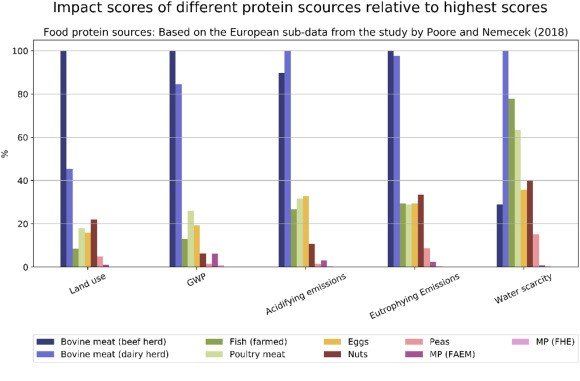
Microbial cultures grow very quickly and are quite robust. Some cultures grow as much as 75 times faster than mammalian cells, and starch made from microbal cultures convert CO2 to starch plants about 8.5 times faster as corn plants. One hectare of land could theoretically have an annual output of 4.1–4.9 Mt. of dry bacterial biomass. In comparison, the average US soybean yield in 2017 was 3.3 t wet weight per hectare. On the right the environmental impacts of various protein sources are compared to illustrate the environmental advantages of microbial sourced food vis-a-vis animal and plant sourced food. The advantages are impressive using both renewable energy, MP (FHE) and a standardized energy mix MP (FAEM).
In closed production systems there are practically no
eutrophication,
emissions,
acidification
or
pollution
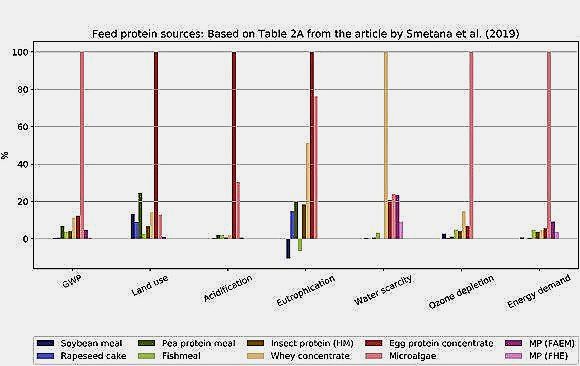
effects, but that doesn't apply to emissions from external resources used in the production process. In the figure below various protein sources for feed are compared including energy demand. Microbal protein has a 53–100% lower environmental impacts than animal-based food protein sources. The two factors that influence this percentage the most are energy and the type of microbes used. Some microbes are autotrophs (self-feeding) and able to obtain carbon directly from carbon dioxide (CO2) or methane (CH4) and manufacture complex organic molecules from simple inorganic compounds (water, CO2, nutrients). Hydrogen-oxidizing bacteria can do the same by utilizing both hydrogen and carbon dioxide, while other microbes e.g. microalgae require nutrients such as phosphorus and nitrogen for growth.
ADVANCING SUSTAINABLE BIOENERGY DEVELOPMENT
New, advanced technologies make it possible to produce climate neutral fuels from non-forest and non-food energy crops. The benefits of cultivation and use of these energy crops for transport fuels and electricity goes beyond the benefits of reducing greenhouse gas emissions. Terrestrial energy crop cultivation and aquatic energy crop harvesting reverses land and water degradation, increases biodiversity and carbon sequestration and improves land fertility. We call this
Deep Green Biomass. Moreover, deploying these energy crops for the production of advanced biofuels will positively impact social-economic structures and energy independence and reduce the need for involuntary migration and deforestation: Deep Green Energy.
Deep Green Energy Partners works to accelerate deployment of deep green biomass for the production of advanced biofuels and biochemicals, to restore soil and water conditions and to optimize the overall ecological-economic effects of investments in the energy transition.
ADVANCING SUSTAINABLE BIOENERGY DEVELOPMENT
New, advanced technologies make it possible to produce climate neutral fuels from non-forest and non-food energy crops. The benefits of cultivation and use of these energy crops for transport fuels and electricity goes beyond the benefits of reducing greenhouse gas emissions. Terrestrial energy crop cultivation and aquatic energy crop harvesting reverses land and water degradation, increases biodiversity and carbon sequestration and improves land fertility. We call this
Deep Green Biomass. Moreover, deploying these energy crops for the production of advanced biofuels will positively impact social-economic structures and energy independence and reduce the need for involuntary migration and deforestation: Deep Green Energy.
Deep Green Energy Partners works to accelerate deployment of deep green biomass for the production of advanced biofuels and biochemicals, to restore soil and water conditions and to optimize the overall ecological-economic effects of investments in the energy transition.
Energy demand for MP is 0.03–25 times that of other feed protein depending on microbe, feedstock and process. Most of energy is used for electricity and heating/cooling and as shown on the right the GWP (global warming impact) varies from minimal to extreme depending whether renewable or a standardized energy mix is used for production. Electricity consumption is the main factor determining the environmental impacts of microbial proteins. Out of all renewables energy crop sourced energy
has the unique potential to turn the whole production process carbon neutral as well as providing the required CO2. Energy crops can also provide the necessary sustainable biomass when biowaste or other sources are (too) contaminated or not available.
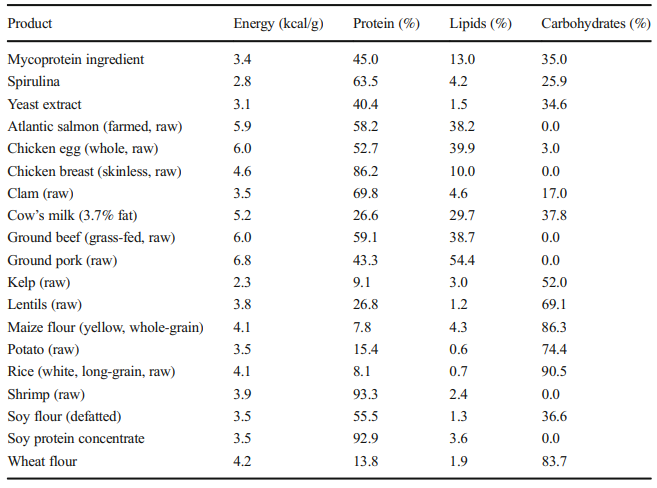
In the table on the left the basic nutritional properties of microbial food products are compared to a selection of basic foodstuffs. All values are given in reference to dry weight. A
1500 m³,
60 meters tall and 7–11 meters wide cultivation tank has an annual output of 50–60 kilo tonnes of dry bacterial biomass. This would roughly translate to 413–496 tonnes of dry microbial biomass/m²/year, if discounting the surrounding area that would be required for downstream processing infrastructure. One hectare of land could theoretically house 82 such vessels and would have a combined annual output of 4.1–4.9 million tonnes of dry bacterial biomass. In comparison, the average US soybean yield in 2017 was 3.3 tonnes wet weight per hectare.
ADVANCING SUSTAINABLE BIOENERGY DEVELOPMENT
New, advanced technologies make it possible to produce climate neutral fuels from non-forest and non-food energy crops. The benefits of cultivation and use of these energy crops for transport fuels and electricity goes beyond the benefits of reducing greenhouse gas emissions. Terrestrial energy crop cultivation and aquatic energy crop harvesting reverses land and water degradation, increases biodiversity and carbon sequestration and improves land fertility. We call this
Deep Green Biomass. Moreover, deploying these energy crops for the production of advanced biofuels will positively impact social-economic structures and energy independence and reduce the need for involuntary migration and deforestation: Deep Green Energy.
Deep Green Energy Partners works to accelerate deployment of deep green biomass for the production of advanced biofuels and biochemicals, to restore soil and water conditions and to optimize the overall ecological-economic effects of investments in the energy transition.
Current global food production is ultimately constrained by the rate at which atmospheric CO2 is converted into edible biomass (plants and animals) through photosynthesis. Industrial CO2-to-microbial biomass combined with CO2-to-energy crops biomass conversion presents a radically different strategy to circumvent the current global boundaries for food production and environmental damages.
ADVANCING SUSTAINABLE BIOENERGY DEVELOPMENT
New, advanced technologies make it possible to produce climate neutral fuels from non-forest and non-food energy crops. The benefits of cultivation and use of these energy crops for transport fuels and electricity goes beyond the benefits of reducing greenhouse gas emissions. Terrestrial energy crop cultivation and aquatic energy crop harvesting reverses land and water degradation, increases biodiversity and carbon sequestration and improves land fertility. We call this
Deep Green Biomass. Moreover, deploying these energy crops for the production of advanced biofuels will positively impact social-economic structures and energy independence and reduce the need for involuntary migration and deforestation: Deep Green Energy.
Deep Green Energy Partners works to accelerate deployment of deep green biomass for the production of advanced biofuels and biochemicals, to restore soil and water conditions and to optimize the overall ecological-economic effects of investments in the energy transition.
PLANT BASED SUBSTITUTES ANIMAL MEATS AND DAIRY
Many sorts of plant-based meat and dairy alternatives, e.g. plant-burgers, tempeh-chicken or soy-milk are already available on the market.
The production process in general involves the same three steps: (i) plant proteins are extracted (ii) these proteins are mixed with other ingredients such as food adhesives, plant-based fat and flour (iii) the mixture is processed to create a layered texture that mimics the fibrous structure of meat. This flexibility in nutrients and sources makes that some plant based alternatives near the taste and structure of meat better than others. Moreover, unlike for meat there is no ''natural" connection between nutrient values and product name. Plant based meat substitutes use substantial less energy than the original.
ADVANCING SUSTAINABLE BIOENERGY DEVELOPMENT
New, advanced technologies make it possible to produce climate neutral fuels from non-forest and non-food energy crops. The benefits of cultivation and use of these energy crops for transport fuels and electricity goes beyond the benefits of reducing greenhouse gas emissions. Terrestrial energy crop cultivation and aquatic energy crop harvesting reverses land and water degradation, increases biodiversity and carbon sequestration and improves land fertility. We call this
Deep Green Biomass. Moreover, deploying these energy crops for the production of advanced biofuels will positively impact social-economic structures and energy independence and reduce the need for involuntary migration and deforestation: Deep Green Energy.
Deep Green Energy Partners works to accelerate deployment of deep green biomass for the production of advanced biofuels and biochemicals, to restore soil and water conditions and to optimize the overall ecological-economic effects of investments in the energy transition.
Hybrid products in which cultured meat and precision fermented organic erases taste differences, optimize nutrient balances and plant based substitutes provide structure and additional nutrients might well deliver tasty and healthy foods faster than we think.
ADVANCING SUSTAINABLE BIOENERGY DEVELOPMENT
New, advanced technologies make it possible to produce climate neutral fuels from non-forest and non-food energy crops. The benefits of cultivation and use of these energy crops for transport fuels and electricity goes beyond the benefits of reducing greenhouse gas emissions. Terrestrial energy crop cultivation and aquatic energy crop harvesting reverses land and water degradation, increases biodiversity and carbon sequestration and improves land fertility. We call this
Deep Green Biomass. Moreover, deploying these energy crops for the production of advanced biofuels will positively impact social-economic structures and energy independence and reduce the need for involuntary migration and deforestation: Deep Green Energy.
Deep Green Energy Partners works to accelerate deployment of deep green biomass for the production of advanced biofuels and biochemicals, to restore soil and water conditions and to optimize the overall ecological-economic effects of investments in the energy transition.
INDOOR FARMING: FRUITS & VEGETABLES
ADVANCING SUSTAINABLE BIOENERGY DEVELOPMENT
New, advanced technologies make it possible to produce climate neutral fuels from non-forest and non-food energy crops. The benefits of cultivation and use of these energy crops for transport fuels and electricity goes beyond the benefits of reducing greenhouse gas emissions. Terrestrial energy crop cultivation and aquatic energy crop harvesting reverses land and water degradation, increases biodiversity and carbon sequestration and improves land fertility. We call this
Deep Green Biomass. Moreover, deploying these energy crops for the production of advanced biofuels will positively impact social-economic structures and energy independence and reduce the need for involuntary migration and deforestation: Deep Green Energy.
Deep Green Energy Partners works to accelerate deployment of deep green biomass for the production of advanced biofuels and biochemicals, to restore soil and water conditions and to optimize the overall ecological-economic effects of investments in the energy transition.
Climate change is already reducing average yields for most of the major vegetables. Moreover, increasing temperatures, reduced irrigation-water availability, flooding, and salinity will be the major limiting factors in sustaining and increasing vegetable productivity.
Under changing climatic situations crop failures, shortage of yields, reduction in quality and increasing pest and disease problems are common rendering vegetable production increasingly unprofitable. The impact of climate change on fruit crops is likely to be even more detrimental as compared to field crops
as the adaptation capacity of shorter duration crops is generally greater than perennials. Climate change affects fruit crops in their different phases of growth and development such as fruit sunburn, inadequate pollination, delayed ripening, reduced color development, low sugar content, poor fruit quality and fruit set, low fruit yield and reduced panicle emergence.
Fruit and vegetable production will therefore either move indoors or perish in many parts of the world. Forced or unforced, indoor vegetable and fruit is climate resilient and location independent and produces more healthy and tasty food as ideal conditions can be created. Indoor yields are multiple times higher per hectare, water use can be regulated according to scarcity and the use and leakage of fertilizer can be minimize. Energy use and associated emissions of indoor farming have the strongest environmental impacts.
ADVANCING SUSTAINABLE BIOENERGY DEVELOPMENT
New, advanced technologies make it possible to produce climate neutral fuels from non-forest and non-food energy crops. The benefits of cultivation and use of these energy crops for transport fuels and electricity goes beyond the benefits of reducing greenhouse gas emissions. Terrestrial energy crop cultivation and aquatic energy crop harvesting reverses land and water degradation, increases biodiversity and carbon sequestration and improves land fertility. We call this
Deep Green Biomass. Moreover, deploying these energy crops for the production of advanced biofuels will positively impact social-economic structures and energy independence and reduce the need for involuntary migration and deforestation: Deep Green Energy.
Deep Green Energy Partners works to accelerate deployment of deep green biomass for the production of advanced biofuels and biochemicals, to restore soil and water conditions and to optimize the overall ecological-economic effects of investments in the energy transition.
ADVANCING SUSTAINABLE BIOENERGY DEVELOPMENT
New, advanced technologies make it possible to produce climate neutral fuels from non-forest and non-food energy crops. The benefits of cultivation and use of these energy crops for transport fuels and electricity goes beyond the benefits of reducing greenhouse gas emissions. Terrestrial energy crop cultivation and aquatic energy crop harvesting reverses land and water degradation, increases biodiversity and carbon sequestration and improves land fertility. We call this
Deep Green Biomass. Moreover, deploying these energy crops for the production of advanced biofuels will positively impact social-economic structures and energy independence and reduce the need for involuntary migration and deforestation: Deep Green Energy.
Deep Green Energy Partners works to accelerate deployment of deep green biomass for the production of advanced biofuels and biochemicals, to restore soil and water conditions and to optimize the overall ecological-economic effects of investments in the energy transition.
INDOOR FARMING - YIELDS
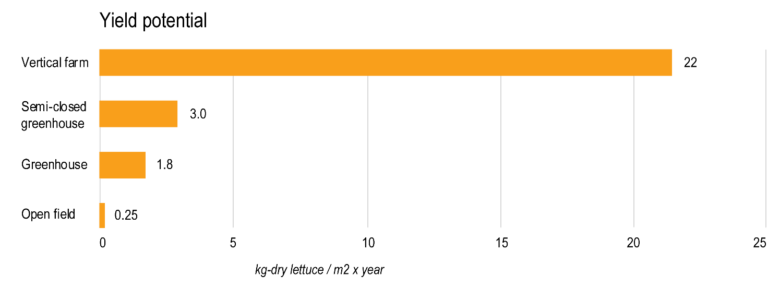
Yields in greenhouse systems are generally far higher than in traditional field production systems. The extended growing season for crops allows them to disproportionately contribute to global production relative to their small footprint. Certain varieties of plants, particularly leafy greens and Asian cabbages, can produce up to 12 harvests per year in a greenhouse system as opposed to one or two annual yields in outdoor fields.
ADVANCING SUSTAINABLE BIOENERGY DEVELOPMENT
New, advanced technologies make it possible to produce climate neutral fuels from non-forest and non-food energy crops. The benefits of cultivation and use of these energy crops for transport fuels and electricity goes beyond the benefits of reducing greenhouse gas emissions. Terrestrial energy crop cultivation and aquatic energy crop harvesting reverses land and water degradation, increases biodiversity and carbon sequestration and improves land fertility. We call this
Deep Green Biomass. Moreover, deploying these energy crops for the production of advanced biofuels will positively impact social-economic structures and energy independence and reduce the need for involuntary migration and deforestation: Deep Green Energy.
Deep Green Energy Partners works to accelerate deployment of deep green biomass for the production of advanced biofuels and biochemicals, to restore soil and water conditions and to optimize the overall ecological-economic effects of investments in the energy transition.
As shown above, vertical farms can produce 88 times the amount of lettuce cultivated on open field on the same area. Lettuce is the most used benchmark in production comparisons is it can be grown in open fields all greenhouse variaties. But e.g tomato yields also show impressive differences: yields in Somalia are about 1 tonne/ha vis-a-vis 560 tonnes/ha in Dutch greenhouses.
Greenhouse cultivation can be either be soil-based or soil-less.
The yields of soil-less cultivation systems are generally much higher than those of soil-based systems due to more precise levels of control for nutrient delivery, oxygenation, pH, and temperature control. Perennial crops, because of their basic biology, are generally only grown in soil-based cropping systems, whereas most annual crops can also be cultivated using soil-free techniques like
hydroponics. Annual plants grown using soil-free techniques in closed systems has significant advantages over traditional soil-based systems as it enables closed recirculating of water, fertilizer and energy. Moreover it avoids eutrophication, the use of pesticides, cuts out the time, distance and costs of refrigerated food trucks and warehouses adding weeks of shelf life.
ADVANCING SUSTAINABLE BIOENERGY DEVELOPMENT
New, advanced technologies make it possible to produce climate neutral fuels from non-forest and non-food energy crops. The benefits of cultivation and use of these energy crops for transport fuels and electricity goes beyond the benefits of reducing greenhouse gas emissions. Terrestrial energy crop cultivation and aquatic energy crop harvesting reverses land and water degradation, increases biodiversity and carbon sequestration and improves land fertility. We call this
Deep Green Biomass. Moreover, deploying these energy crops for the production of advanced biofuels will positively impact social-economic structures and energy independence and reduce the need for involuntary migration and deforestation: Deep Green Energy.
Deep Green Energy Partners works to accelerate deployment of deep green biomass for the production of advanced biofuels and biochemicals, to restore soil and water conditions and to optimize the overall ecological-economic effects of investments in the energy transition.
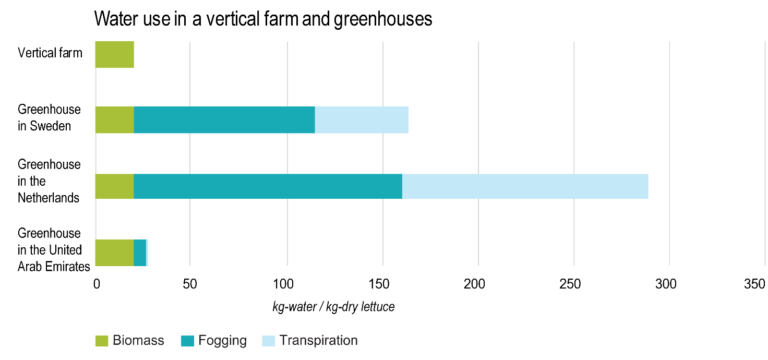
INDOOR FARMING - WATER CONSUMPTION
ADVANCING SUSTAINABLE BIOENERGY DEVELOPMENT
New, advanced technologies make it possible to produce climate neutral fuels from non-forest and non-food energy crops. The benefits of cultivation and use of these energy crops for transport fuels and electricity goes beyond the benefits of reducing greenhouse gas emissions. Terrestrial energy crop cultivation and aquatic energy crop harvesting reverses land and water degradation, increases biodiversity and carbon sequestration and improves land fertility. We call this
Deep Green Biomass. Moreover, deploying these energy crops for the production of advanced biofuels will positively impact social-economic structures and energy independence and reduce the need for involuntary migration and deforestation: Deep Green Energy.
Deep Green Energy Partners works to accelerate deployment of deep green biomass for the production of advanced biofuels and biochemicals, to restore soil and water conditions and to optimize the overall ecological-economic effects of investments in the energy transition.
Vertical farms are assumed to be closed systems in terms of water use while in greenhouses the rate of ventilation has a high impact on water use. In other words, in VF all the water put into the system is converting to biomass while in greenhouses part of the water consumes to fogging and transpiration. In greenhouses the water use seems to depend highly on the location: Greenhouses in Sweden and the Netherlands use fogging as a cooling method instead of an air conditioner and the humidity level in the greenhouse is managed with ventilation. In the United Arab Emirates water is scarcer and is not used for cooling.
ADVANCING SUSTAINABLE BIOENERGY DEVELOPMENT
New, advanced technologies make it possible to produce climate neutral fuels from non-forest and non-food energy crops. The benefits of cultivation and use of these energy crops for transport fuels and electricity goes beyond the benefits of reducing greenhouse gas emissions. Terrestrial energy crop cultivation and aquatic energy crop harvesting reverses land and water degradation, increases biodiversity and carbon sequestration and improves land fertility. We call this
Deep Green Biomass. Moreover, deploying these energy crops for the production of advanced biofuels will positively impact social-economic structures and energy independence and reduce the need for involuntary migration and deforestation: Deep Green Energy.
Deep Green Energy Partners works to accelerate deployment of deep green biomass for the production of advanced biofuels and biochemicals, to restore soil and water conditions and to optimize the overall ecological-economic effects of investments in the energy transition.
We will have to increase food production with 35-50% by 2050 to feed the growing world population. To asses if and how this can be done simultaneously with land restoration the Dutch PBL has developed three scenarios for meeting the world need for food and land restoration without substitution of part of land-based food production by the new, soil-less food technologies.
ADVANCING SUSTAINABLE BIOENERGY DEVELOPMENT
New, advanced technologies make it possible to produce climate neutral fuels from non-forest and non-food energy crops. The benefits of cultivation and use of these energy crops for transport fuels and electricity goes beyond the benefits of reducing greenhouse gas emissions. Terrestrial energy crop cultivation and aquatic energy crop harvesting reverses land and water degradation, increases biodiversity and carbon sequestration and improves land fertility. We call this
Deep Green Biomass. Moreover, deploying these energy crops for the production of advanced biofuels will positively impact social-economic structures and energy independence and reduce the need for involuntary migration and deforestation: Deep Green Energy.
Deep Green Energy Partners works to accelerate deployment of deep green biomass for the production of advanced biofuels and biochemicals, to restore soil and water conditions and to optimize the overall ecological-economic effects of investments in the energy transition.
INDOOR FARMING - EMISSIONS
Emissions
from open field and indoor farming systems are dependent on various variables including transport distances, operating practices and the energy sources used throughout the system as shown on the right. Energy inputs are the highest source of CO2eq emissions in all systems except in those cases where food is farmed open field close to the end-consumer. Unless renewable energy is used in transport the proximity of production location to end-user markets transport is a decisive factor for emissions of all systems. Depending on the use of renewable or fossil energy in the actual production proces vertical farming and advanced greenhouse farming produce could be either low or extremely emitting. In the end the choice for a particular production technique will depend on the availability and cost of water, land, renewable energy, CO2 as growth feedstock, and supply and quality security. As land and water become scarcer, supply security diminishes while demand is growing, indoor farming will grow irrespective of climate impacts.
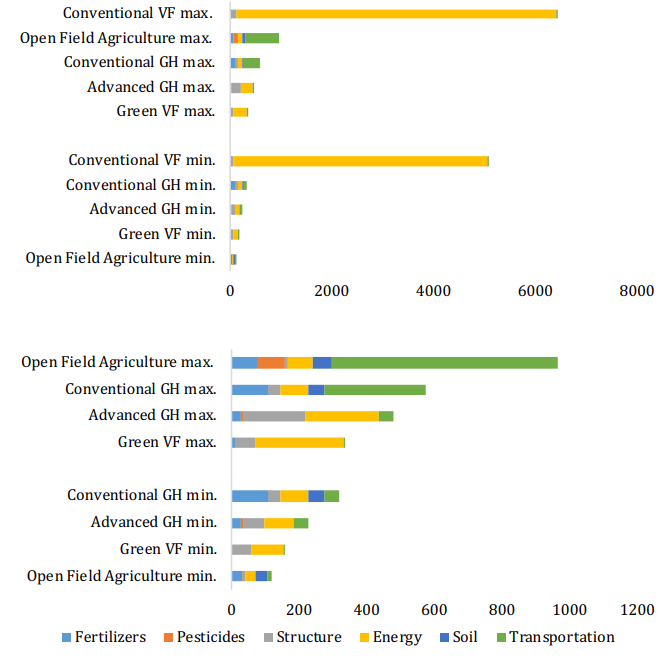
ADVANCING SUSTAINABLE BIOENERGY DEVELOPMENT
New, advanced technologies make it possible to produce climate neutral fuels from non-forest and non-food energy crops. The benefits of cultivation and use of these energy crops for transport fuels and electricity goes beyond the benefits of reducing greenhouse gas emissions. Terrestrial energy crop cultivation and aquatic energy crop harvesting reverses land and water degradation, increases biodiversity and carbon sequestration and improves land fertility. We call this
Deep Green Biomass. Moreover, deploying these energy crops for the production of advanced biofuels will positively impact social-economic structures and energy independence and reduce the need for involuntary migration and deforestation: Deep Green Energy.
Deep Green Energy Partners works to accelerate deployment of deep green biomass for the production of advanced biofuels and biochemicals, to restore soil and water conditions and to optimize the overall ecological-economic effects of investments in the energy transition.
A reliable supply of renewable energy and CO2 will be essential for reliable and sustainable indoor farming. Both can be provided by energy crop based electricity. There will be some trade-off as energy crops (crops, pellets, gas or liquids) will have to be transported but these are largely off-set by the reduction of more emissions intensive refrigerated transport of vegetables and fruits, the carbon soil sequestration by energy crops. but can be understood by considering that emissions are the result of the interplay maritime shipping (0.01–0.02 kgCO2e tkm−1) versus land and sutrade-off rapidly a reliable and sufficient renewable energy and CO2 supply rade-off between cost and market road transport, which in turn features a much higher emission intensity per tkm than shipping (0.2–0.66 kgCO2e tkm−1)
f distances, modes and refrigeration needs. Switching to local sup-ply reduces long-distance food transportation, which relies heav-ily on maritime shipping (0.01–0.02 kgCO2e tkm−1), but increases domestic food supply dominated by road transport, which in turn features a much higher emission intensity per tkm than shipping (0.2–0.66 kgCO2e tkm−1)
The focus in (a)cellular food technologies is often meat as meat production causes most of agricultural emissions, about 7 Gt/y and uses 3 billion hectares of land. But acellular food production is however not limited to meat but provide dairy, fats, carbohydrates and vitamines of which some are already part of our foods. Replacing traditional produced meat, dairy, rice and wheat by cellular and acellular produced substitutes is the only option for meeting future demand and it will directly eliminate methane and nitrogen emissions from the food system.
It will also leave billions of hectares of land in danger of falling prey to abandonment and erosion. This land can however be used for natural carbon sequestration by less demanding plants that can provide the CO2 and electricity for (a)cellular and (vertical) greenhouse farming or other purposes: carbon and energy farming. Thus (a)cellular food technologies turn the relation of land-use for food, feed, forests and fuels from competition to complimentary and from self-destructive to restorative.
ADVANCING SUSTAINABLE BIOENERGY DEVELOPMENT
New, advanced technologies make it possible to produce climate neutral fuels from non-forest and non-food energy crops. The benefits of cultivation and use of these energy crops for transport fuels and electricity goes beyond the benefits of reducing greenhouse gas emissions. Terrestrial energy crop cultivation and aquatic energy crop harvesting reverses land and water degradation, increases biodiversity and carbon sequestration and improves land fertility. We call this
Deep Green Biomass. Moreover, deploying these energy crops for the production of advanced biofuels will positively impact social-economic structures and energy independence and reduce the need for involuntary migration and deforestation: Deep Green Energy.
Deep Green Energy Partners works to accelerate deployment of deep green biomass for the production of advanced biofuels and biochemicals, to restore soil and water conditions and to optimize the overall ecological-economic effects of investments in the energy transition.
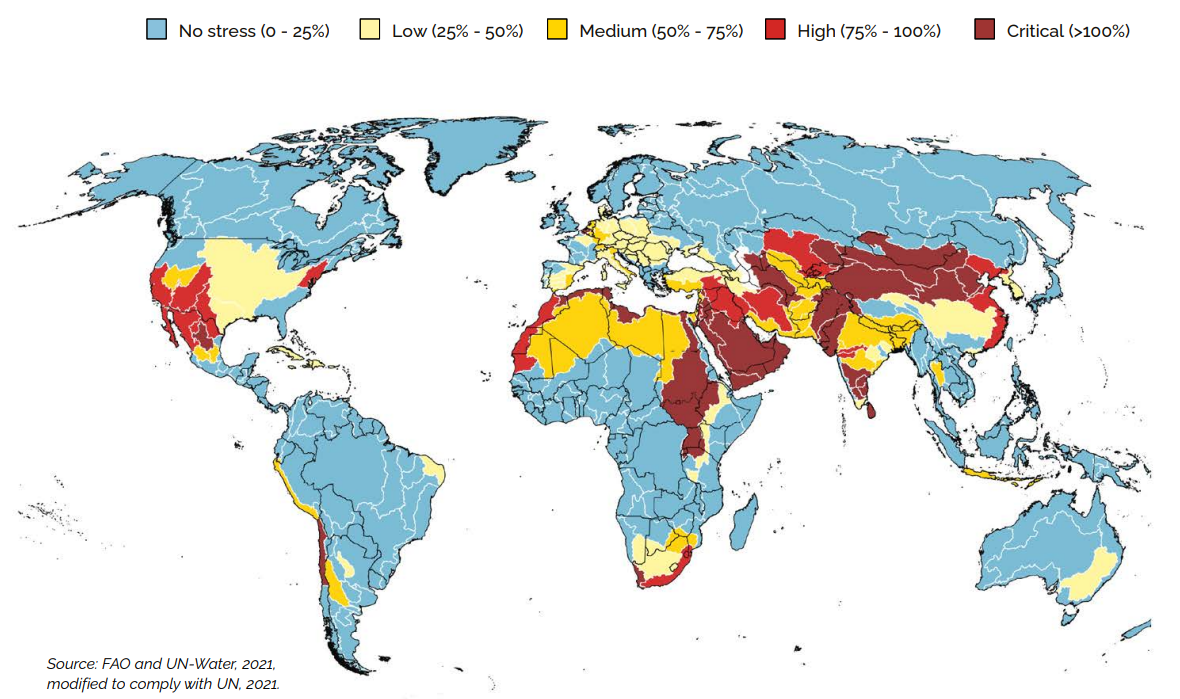
NASA, and many others predict that climate change may affect the production of maize (corn) and wheat as early as 2030 under a high greenhouse gas emissions scenario. Average global crop yields for maize, or corn, may see a decrease of 24% by late century, if current climate change trends continue. Wheat, in contrast, may see an uptick in crop yields by about 17%. The change in yields is due to the projected increases in temperature, shifts in rainfall patterns and elevated surface carbon dioxide concentrations due to human-caused greenhouse gas emissions, making it more difficult to grow maize in the tropics and expanding wheat’s growing range. IPCC, 2019: Summary for Policymakers. In: Climate Change and Land: an IPCC special report on climate change, desertification, land degradation, sustainable land management, food security, and greenhouse gas fluxes in terrestrial ecosystems
ADVANCING SUSTAINABLE BIOENERGY DEVELOPMENT
New, advanced technologies make it possible to produce climate neutral fuels from non-forest and non-food energy crops. The benefits of cultivation and use of these energy crops for transport fuels and electricity goes beyond the benefits of reducing greenhouse gas emissions. Terrestrial energy crop cultivation and aquatic energy crop harvesting reverses land and water degradation, increases biodiversity and carbon sequestration and improves land fertility. We call this
Deep Green Biomass. Moreover, deploying these energy crops for the production of advanced biofuels will positively impact social-economic structures and energy independence and reduce the need for involuntary migration and deforestation: Deep Green Energy.
Deep Green Energy Partners works to accelerate deployment of deep green biomass for the production of advanced biofuels and biochemicals, to restore soil and water conditions and to optimize the overall ecological-economic effects of investments in the energy transition.
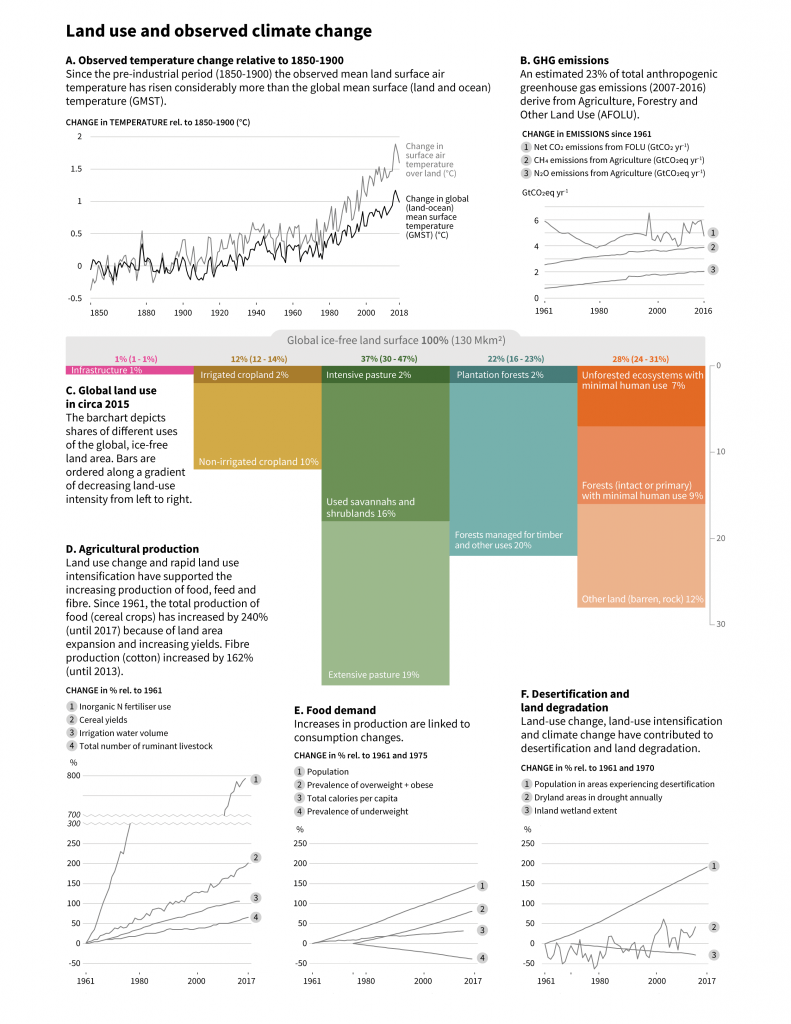
NASA, and many others predict that climate change may affect the production of maize (corn) and wheat as early as 2030 under a high greenhouse gas emissions scenario. Average global crop yields for maize, or corn, may see a decrease of 24% by late century, if current climate change trends continue. Wheat, in contrast, may see an uptick in crop yields by about 17%. The change in yields is due to the projected increases in temperature, shifts in rainfall patterns and elevated surface carbon dioxide concentrations due to human-caused greenhouse gas emissions, making it more difficult to grow maize in the tropics and expanding wheat’s growing range. IPCC, 2019: Summary for Policymakers. In: Climate Change and Land: an IPCC special report on climate change, desertification, land degradation, sustainable land management, food security, and greenhouse gas fluxes in terrestrial ecosystems
ADVANCING SUSTAINABLE BIOENERGY DEVELOPMENT
New, advanced technologies make it possible to produce climate neutral fuels from non-forest and non-food energy crops. The benefits of cultivation and use of these energy crops for transport fuels and electricity goes beyond the benefits of reducing greenhouse gas emissions. Terrestrial energy crop cultivation and aquatic energy crop harvesting reverses land and water degradation, increases biodiversity and carbon sequestration and improves land fertility. We call this
Deep Green Biomass. Moreover, deploying these energy crops for the production of advanced biofuels will positively impact social-economic structures and energy independence and reduce the need for involuntary migration and deforestation: Deep Green Energy.
Deep Green Energy Partners works to accelerate deployment of deep green biomass for the production of advanced biofuels and biochemicals, to restore soil and water conditions and to optimize the overall ecological-economic effects of investments in the energy transition.
Today around 800 million people are undernourished and at current rates half of the world population will be living in water stressed areas by 2050. Land and water systems are at a breaking point and in order to feed the world in 2050 we will have to decouple the growth of food production from land and water demand.
Livestock & fisheries account for 31% of all food system emissions and for two thirds of all agriculture land use. If emissions from land-use and feed crop productions are included this brings the total share to 53%. Crop production accounts for 27% of food emissions. 21% of food emissions comes from crop production for direct human consumption, and 6% comes from the production of crops for animal feed (already included for livestock). Land use accounts for 24% of food emissions. Twice as many emissions result from land use for livestock (16%) as for crops for human consumption (8%). Supply chains account for 18% of food emissions. Food processing (converting produce from the farm into final products), transport, packaging and retail all require energy and resource inputs. If we would allocate the supply chain emissions to crops and livestock production, livestock would account to around two-thirds of all greenhouse gas emissions from agriculture.