
ENERGY
ADVANCING SUSTAINABLE BIOENERGY DEVELOPMENT
New, advanced technologies make it possible to produce climate neutral fuels from non-forest and non-food energy crops. The benefits of cultivation and use of these energy crops for transport fuels and electricity goes beyond the benefits of reducing greenhouse gas emissions. Terrestrial energy crop cultivation and aquatic energy crop harvesting reverses land and water degradation, increases biodiversity and carbon sequestration and improves land fertility. We call this
Deep Green Biomass. Moreover, deploying these energy crops for the production of advanced biofuels will positively impact social-economic structures and energy independence and reduce the need for involuntary migration and deforestation: Deep Green Energy.
Deep Green Energy Partners works to accelerate deployment of deep green biomass for the production of advanced biofuels and biochemicals, to restore soil and water conditions and to optimize the overall ecological-economic effects of investments in the energy transition.
Modular Conversion of the 19.25 Gt/yr Grass Harvest into Drop-In Fuels & Materials (2026–2050)
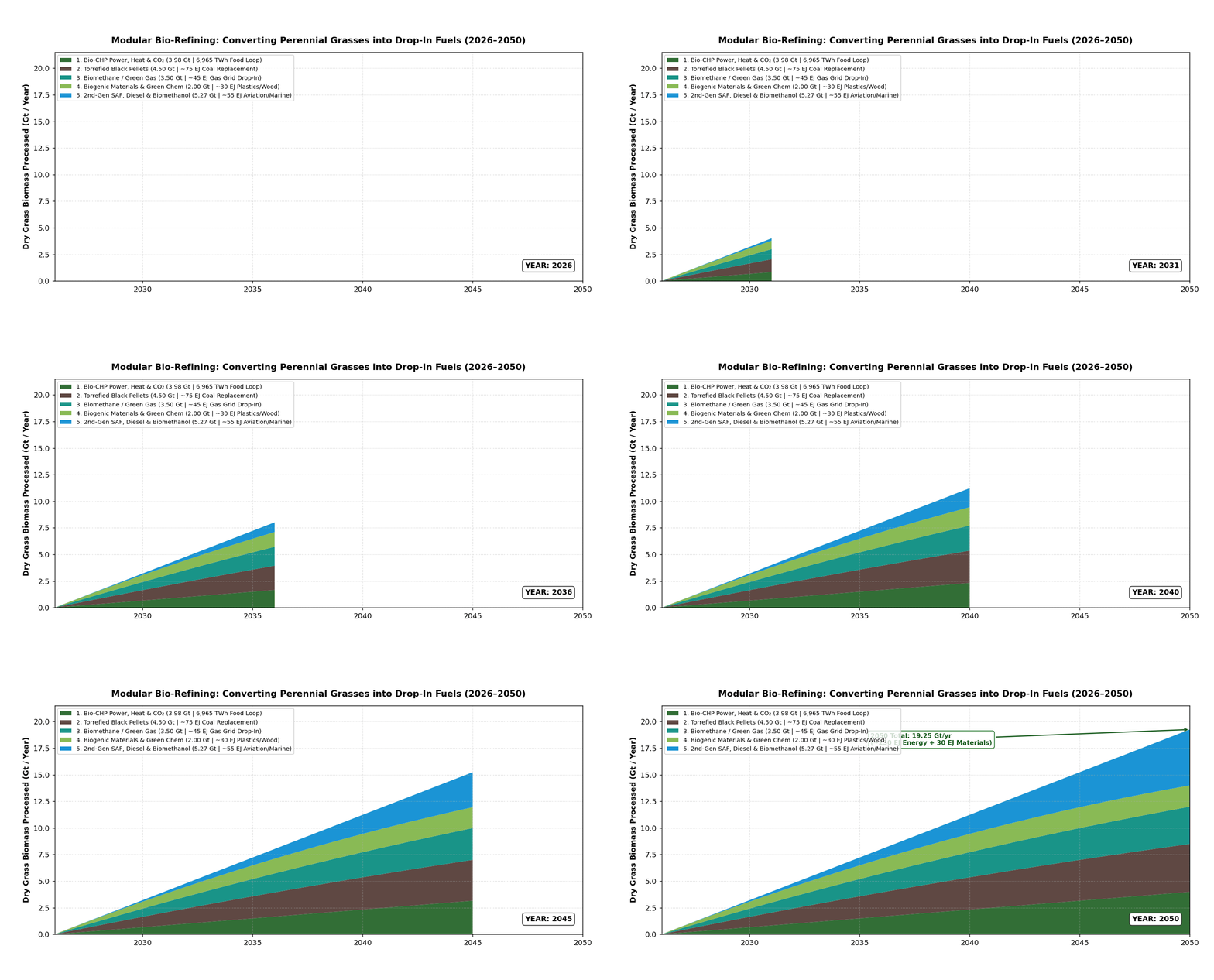
Table: Energy & Conversion Pathway 2050
| 2050 Energy & Conversion Pathway | Grass Input (Gt/yr) | Net Energy Output | Existing Infrastructure Reused (Zero Stranded Assets) | Source |
|---|---|---|---|---|
| 1. Bio-CHP Power & Heat (Food-Energy Loop) TRL 9 | 3.98 Gt/yr
(20.7%) |
6,965 TWh (~25 EJ) | Powers 100% of indoor farms & fermentation tanks; captures 7.0 Gt pure CO₂. | IEA Bioenergy |
| 2. Torrefied Black Pellets TRL 8–9 | 4.50 Gt/yr
(23.4%) |
~75 EJ | Direct drop-in coal replacement in existing coal power stations and steel furnaces. | IRENA |
| 3. Biomethane / Renewable Natural Gas TRL 9 | 3.50 Gt/yr
(18.2%) |
~45 EJ | Injected directly into existing natural gas pipelines for industrial heat & winter backup. | IEA Task 37 |
| 4. 2nd-Gen Liquid Biofuels (SAF, Diesel, Methanol) TRL 7–9 | 5.27 Gt/yr
(27.4%) |
~55 EJ | Powers existing jet turbines (SAF), marine engines (biomethanol), and heavy trucks. | ICAO SAF |
| 5. Biogenic Materials & Green Chemistry TRL 8–9 | 2.00 Gt/yr
(10.4%) |
~30 EJ (material value) | Replaces oil-based plastics, resins, packaging, and commercial forest logging. | nova-Institute |
| Total DGE Bio-Energy & Material Output | 19.25 Gt/yr (100%) | ~230 EJ + 30 EJ mat. | Cuts fossil energy share from ~80% to ~10% and wood fuel from ~8% to ~1.5%. | U.S. DOE |
Table: Primary Energy Source 2050
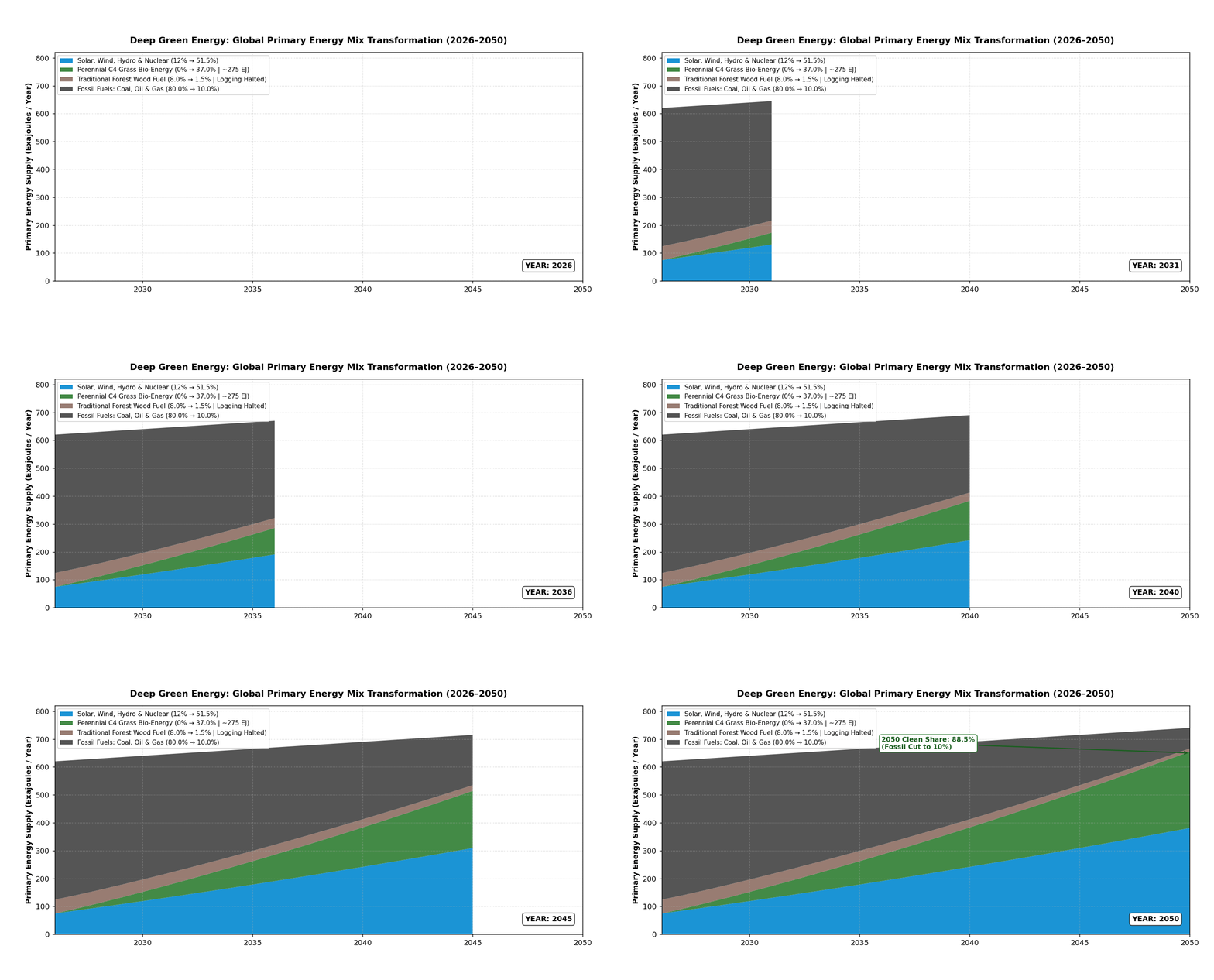
Table: Primary Energy Source 2050
| Primary Energy Source (2050) | 2025/2026 Baseline (~620 EJ) |
Realistic BAU 2050 (~760 EJ) |
Deep Green Energy 2050 (~740 EJ) |
Real-World Feasibility & Strategic Role | Source |
|---|---|---|---|---|---|
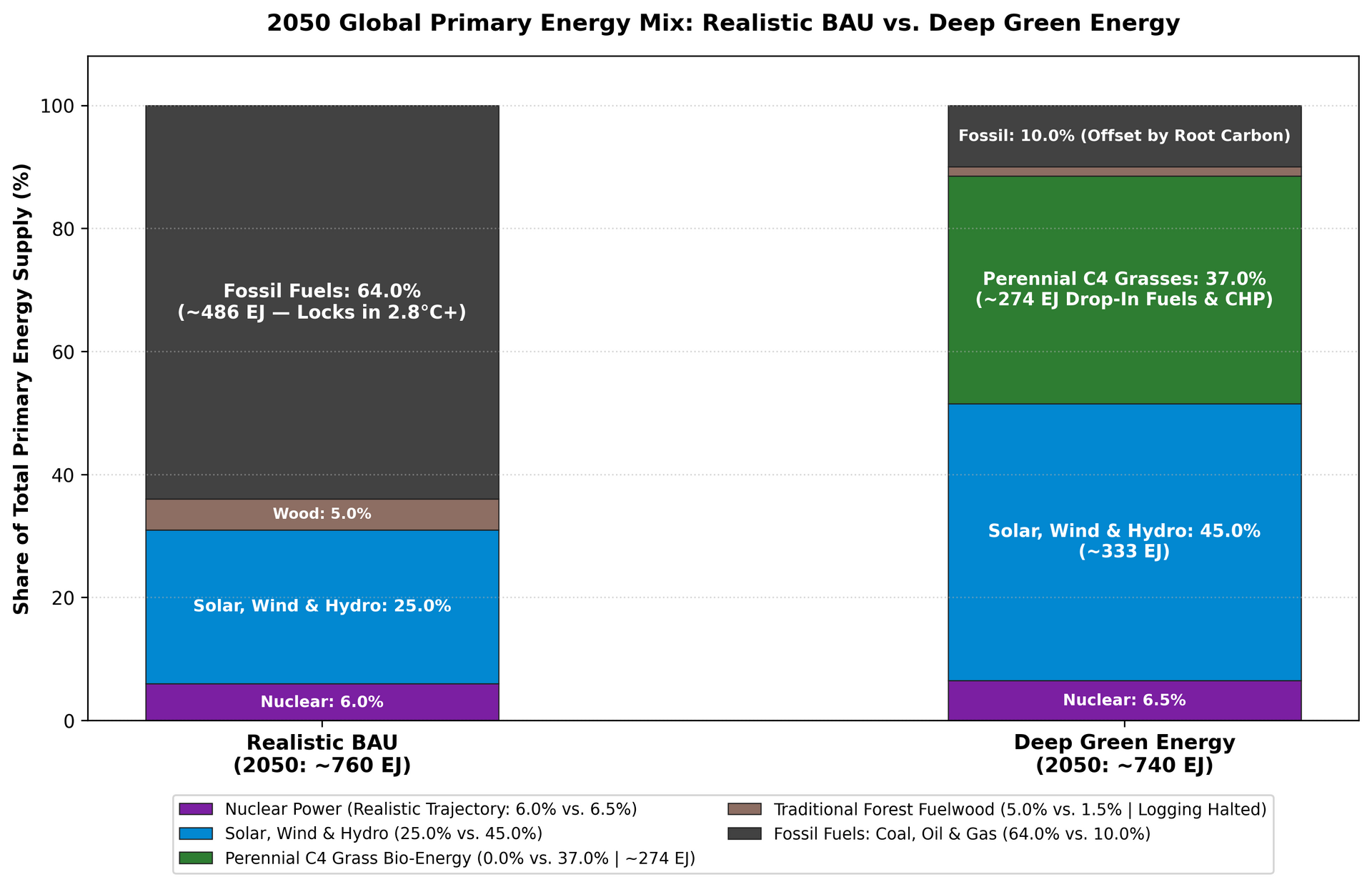
| Fossil Fuels (Coal, Oil & Natural Gas) | 80.0% (496 EJ) | 64.0% (486 EJ) | 10.0% (74 EJ) | -85% reduction: Replaced by drop-in pellets, biomethane, SAF, and biomethanol. | IEA WEO |
| Solar, Wind & Hydro | 7.5% (47 EJ) | 25.0% (190 EJ) | 45.0% (333 EJ) | Captures cost-effective renewable electricity growth without overloading transmission grids. | IRENA |
| Nuclear Power (Existing + SMRs) | 4.5% (28 EJ) | 6.0% (46 EJ) | 6.5% (48 EJ) | Identical to realistic projections: Reflects steady fleet extensions and modular reactors, avoiding utopian build-rate assumptions. | IAEA |
| Perennial C4 Grasses (Miscanthus & Napier) | 0.0% (0 EJ) | 0.0% (0 EJ) | 37.0% (274 EJ) | The missing link: Supplies dispatchable high-temperature heat, aviation/marine fuels, and winter grid backup. | IEA Bioenergy |
| Traditional Fuelwood & Forestry | 8.0% (50 EJ) | 5.0% (38 EJ) | 1.5% (11 EJ) | Halts deforestation: Fast-growing grass harvests replace slow-growing forest logging for cooking and heating. | FAO FRA |
| Natural Capital Balance Sheet Impact
(Climate, Soils & Forests) |
-$5.0 T/yr | -$15.0 T/yr | +$5.5 T/yr | Net ecosystem restoration: Cuts fossil emissions by -85%, halts fuelwood logging & adds +$200T natural capital by 2050. | NGFS/ UN SEEA |
| Total Primary Energy Supply | 100.0% (~620 EJ) | 100.0% (~760 EJ) | 100.0% (~740 EJ) | Full energy security with 90% clean/biogenic share and zero stranded grid or fleet infrastructure. | Carbon Tracker |
Table: DGE energy & Biomass Component
| DGE Energy & Biomass Component | 2050 Physical Scale | Total CAPEX | Annual Cash Flow (EBITDA) | Payback Time | Annual ROI | Source |
|---|---|---|---|---|---|---|
| 1. Perennial Grass Plantations (Miscanthus & Napier) | 855.7 million ha
($2,000/ha establishment) |
$1.71 T | $0.43 T / yr | 4.0 years | 25.0% | U.S. DOE |
| 2. Bio-CHP Power & CO₂ Capture Plants | 885 GW
baseload capacity ($3,000/kW) |
$2.66 T | $0.40 T / yr | 6.7 years | 15.0% | IEA Bioenergy |
| 3. Bio-Refineries (Pellets, Biomethane & Drop-In Fuels) | 15.27 Gt/yr
feedstock processing (~205 EJ) |
$3.80 T | $0.52 T / yr | 7.3 years | 13.7% | IRENA |
| Total DGE Energy & Biomass Module | ~230 EJ clean energy + 27.81 Gt CO₂ impact | $8.17 T | $1.35 T / yr | 6.1 years | 16.5% | IEA WEO |
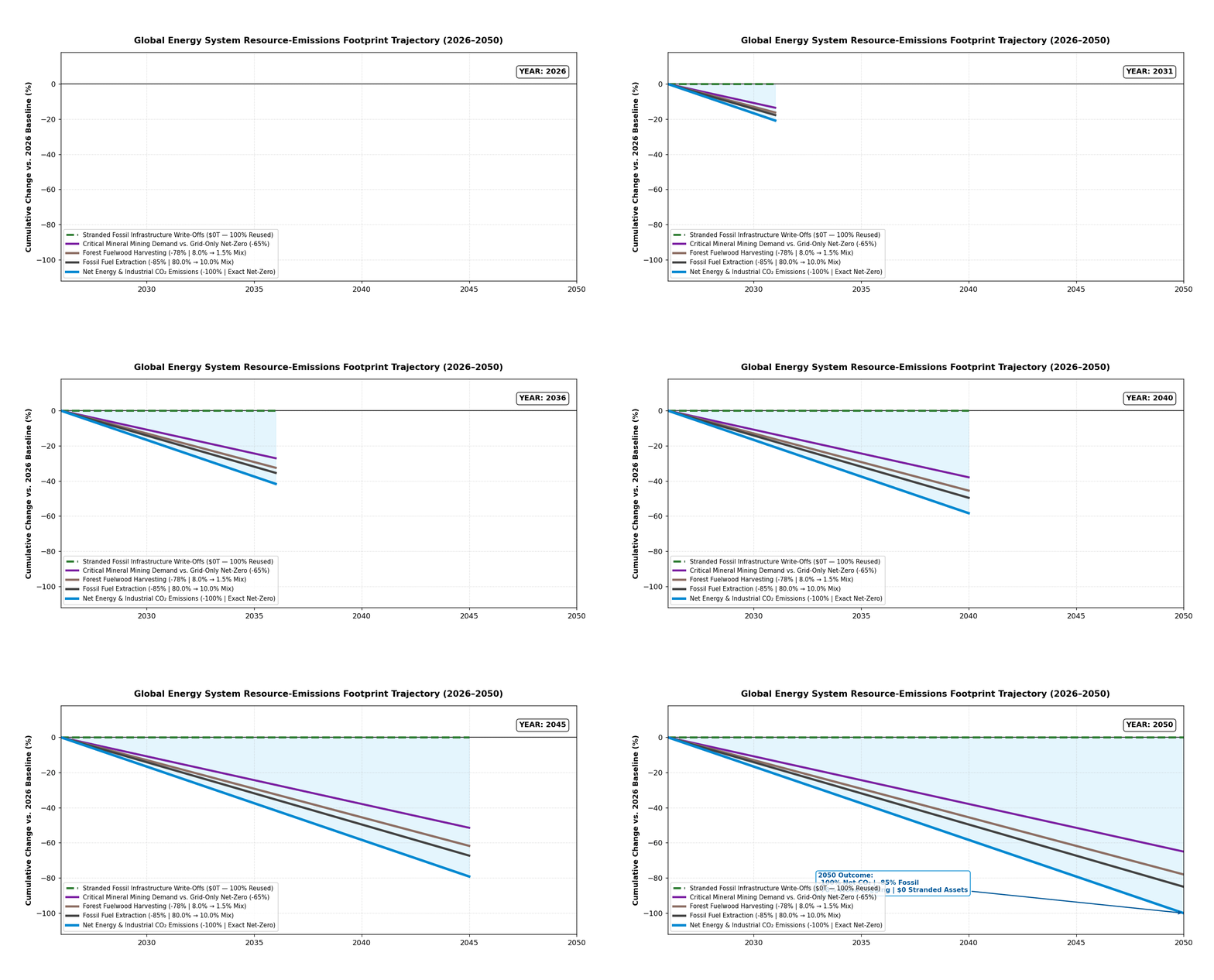
DGE Energy CAPEX, ROI, Payback Time, Write-offs - BAU vs. DGE (2026-2050)
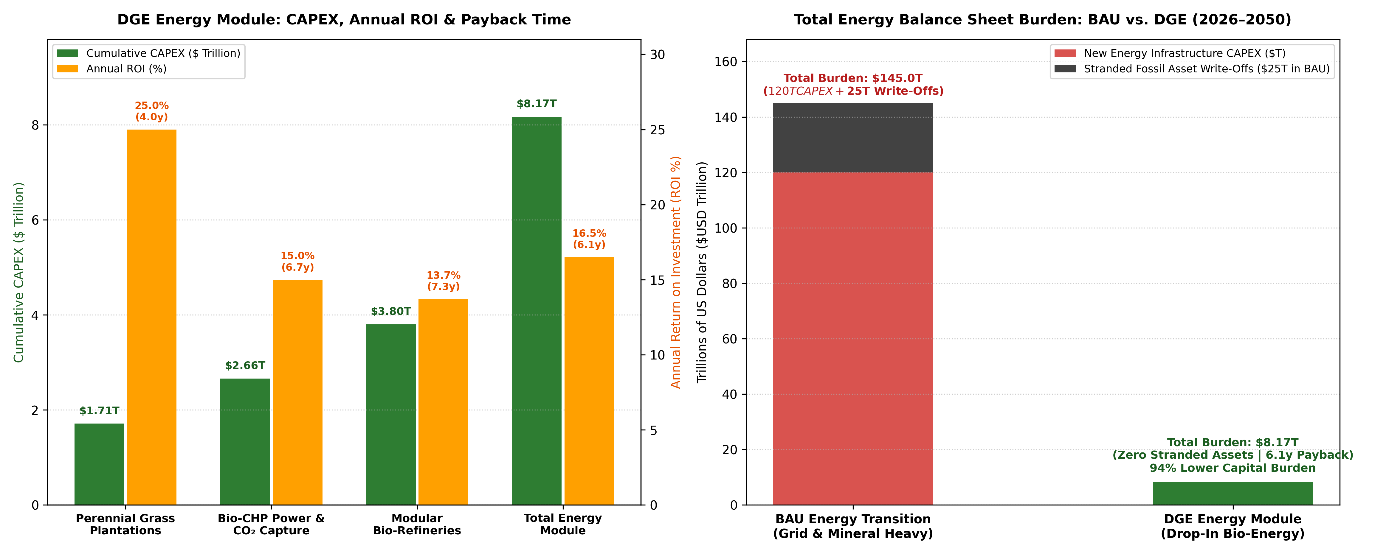
Figure E4: 2050 Primary Energy Mix Comparison - Realistic BAU vs. DGE
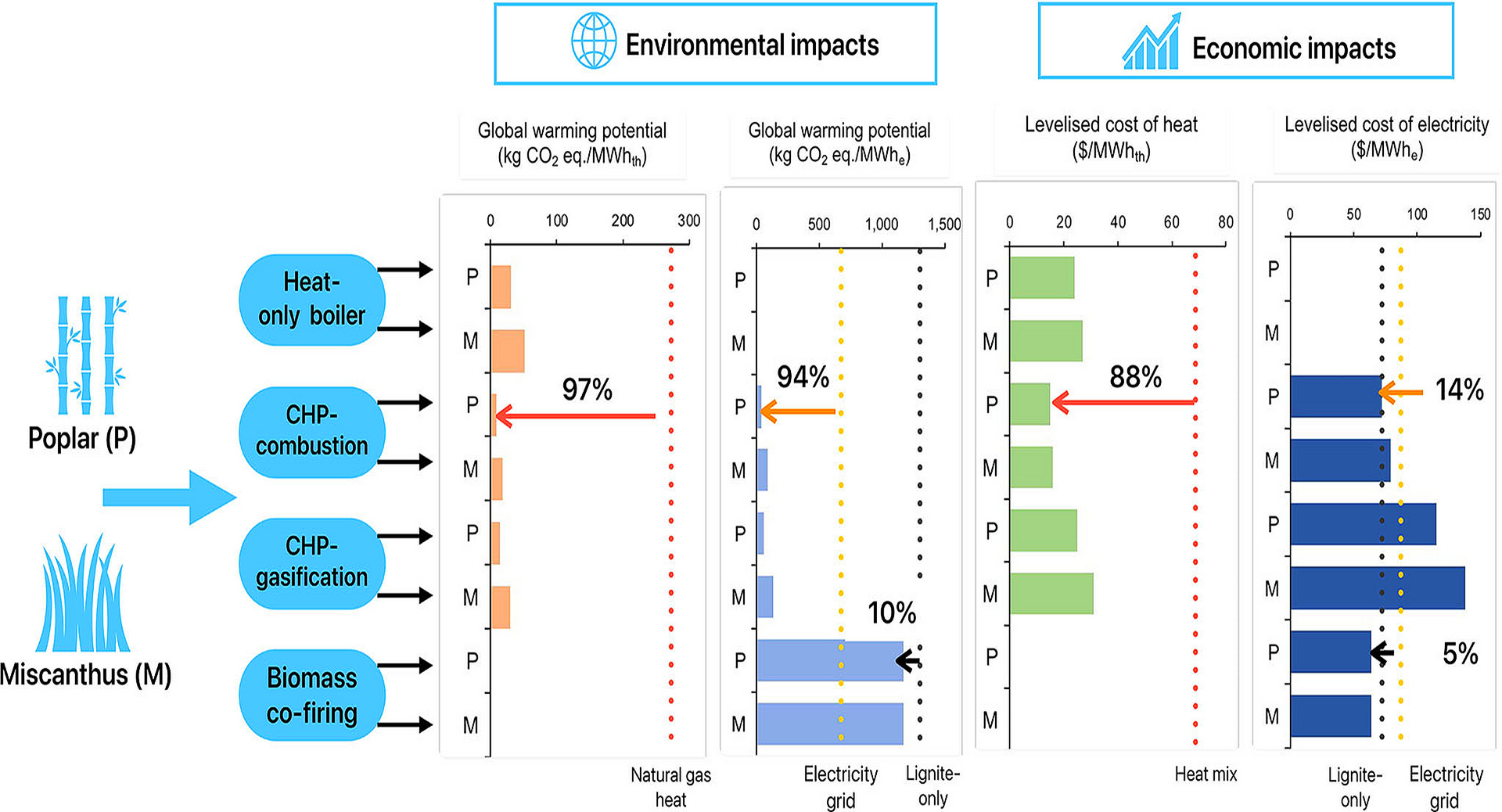
Environmental and economic impacts of utilizing Miscanthus and Poplar for heat and electricity production in Turkey.
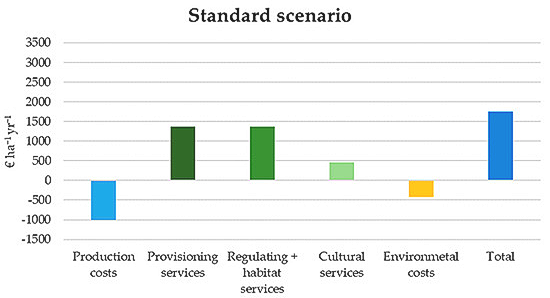
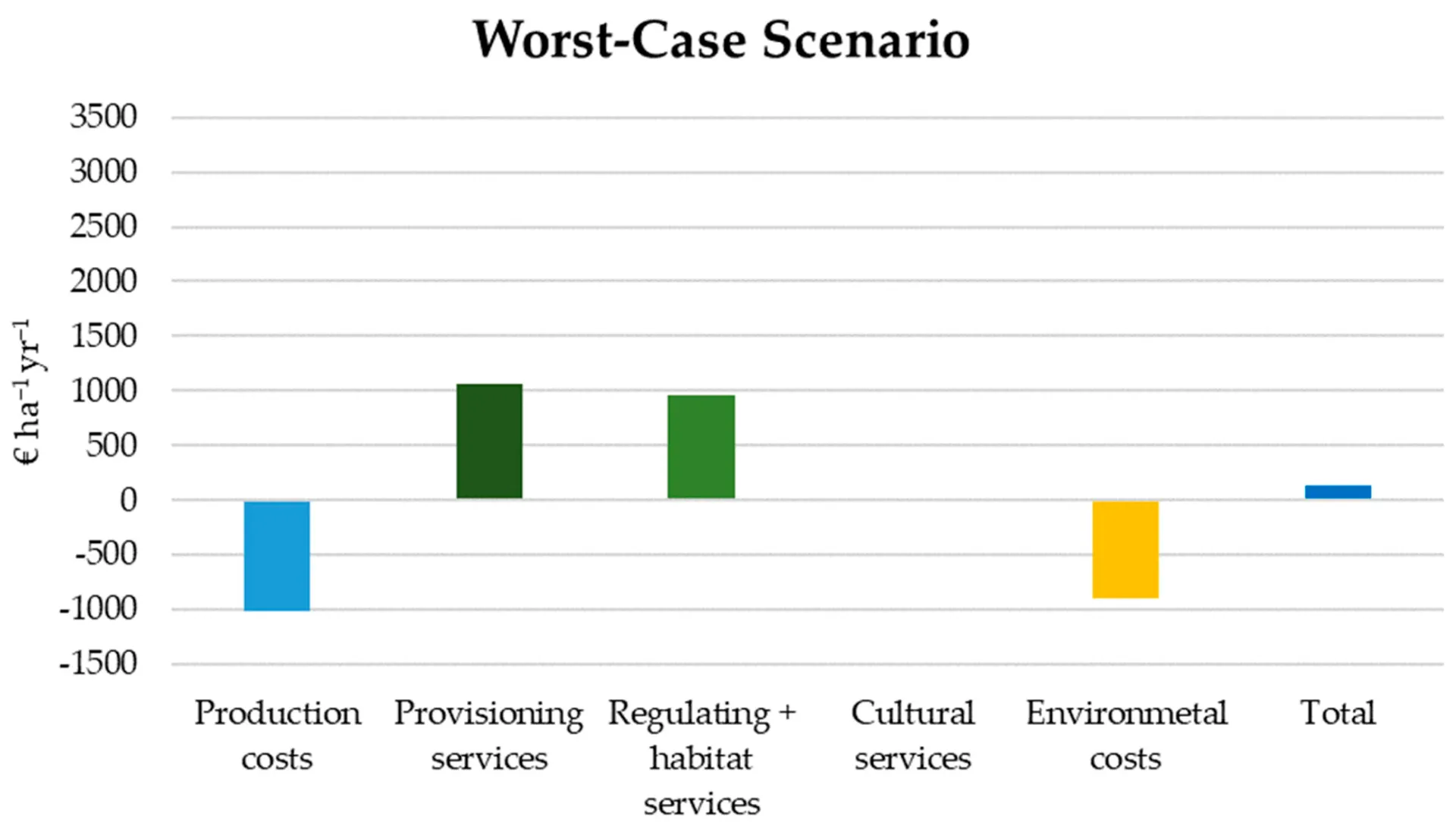
True costs and benefits for Miscanthus cultivation in Germany in the standard scenario, assuming average impacts and central monetization factors.
ADVANCING SUSTAINABLE BIOENERGY DEVELOPMENT
New, advanced technologies make it possible to produce climate neutral fuels from non-forest and non-food energy crops. The benefits of cultivation and use of these energy crops for transport fuels and electricity goes beyond the benefits of reducing greenhouse gas emissions. Terrestrial energy crop cultivation and aquatic energy crop harvesting reverses land and water degradation, increases biodiversity and carbon sequestration and improves land fertility. We call this
Deep Green Biomass. Moreover, deploying these energy crops for the production of advanced biofuels will positively impact social-economic structures and energy independence and reduce the need for involuntary migration and deforestation: Deep Green Energy.
Deep Green Energy Partners works to accelerate deployment of deep green biomass for the production of advanced biofuels and biochemicals, to restore soil and water conditions and to optimize the overall ecological-economic effects of investments in the energy transition.
These projections are in line with the latest 2023 report concerning governments plans for fossil energy production: 110% more fossil fuels in 2030 than would be consistent with limiting warming to 1.5°C, and 69% more than would be consistent with 2°C or even the 2.8°C in the current scenario.
ADVANCING SUSTAINABLE BIOENERGY DEVELOPMENT
New, advanced technologies make it possible to produce climate neutral fuels from non-forest and non-food energy crops. The benefits of cultivation and use of these energy crops for transport fuels and electricity goes beyond the benefits of reducing greenhouse gas emissions. Terrestrial energy crop cultivation and aquatic energy crop harvesting reverses land and water degradation, increases biodiversity and carbon sequestration and improves land fertility. We call this
Deep Green Biomass. Moreover, deploying these energy crops for the production of advanced biofuels will positively impact social-economic structures and energy independence and reduce the need for involuntary migration and deforestation: Deep Green Energy.
Deep Green Energy Partners works to accelerate deployment of deep green biomass for the production of advanced biofuels and biochemicals, to restore soil and water conditions and to optimize the overall ecological-economic effects of investments in the energy transition.
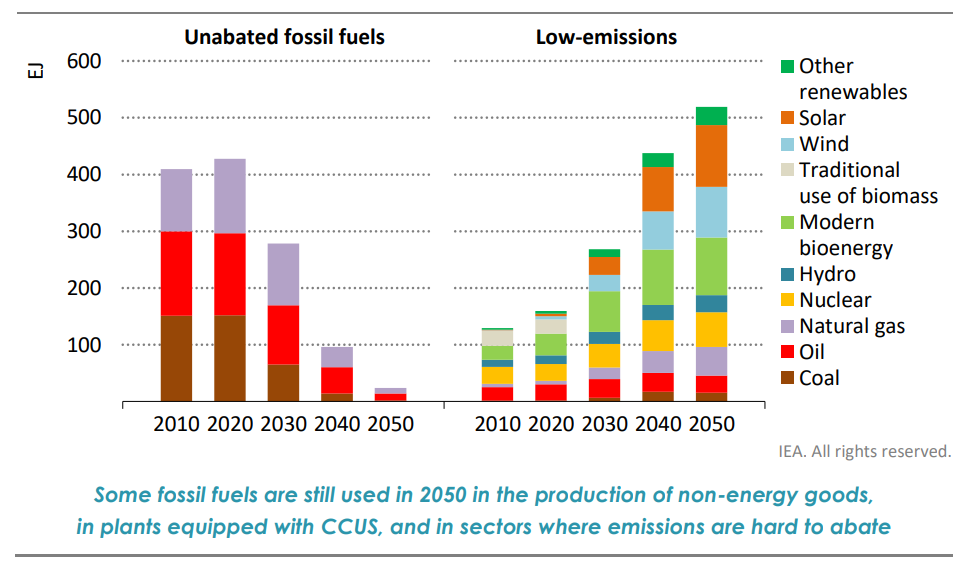
Projected coal, oil and gas production, 2020-2050
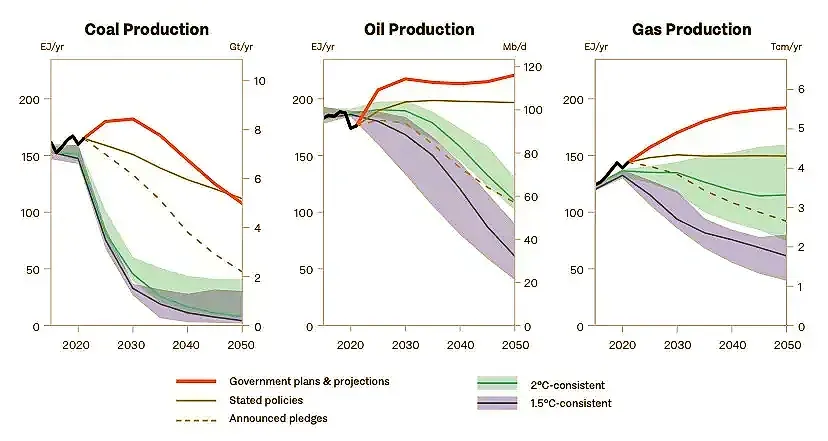
Projected emissions from fossil fuel use, 2020-2050
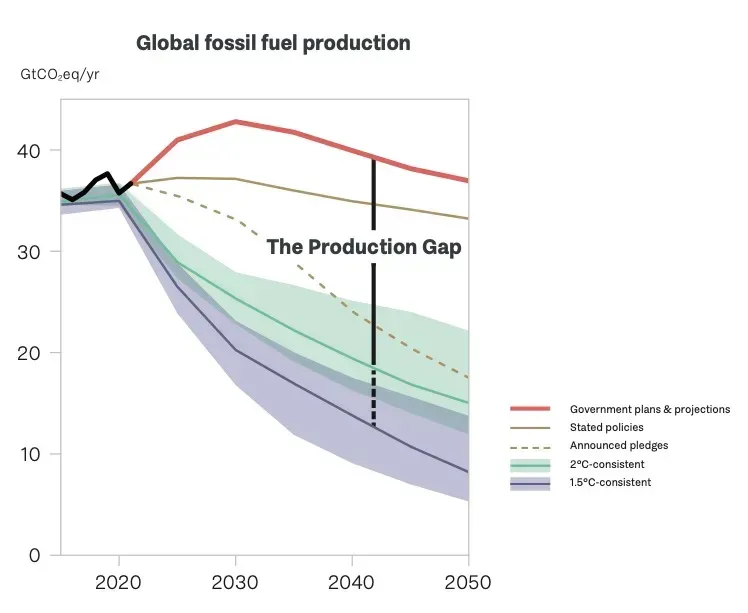
The IPCC, IEA and many other organizations have developed detailed ''net-zero" emissions scenarios necessary to limit emissions from the energy system sufficiently to keep GW within the 1.5-2°C threshold. All scenarios are basically based on the same instruments with different emphasizes: increased energy efficiencies, substitution of fossil fuel by low-carbon energy - wind-, solar-, hydro- and nuclear-energy - or bioenergy, substitution of bad coal by less bad gas and carbon capture. Electrification by renewables is key in all scenarios as it increases energy efficiencies and reduces emissions, it however doesn't do so at the same time which result in a trade-off between reduced emissions and material use in the long run and their increase in the shortterm.
ADVANCING SUSTAINABLE BIOENERGY DEVELOPMENT
New, advanced technologies make it possible to produce climate neutral fuels from non-forest and non-food energy crops. The benefits of cultivation and use of these energy crops for transport fuels and electricity goes beyond the benefits of reducing greenhouse gas emissions. Terrestrial energy crop cultivation and aquatic energy crop harvesting reverses land and water degradation, increases biodiversity and carbon sequestration and improves land fertility. We call this
Deep Green Biomass. Moreover, deploying these energy crops for the production of advanced biofuels will positively impact social-economic structures and energy independence and reduce the need for involuntary migration and deforestation: Deep Green Energy.
Deep Green Energy Partners works to accelerate deployment of deep green biomass for the production of advanced biofuels and biochemicals, to restore soil and water conditions and to optimize the overall ecological-economic effects of investments in the energy transition.
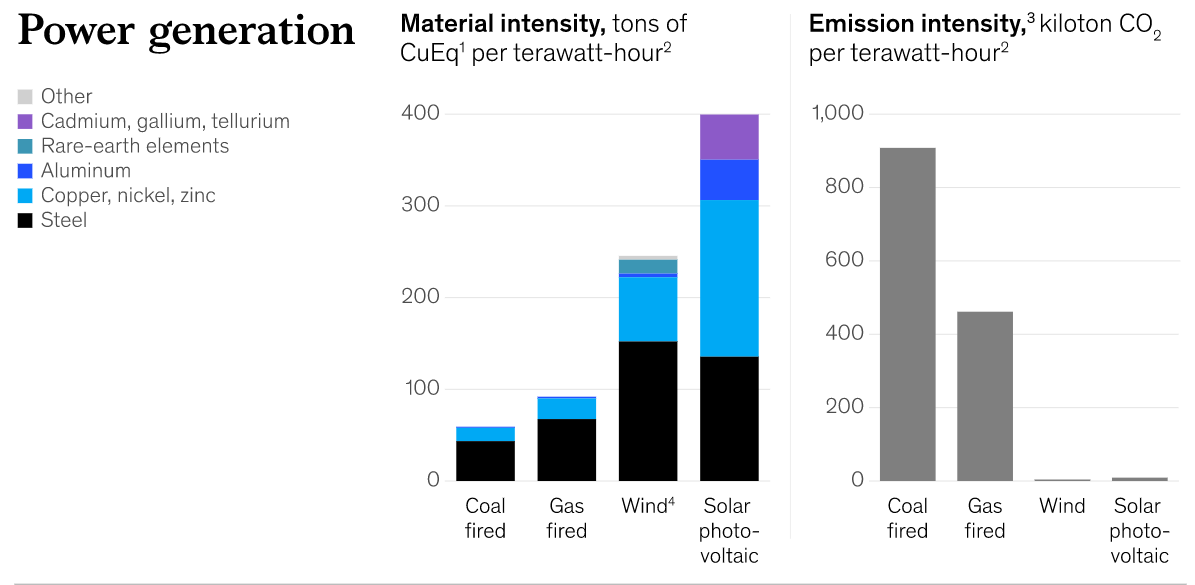
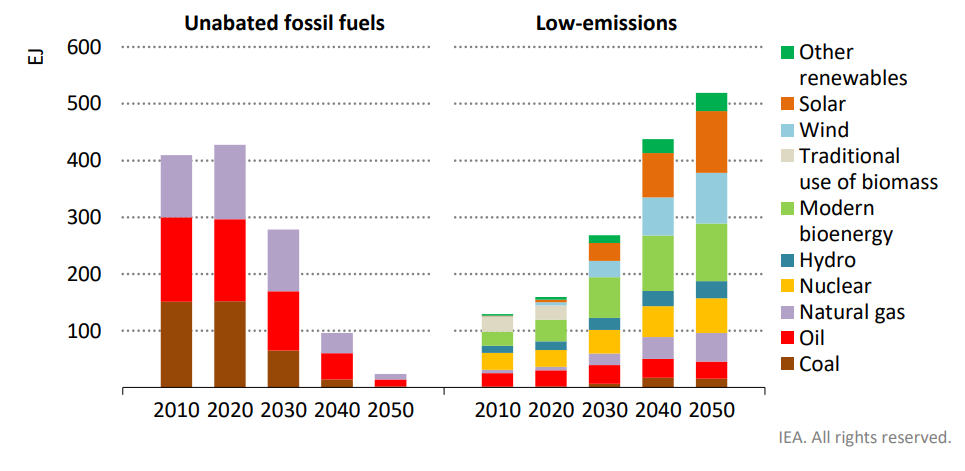
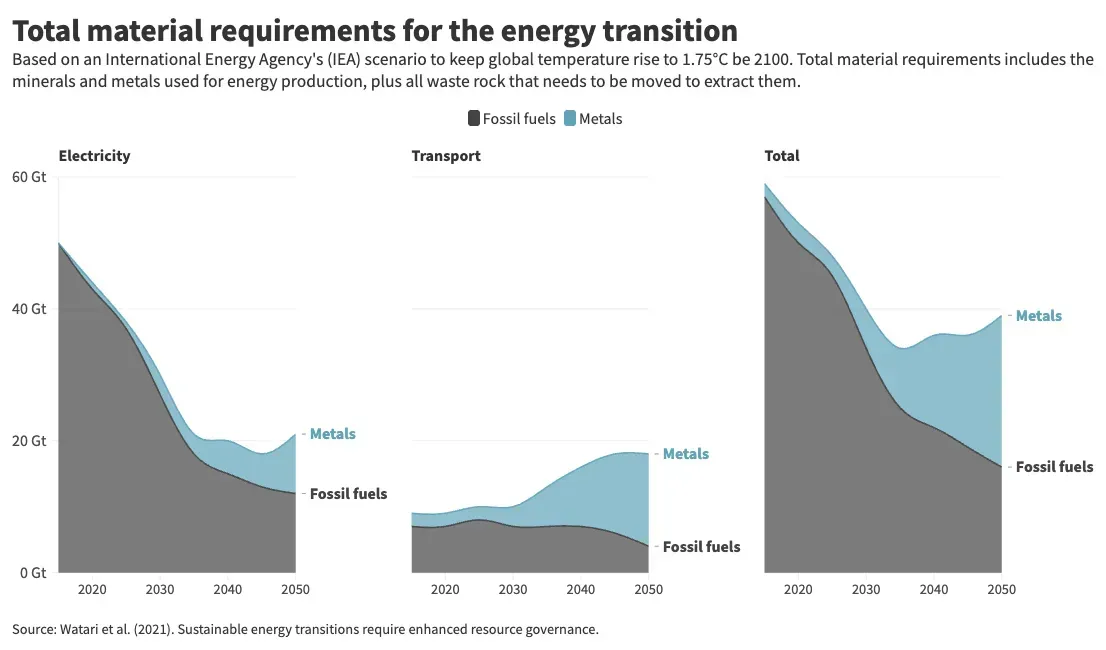
Over time less raw materials are needed for a renewable based, electrified energy system than for the current fossil energy based system. But most resource needs for the transition are front loaded, hence the initial push will paradoxally increase material demand and thus emissions in the next decades. Demand for materials depends in the various net-zero scenarios but in middle of the rode scenarios electricity supply needs to increase from
~28,000 TWh in 2022 to over ~100,000 TWh by 2050.
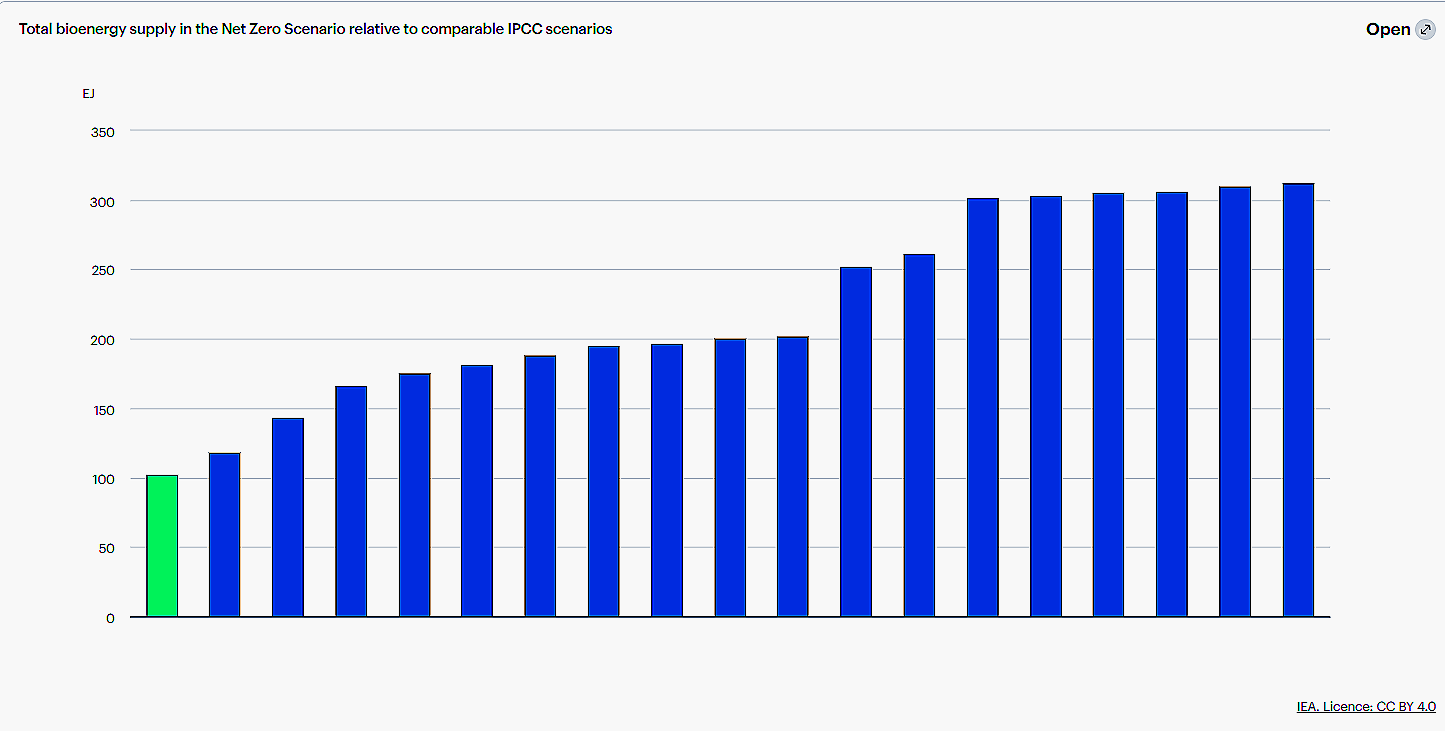
The world therefore need as many 200,000 offshore wind turbines and 40 billion of solar panels worldwide and the supply of sustainable bioenergy for electricity and fuels has to increase from 60 EJ to between 100-312 EJ annually.
But that is not all. The total length of the world's power networks needs to be increased by 116% to 166.4 million kilometers by 2050. On the demand side about 1.3 billion additional residential heat pumps and 700 million additional batteries for electric vehicles will have to be produced by 2050, while production of "green hydrogen" has to increase from 1Mt today to 500-800Mt and up-scaling carbon capture, for utilization and removal capacity from 0.01 to 7–10 GtCO2 per annum
will be needed.
The supply of all of these requires a lot of mining and industrial production of which most is front loaded, i.e. the cost come before the benefits. This doesn't apply only to the investment cost but also to the cost to biodiversity, ecosystem service and global GDP.
The value of natural capital per capita has declined by around 48% since 1990
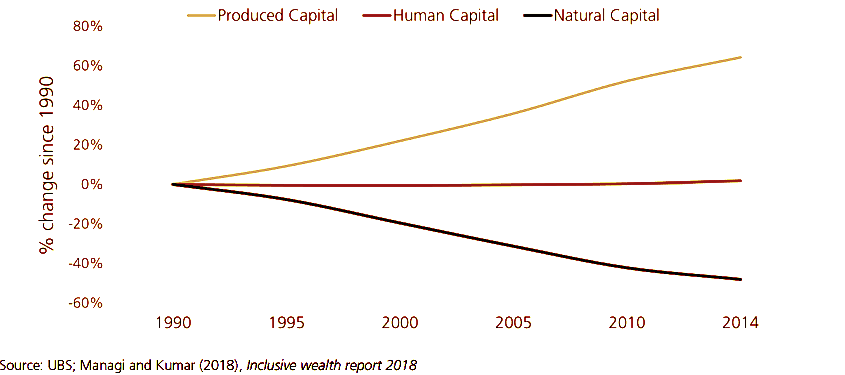
Declining ecosystem services could cost the world 2.3% in annual GDP by 2030
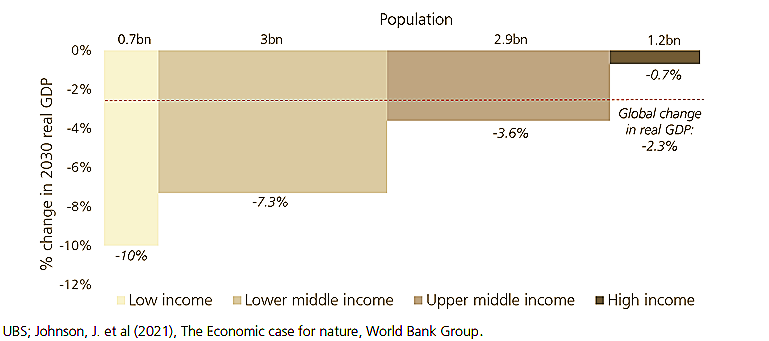
In 2023 the
IMF put the annual environmental cost of fossil fuel at least 5 trillion per year and the direct subsidies at USD 1.6 trillion which is more than the total annual sales revenue of fossil fuels, i.e. the monetized cost and benefits of fossil fuels are zero today. This implies that future net costs of fossil fuel use will
unavoidably surpass it's profits in terms of global GDP, GW and ecosystems services (ESs). As renewable energy requires less materials and causes less emissions over time the logic for replacing fossil fuels by renewables is pretty evident. But unless we can avoid additional emissions and reduce ecosystem losses to the bare minimum there will be little dividend on our investments in a renewable energy system in the end.
ADVANCING SUSTAINABLE BIOENERGY DEVELOPMENT
New, advanced technologies make it possible to produce climate neutral fuels from non-forest and non-food energy crops. The benefits of cultivation and use of these energy crops for transport fuels and electricity goes beyond the benefits of reducing greenhouse gas emissions. Terrestrial energy crop cultivation and aquatic energy crop harvesting reverses land and water degradation, increases biodiversity and carbon sequestration and improves land fertility. We call this
Deep Green Biomass. Moreover, deploying these energy crops for the production of advanced biofuels will positively impact social-economic structures and energy independence and reduce the need for involuntary migration and deforestation: Deep Green Energy.
Deep Green Energy Partners works to accelerate deployment of deep green biomass for the production of advanced biofuels and biochemicals, to restore soil and water conditions and to optimize the overall ecological-economic effects of investments in the energy transition.
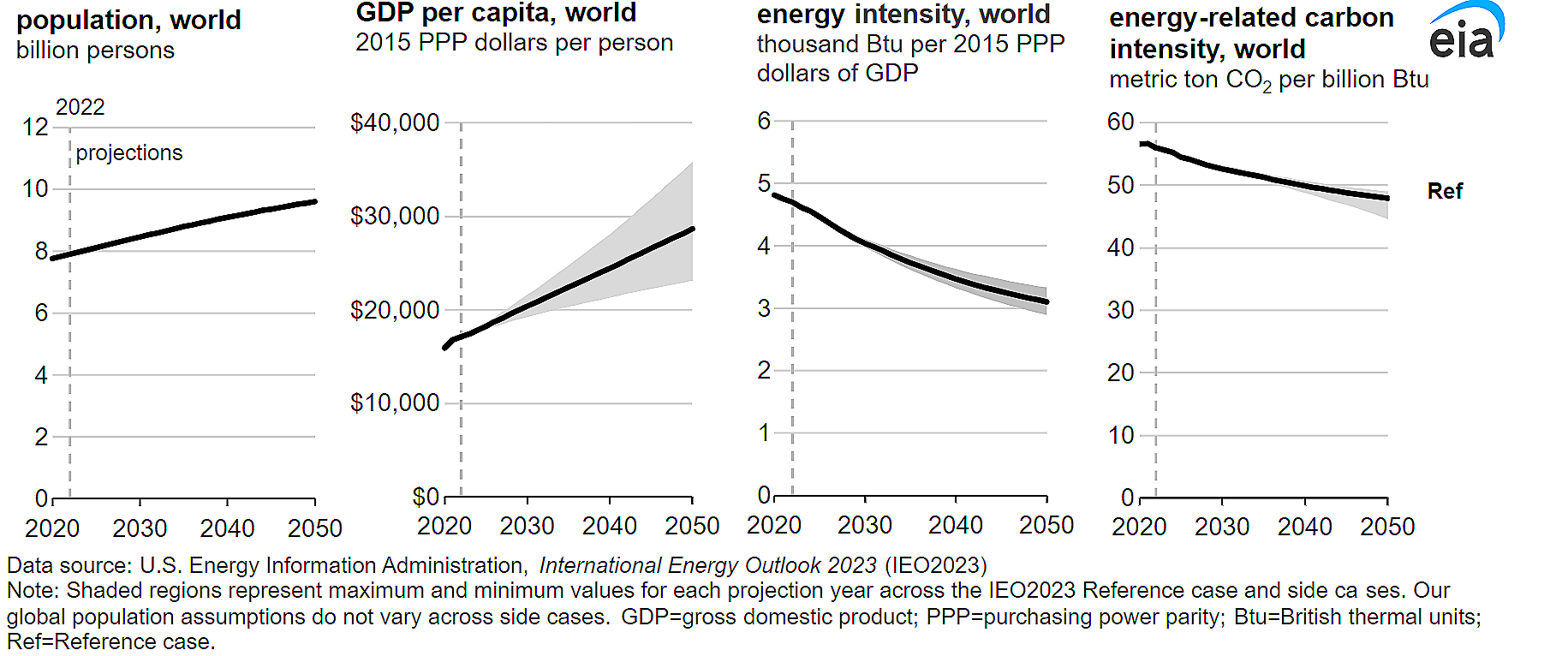
Actual energy consumption and growth depends on a number of factors: population and GDP growth, the primary energy source and the efficiencies/losses of energy production/generation, the conversion of primary to final energy and end-user equipment and human behavior. Primary energy consumption measures total energy demand from all fossil and non-fossil sources, while final energy consumption refers to what end-users actually consume as electricity or fuels. The difference relates mainly to what the energy sector needs itself, the conversion efficiency from primary energy source to final energy product and distribution losses between the production/generation location and the end-user.
ADVANCING SUSTAINABLE BIOENERGY DEVELOPMENT
New, advanced technologies make it possible to produce climate neutral fuels from non-forest and non-food energy crops. The benefits of cultivation and use of these energy crops for transport fuels and electricity goes beyond the benefits of reducing greenhouse gas emissions. Terrestrial energy crop cultivation and aquatic energy crop harvesting reverses land and water degradation, increases biodiversity and carbon sequestration and improves land fertility. We call this
Deep Green Biomass. Moreover, deploying these energy crops for the production of advanced biofuels will positively impact social-economic structures and energy independence and reduce the need for involuntary migration and deforestation: Deep Green Energy.
Deep Green Energy Partners works to accelerate deployment of deep green biomass for the production of advanced biofuels and biochemicals, to restore soil and water conditions and to optimize the overall ecological-economic effects of investments in the energy transition.
Energy demand drivers, projections 2050
Primary energy use by fuel, projections 2050
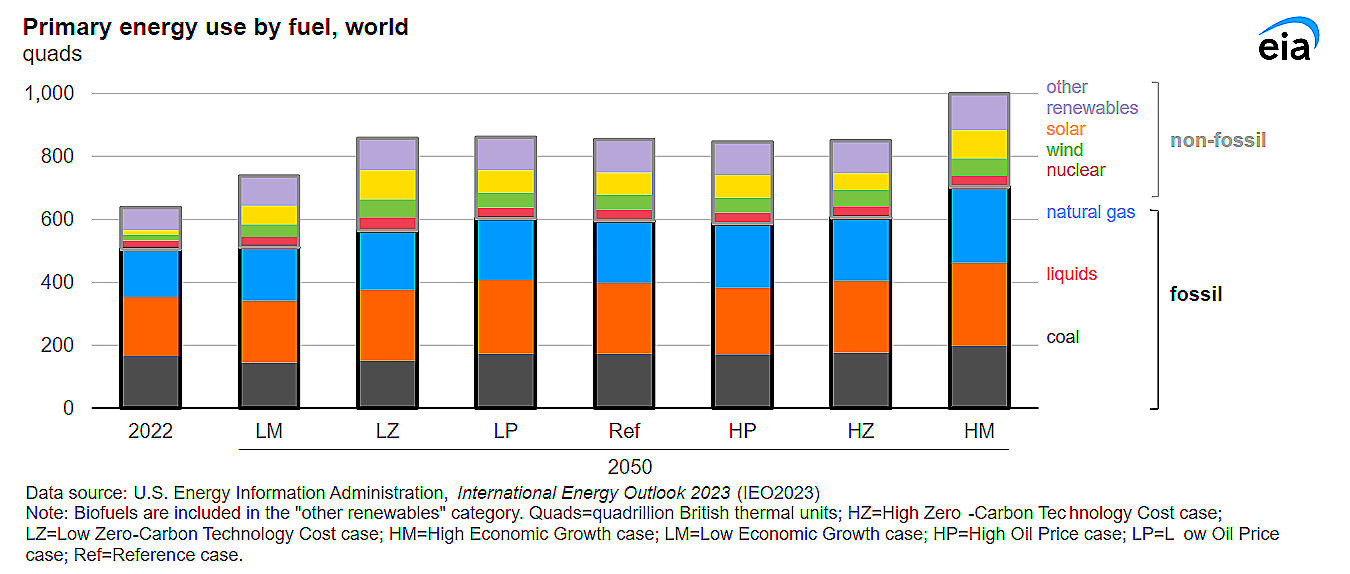
In middle of the road scenario final energy consumption grows by 37,5% until 2050, i.e. ~573.4 EJ total, of which ~33% or 191 EJ is electricity of which ~95.5 EJ comes from renewable sources. The remaining final energy consumption, nuclear, fossil and biofuels, would therefore be about ~478 EJ. Without increasing efficiencies in energy production/generation, conversion, distribution and/or end-user equipment this would result in a total primary energy demand of ~860 EJ of which ~600 EJ fossil sourced and ~260 EJ from renewables. Including the projected gains from e.g. substitution of coal by gas and electrification, demand for primary fossil energy by 2035 is projected to be ~575 EJ dropping to ~520 EJ by 2050, which is 20% and 10% respectively higher than in 2020.
Assuming that the growing demand for final energy consumption demand will be met, we have to asses how we can reduce the 575-520 EJ of primary fossil fuels by substitution and efficiency increases throughout the value chain beyond what is already included in the projections.
The
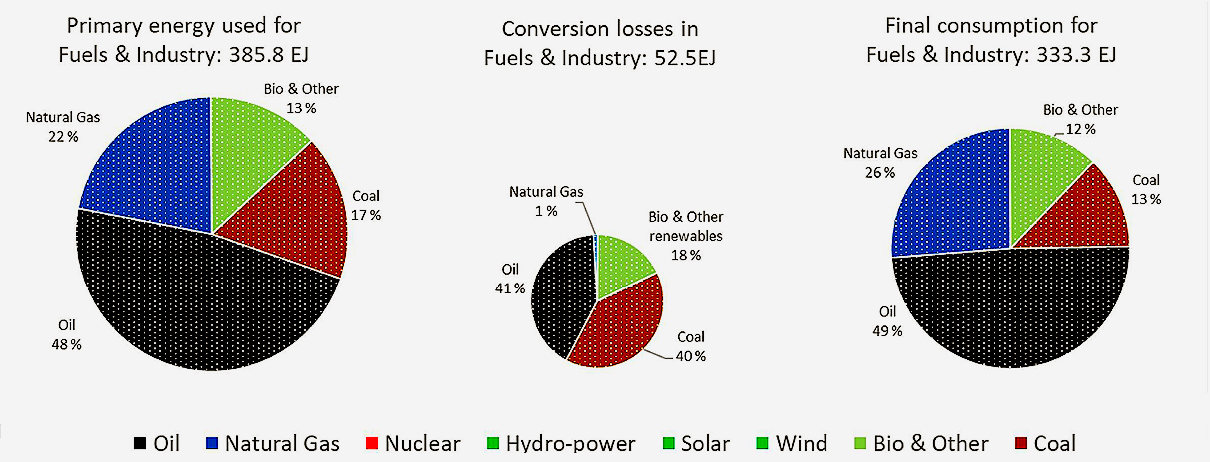
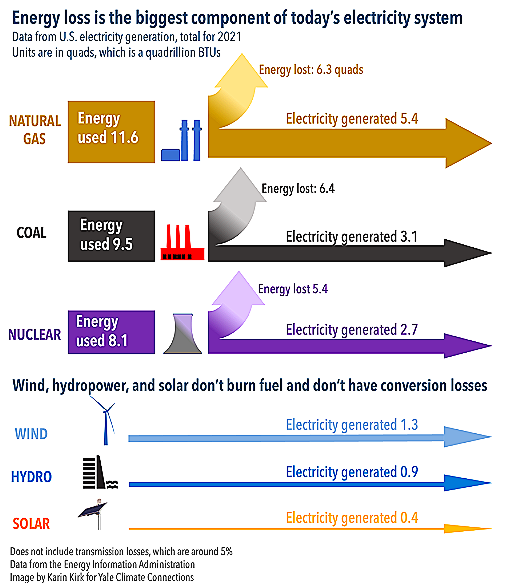
total global primary energy use in 2020 was 611 EJ, of which 63 %, i.e., 385.8 EJ was used for fuel and industrial processes. The remaining 37%, i.e., 225.7 EJ was used as electricity. The total final energy consumption was 416.6 EJ, of which ~20%, 83.3 EJ as electricity and ~80%, 333.3 EJ for fuels and industry. Thus on average about 32% of the total primary energy, 194 EJ out of 611 EJ, was lost in the processing, conversion and distribution of primary energy to final energy consumption. The primary-final energy use losses for fuels and industry were relatively small, 14% on average. Those for for electricity production on the other hand were rather high at 63% as only 11% was produced from hydro, wind and solar with energy losses of about ~6% and the remaining 89% from carbon sources and nuclear with conversion losses of 56-63%.
Primary energy use, losses and final use electricity
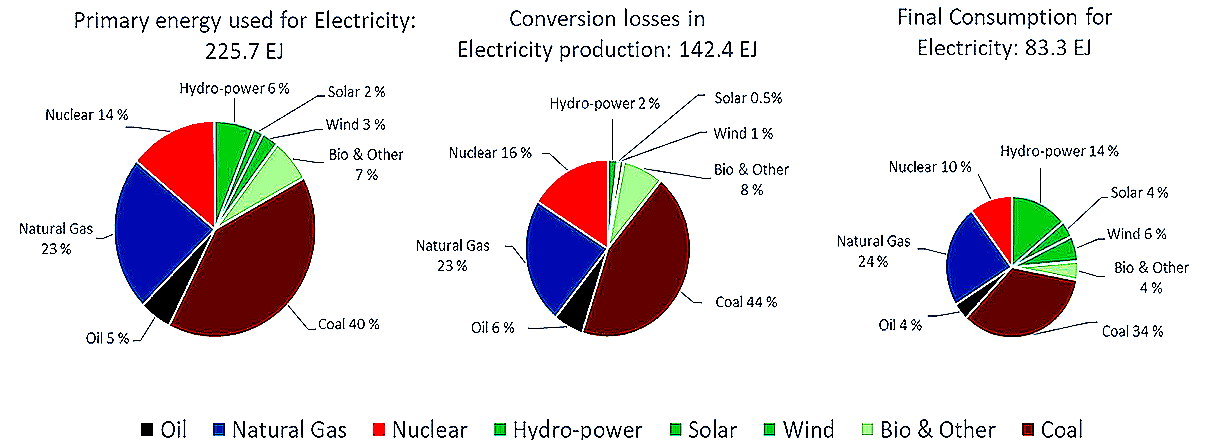
Primary energy use, losses and final use fuels and industry
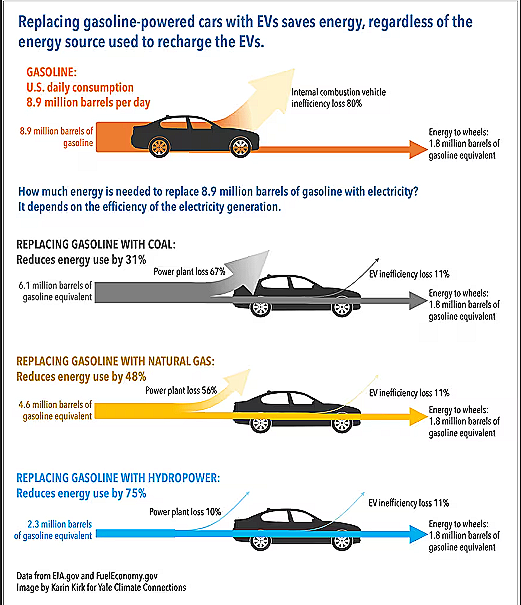
Electrification from low-carbon energy sources is the most efficient option to increase energy efficiencies and to reduce primary and final energy use for non-heavy duty applications. Passenger transport and heating by households represents ~40% of all global energy use. The main focus for efficiency gains by households is therefore on electric vehicles (EVs) and heat pumps, and optimizing their energy value chains. The combinend effects of less energy losses in the supply chain and higher energy efficiencies in the end-user equipment are substantial as shown below for passenger cars. Internal combustion engines are 20% energy efficient, i.e. 80% of the energy in petrol, diesel or gas put in a car is lost as mainly heat and friction while and electric motor has a loss of 27%. When electricity is produced from carbon fuels or nuclear more energy is lost, e.g. 56% for gas, 68% for coal and 67% for nuclear. Electricity distribution losses are about 5% on average.
ADVANCING SUSTAINABLE BIOENERGY DEVELOPMENT
New, advanced technologies make it possible to produce climate neutral fuels from non-forest and non-food energy crops. The benefits of cultivation and use of these energy crops for transport fuels and electricity goes beyond the benefits of reducing greenhouse gas emissions. Terrestrial energy crop cultivation and aquatic energy crop harvesting reverses land and water degradation, increases biodiversity and carbon sequestration and improves land fertility. We call this
Deep Green Biomass. Moreover, deploying these energy crops for the production of advanced biofuels will positively impact social-economic structures and energy independence and reduce the need for involuntary migration and deforestation: Deep Green Energy.
Deep Green Energy Partners works to accelerate deployment of deep green biomass for the production of advanced biofuels and biochemicals, to restore soil and water conditions and to optimize the overall ecological-economic effects of investments in the energy transition.
Energy losses electricity supply by source
Energy losses passenger cars by power source
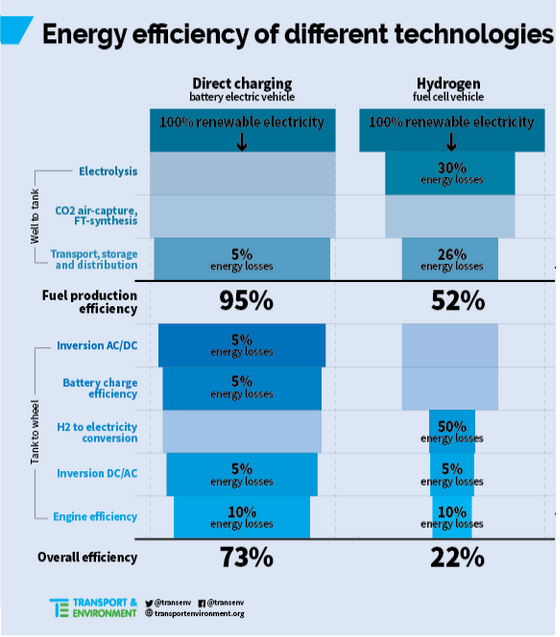
Overall energy losses electric passenger car
ADVANCING SUSTAINABLE BIOENERGY DEVELOPMENT
New, advanced technologies make it possible to produce climate neutral fuels from non-forest and non-food energy crops. The benefits of cultivation and use of these energy crops for transport fuels and electricity goes beyond the benefits of reducing greenhouse gas emissions. Terrestrial energy crop cultivation and aquatic energy crop harvesting reverses land and water degradation, increases biodiversity and carbon sequestration and improves land fertility. We call this
Deep Green Biomass. Moreover, deploying these energy crops for the production of advanced biofuels will positively impact social-economic structures and energy independence and reduce the need for involuntary migration and deforestation: Deep Green Energy.
Deep Green Energy Partners works to accelerate deployment of deep green biomass for the production of advanced biofuels and biochemicals, to restore soil and water conditions and to optimize the overall ecological-economic effects of investments in the energy transition.
Depending on the energy sources used throughout the supply chain, actual energy savings for EVs are between
25% and 75% (typically 40-50% using today's grid electricity) compared to fossil powered cars. The energy efficiencies for electric heat pumps are even higher and emissions
savings from electric residential heat pumps are between 30% and 80% when compared to gas heating. About 45% of all transport concerns passenger transport by road, and space heating in buildings uses ~50% of all energy used for heating/cooling. As transport uses ~30% of all energy and heating/cooling ~50%, about 40% of today's energy use could technically be electrified by just these two applications.
Industrial processes and district heating, representing ~25 and ~10% of all current energy use, require high density fuels and the lifetime of assets in the value chain are long. The options for rapid replacement of fuels by electricity in these sectors are limited to low heat requirements, representing about 30%, or ~10% of final energy demand. Adding this to the 40% for heat and EVs and the 10% for lighting, refrigerators and other electronic uses, the total potential for rapid (before 2050) electrification is ~60%.
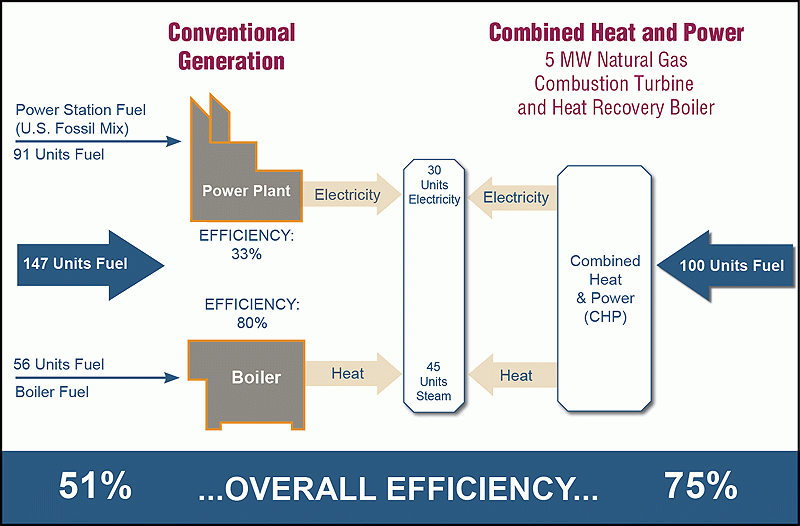
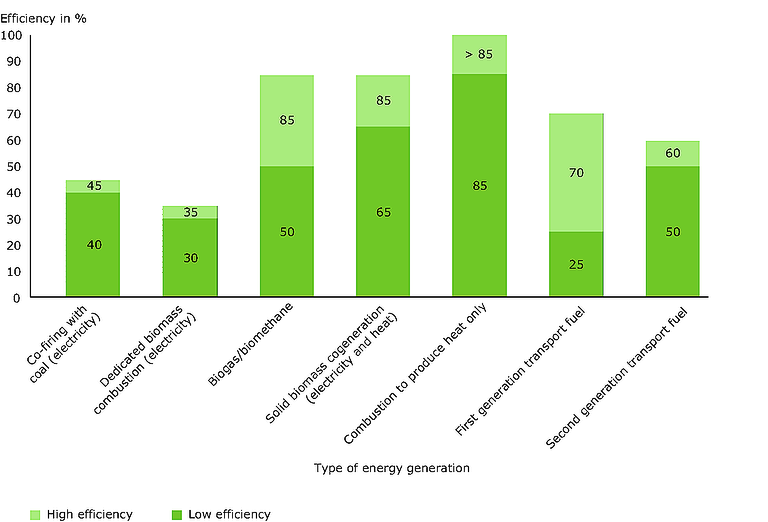
Energy efficiency gains can however also be realized within current production systems. Conversion efficiencies of energy used for industrial and district heat are already quite high (>85%), resulting in the relatively low primary-final energy losses. This however doesn't apply to electricity production from fuels (or nuclear): 63% losses, of which 90% is caused by conversion losses in the form of mainly heat. Combining heat and electricity production (CHP) and replacing coal by gas or biomass (pellets or biogas) can produce electricity with minimal energy losses and additional emissions as shown below.
Efficiency conventional and combined heat and power generation
Efficiency bioenergy by type of energy generation
The remaining fossil energy used for heat and transport for trucks, ships and planes, ~35% of current energy use, could be replaced by various biofuels, hydrogen or e-fuels. For heat this will likely have neutral or positive effects on overall conversion efficiencies. For transport fuels this will however result in increased conversion and efficiency losses for biofuels compared to fossil fuels (30-50%). The actual efficiency impacts of hydrogen throughout the value chain are yet uncertain as hydrogen is not an energy source by itself and it will always take more energy to produce hydrogen (by separating it from other elements in molecules) than hydrogen provides when it is converted to useful energy.
Storage can create opportunities to leverage intermittancy
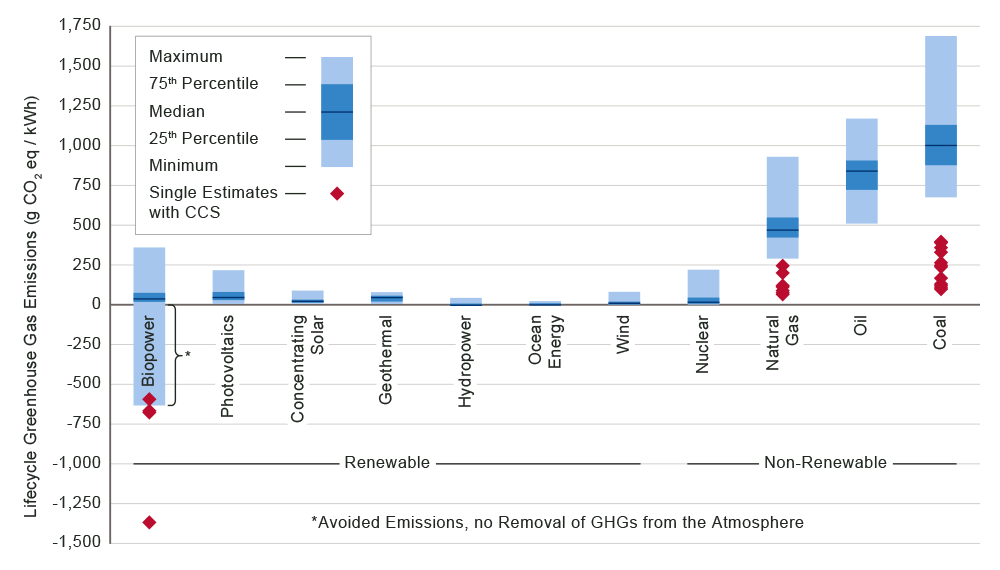
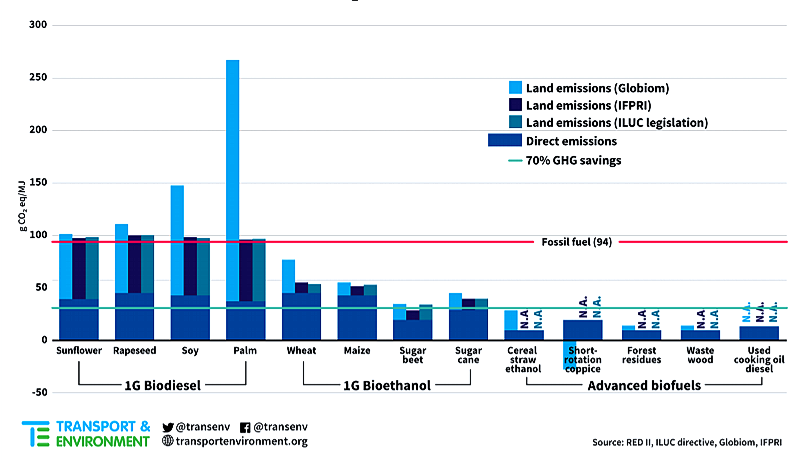
The net GHG savings of substituting fossil fuels by renewables or coal by gas for primary energy supply seem pretty evident considering the below life cycle assessments for electricity and biofuels generation.
Life Cycle Assessment GHG emissions Electricity Generation
Life Cycle Assessment Biofuels including land-use
The actual GHG savings from fossil substitution do however not only depend on production/generation efficiencies and emissions but on the particulars of each level of the supply and value chain. Substituting bad fossil with less bad fossil e.g. coal with gas makes less of difference when factoring in the under-reported actual methane leakages from natural gas supply chains (1-2% on average). Substitution of fossil fuels with renewables and increased electrification will create additional GHG emissions from distribution infrastructure, terminal equipment, maintenance and end-of life disposal/recycling.
The initial push and subsequent maintenance of a low-carbon energy supply system will increase fossil energy consumption and cause emissions of between 70 to 395 GtCO2 until its completion.
Moreover it will cause a decline of 10–34% in net energy available to society which will likely be compensated by increased fossil fuel production. The average, 200 GtCO2eq, will thus consume the whole remaining carbon budget for 1.5°C by itself unless the effects of substitution and carbon capture outpace the emissions of increased energy supply.
ADVANCING SUSTAINABLE BIOENERGY DEVELOPMENT
New, advanced technologies make it possible to produce climate neutral fuels from non-forest and non-food energy crops. The benefits of cultivation and use of these energy crops for transport fuels and electricity goes beyond the benefits of reducing greenhouse gas emissions. Terrestrial energy crop cultivation and aquatic energy crop harvesting reverses land and water degradation, increases biodiversity and carbon sequestration and improves land fertility. We call this
Deep Green Biomass. Moreover, deploying these energy crops for the production of advanced biofuels will positively impact social-economic structures and energy independence and reduce the need for involuntary migration and deforestation: Deep Green Energy.
Deep Green Energy Partners works to accelerate deployment of deep green biomass for the production of advanced biofuels and biochemicals, to restore soil and water conditions and to optimize the overall ecological-economic effects of investments in the energy transition.
How actual emissions compare for an electricity system based on predominantly wind and solar or from predominantly (bio)gas in the long run is also unclear yet. Reductions in operating emissions for e.g. wind generation could be offset by an increase of emissions associated with grid flexibility, delivery security, transmission, and distribution. Emissions reductions of between
20% and 40% are typically assumed but might actually be around 10–20%
when the share of e.g. wind increases versus gas.
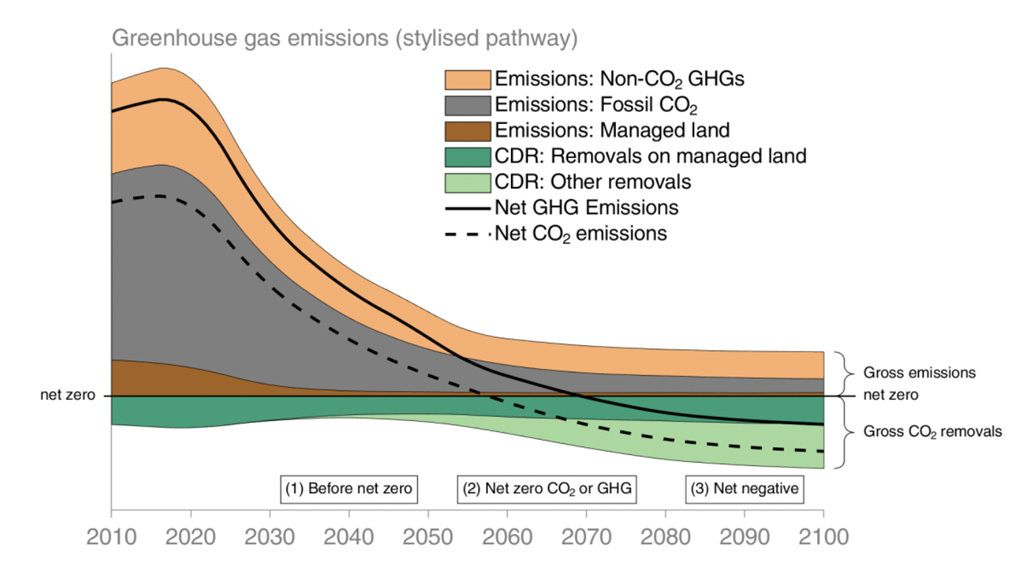
Carbon capture and reuse or storage, the red diamonds in the above electricity LCA, can be either done before the fact by vegetation (bioenergy) and directly from the air (DACCS), or after the fact at the smokestacks of power, CHP plants, refineries and factories (CCS). Technically carbon capture and storage could eliminate the difference in net-emissions between low-carbon and fossil energy, and even enable emissions negative energy from bioenergy (the diamonds for biopower and light blue bar for advanced biofuels). Today however only 0.01% of all carbon emissions are captured at smokestacks and the efficiency, techno- economic, and institutional feasibility of CCS is doubtful.
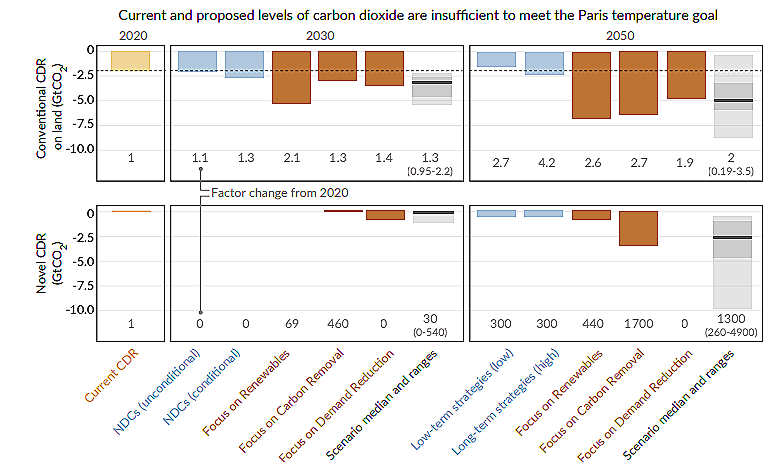
Thus meaningful technical carbon capture (or novel carbon capture) will take a few decades in a best case scenario. Conventional natural carbon sequestration (plants and trees) is therefore the only realistic option for the 5–10 GtCO2 of carbon dioxide removal (CDR) annually up to 2050, even in scenarios in which fossil fuels are rapidly phased out.
ADVANCING SUSTAINABLE BIOENERGY DEVELOPMENT
New, advanced technologies make it possible to produce climate neutral fuels from non-forest and non-food energy crops. The benefits of cultivation and use of these energy crops for transport fuels and electricity goes beyond the benefits of reducing greenhouse gas emissions. Terrestrial energy crop cultivation and aquatic energy crop harvesting reverses land and water degradation, increases biodiversity and carbon sequestration and improves land fertility. We call this
Deep Green Biomass. Moreover, deploying these energy crops for the production of advanced biofuels will positively impact social-economic structures and energy independence and reduce the need for involuntary migration and deforestation: Deep Green Energy.
Deep Green Energy Partners works to accelerate deployment of deep green biomass for the production of advanced biofuels and biochemicals, to restore soil and water conditions and to optimize the overall ecological-economic effects of investments in the energy transition.
Levels of carbon dioxide removals in different 1.5-2°C GW scenarios
Net GHG and CO2 emissions, and carbon removals for 1.5-2°C GW scenarios
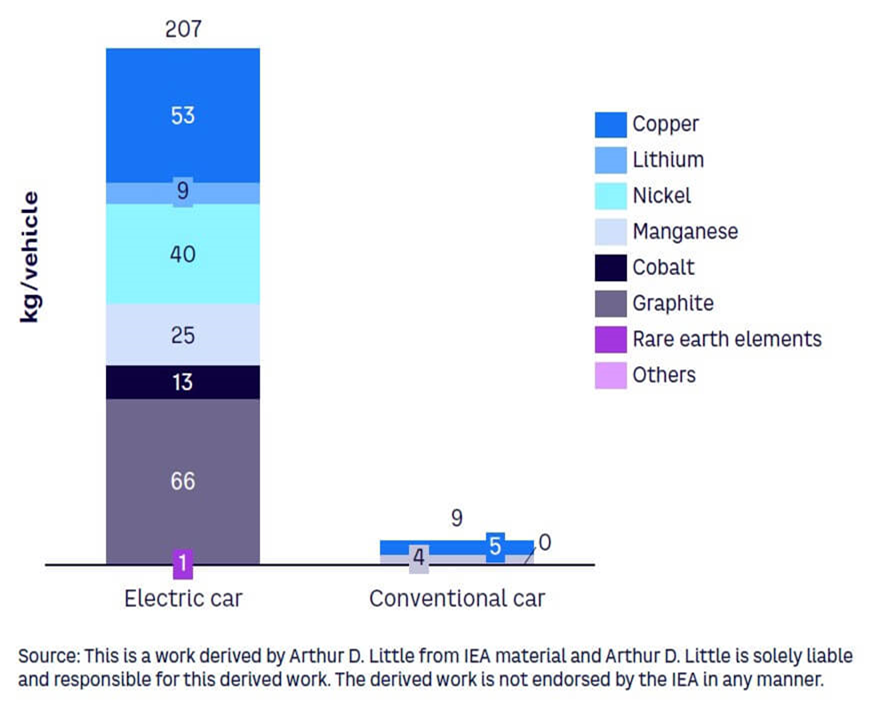
The resource requirements for electrification are many: minerals, metals and concrete for production, distribution infrastructure and end-user equipment. Additional "critical" mineral requirements for wind turbines, solar panels and batteries are in the range of 400%-4000%. Electric vehicles (EVs) represent more than 50% of all projected emissions savings up to 2060 and are thus one of the main drivers for rapid electrification as well of the exploding demand for critical minerals and metals. The production of lithium-ion batteries for EVs causes the overall impacts of electric vehicles to be
50% -500% times as damaging to the environment (except for GW) as conventional cars.
ADVANCING SUSTAINABLE BIOENERGY DEVELOPMENT
New, advanced technologies make it possible to produce climate neutral fuels from non-forest and non-food energy crops. The benefits of cultivation and use of these energy crops for transport fuels and electricity goes beyond the benefits of reducing greenhouse gas emissions. Terrestrial energy crop cultivation and aquatic energy crop harvesting reverses land and water degradation, increases biodiversity and carbon sequestration and improves land fertility. We call this
Deep Green Biomass. Moreover, deploying these energy crops for the production of advanced biofuels will positively impact social-economic structures and energy independence and reduce the need for involuntary migration and deforestation: Deep Green Energy.
Deep Green Energy Partners works to accelerate deployment of deep green biomass for the production of advanced biofuels and biochemicals, to restore soil and water conditions and to optimize the overall ecological-economic effects of investments in the energy transition.
ADVANCING SUSTAINABLE BIOENERGY DEVELOPMENT
New, advanced technologies make it possible to produce climate neutral fuels from non-forest and non-food energy crops. The benefits of cultivation and use of these energy crops for transport fuels and electricity goes beyond the benefits of reducing greenhouse gas emissions. Terrestrial energy crop cultivation and aquatic energy crop harvesting reverses land and water degradation, increases biodiversity and carbon sequestration and improves land fertility. We call this
Deep Green Biomass. Moreover, deploying these energy crops for the production of advanced biofuels will positively impact social-economic structures and energy independence and reduce the need for involuntary migration and deforestation: Deep Green Energy.
Deep Green Energy Partners works to accelerate deployment of deep green biomass for the production of advanced biofuels and biochemicals, to restore soil and water conditions and to optimize the overall ecological-economic effects of investments in the energy transition.
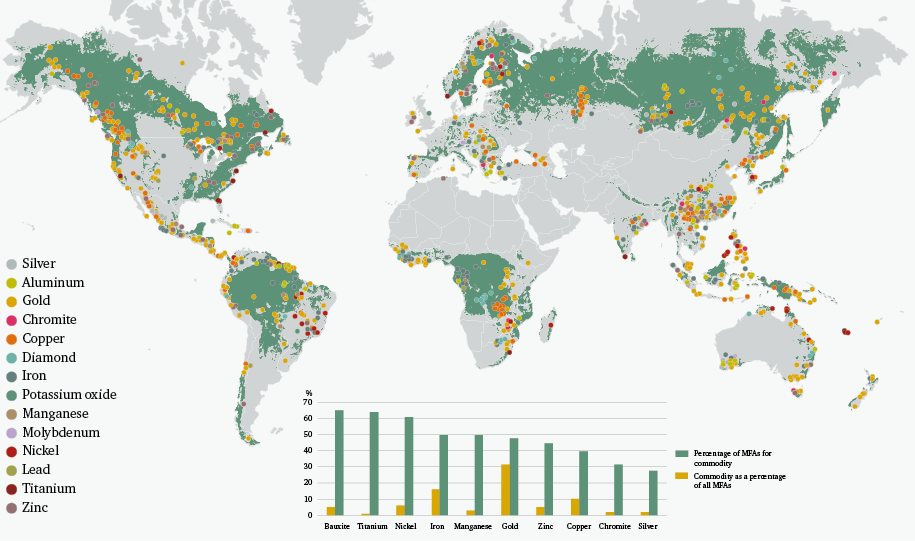
The required ''critical" minerals deposits are often concentrated in the remaining "critical" terrestrial ecosystems and oceans as much of the rest already have been used. Mining potentially already influences over a third of Earth’s terrestrial land area (37%, excluding Antarctica) as impacts extend 50 km from mine sites. Expansion of mining areas will therefore increase global critical biodiversity loss and the damages from mining to biodiversity and clean water supply may surpass those averted by climate change mitigation
through avoided emissions by solar and wind energy. Thus electrification, and in particular wind turbines, solar panels and batteries might reduce incremental GHG emissions from energy, but it isn't green nor sustainable.
ADVANCING SUSTAINABLE BIOENERGY DEVELOPMENT
New, advanced technologies make it possible to produce climate neutral fuels from non-forest and non-food energy crops. The benefits of cultivation and use of these energy crops for transport fuels and electricity goes beyond the benefits of reducing greenhouse gas emissions. Terrestrial energy crop cultivation and aquatic energy crop harvesting reverses land and water degradation, increases biodiversity and carbon sequestration and improves land fertility. We call this
Deep Green Biomass. Moreover, deploying these energy crops for the production of advanced biofuels will positively impact social-economic structures and energy independence and reduce the need for involuntary migration and deforestation: Deep Green Energy.
Deep Green Energy Partners works to accelerate deployment of deep green biomass for the production of advanced biofuels and biochemicals, to restore soil and water conditions and to optimize the overall ecological-economic effects of investments in the energy transition.
ADVANCING SUSTAINABLE BIOENERGY DEVELOPMENT
New, advanced technologies make it possible to produce climate neutral fuels from non-forest and non-food energy crops. The benefits of cultivation and use of these energy crops for transport fuels and electricity goes beyond the benefits of reducing greenhouse gas emissions. Terrestrial energy crop cultivation and aquatic energy crop harvesting reverses land and water degradation, increases biodiversity and carbon sequestration and improves land fertility. We call this
Deep Green Biomass. Moreover, deploying these energy crops for the production of advanced biofuels will positively impact social-economic structures and energy independence and reduce the need for involuntary migration and deforestation: Deep Green Energy.
Deep Green Energy Partners works to accelerate deployment of deep green biomass for the production of advanced biofuels and biochemicals, to restore soil and water conditions and to optimize the overall ecological-economic effects of investments in the energy transition.
The environmental impacts of low-carbon electricity, e.g. solar, wind and
hydro production differ considerably per country or region but will be positive in general vis-a-vis fossil fuels, this however does not imply that their impacts on ecosystems are positive. The monetized impacts of an substantial expanding low-carbon energy share in the energy mix by hydro, wind and solar for e.g Pakistan is illustrative: a total positive economic impact of up to USD 9.6 billion per year, with a complete loss of USD 1.2 billion per year in ecosystem services. When adding the full ecosystem impacts of batteries for cars and electricity storage the question arises if the combined damages from massive transport electrification and a massive increase of solar, wind and hydro isn't similar to jumping out of the frying pan and into the fire. There is however one option that mitigates direct eco-damages from electrification and reduces emissions: bioenergy from energy crops
ADVANCING SUSTAINABLE BIOENERGY DEVELOPMENT
New, advanced technologies make it possible to produce climate neutral fuels from non-forest and non-food energy crops. The benefits of cultivation and use of these energy crops for transport fuels and electricity goes beyond the benefits of reducing greenhouse gas emissions. Terrestrial energy crop cultivation and aquatic energy crop harvesting reverses land and water degradation, increases biodiversity and carbon sequestration and improves land fertility. We call this
Deep Green Biomass. Moreover, deploying these energy crops for the production of advanced biofuels will positively impact social-economic structures and energy independence and reduce the need for involuntary migration and deforestation: Deep Green Energy.
Deep Green Energy Partners works to accelerate deployment of deep green biomass for the production of advanced biofuels and biochemicals, to restore soil and water conditions and to optimize the overall ecological-economic effects of investments in the energy transition.
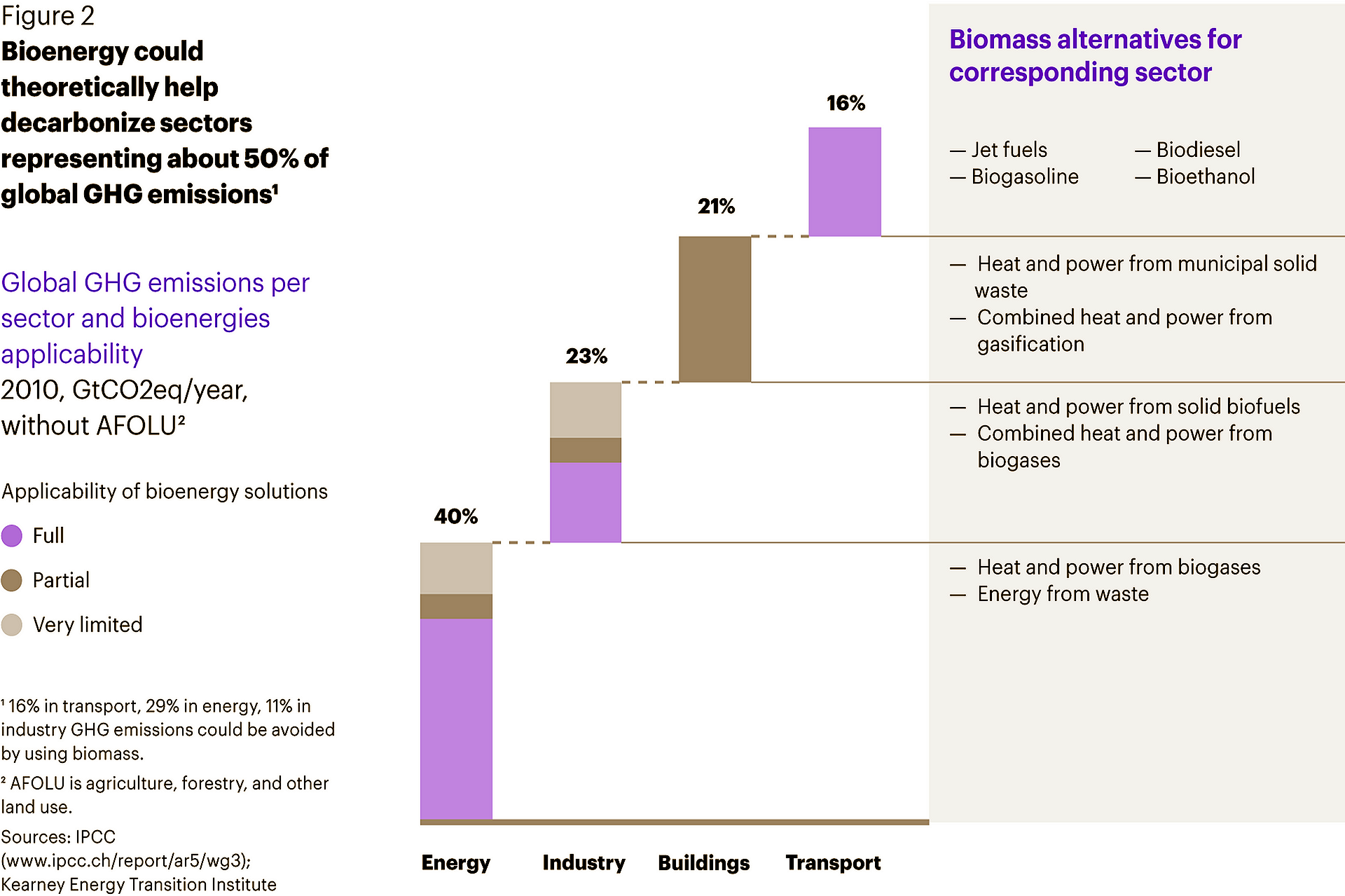
Today bioenergy provides ~60 EJ or ~10% of all energy and could theoretically be upscaled to decarbonize ~50% of all global GHG emissions from energy. Bioenergy is flexible deployable for the production of electricity and solid, liquid and gaseous fuels, but primary-final energy efficiencies for bioenergy differ with it's deployment and so does it's replacement factors for fossil or low carbon energy.
ADVANCING SUSTAINABLE BIOENERGY DEVELOPMENT
New, advanced technologies make it possible to produce climate neutral fuels from non-forest and non-food energy crops. The benefits of cultivation and use of these energy crops for transport fuels and electricity goes beyond the benefits of reducing greenhouse gas emissions. Terrestrial energy crop cultivation and aquatic energy crop harvesting reverses land and water degradation, increases biodiversity and carbon sequestration and improves land fertility. We call this
Deep Green Biomass. Moreover, deploying these energy crops for the production of advanced biofuels will positively impact social-economic structures and energy independence and reduce the need for involuntary migration and deforestation: Deep Green Energy.
Deep Green Energy Partners works to accelerate deployment of deep green biomass for the production of advanced biofuels and biochemicals, to restore soil and water conditions and to optimize the overall ecological-economic effects of investments in the energy transition.
When bioenergy is deployed for electricity it is less efficient compared to low-carbon renewables but as it readily dispensable and not intermittent the overall energy efficiency value in an integrated electricity system becomes more equal. Compared to coal, natural gas and nuclear, at conversion efficiency rates for electricity of between 30-35%, 33-60%, 33-45% respectively, biomass is comparable at 30-45%. Deployed for industrial heat the energy efficiency of biomass are a little below to those fossil fuels. The conversion efficiencies for advanced biofuels for transport are however 50%-60% compared to oil and gas.
ADVANCING SUSTAINABLE BIOENERGY DEVELOPMENT
New, advanced technologies make it possible to produce climate neutral fuels from non-forest and non-food energy crops. The benefits of cultivation and use of these energy crops for transport fuels and electricity goes beyond the benefits of reducing greenhouse gas emissions. Terrestrial energy crop cultivation and aquatic energy crop harvesting reverses land and water degradation, increases biodiversity and carbon sequestration and improves land fertility. We call this
Deep Green Biomass. Moreover, deploying these energy crops for the production of advanced biofuels will positively impact social-economic structures and energy independence and reduce the need for involuntary migration and deforestation: Deep Green Energy.
Deep Green Energy Partners works to accelerate deployment of deep green biomass for the production of advanced biofuels and biochemicals, to restore soil and water conditions and to optimize the overall ecological-economic effects of investments in the energy transition.
Bioenergy can be renewable, sustainable, both or neither. The only type of biomass that can fulfill all sustainable criteria are energy crops. Energy crop cultivation not only provides the most efficient option for removing carbon from the atmosphere but also the only ecological and economic viable business case to do so as illustrated for the monetized ESs cost and benefits for Miscanthus cultivation for bioenergy in Germany. As a rule of thumb: the worse the soil and land conditions, the lower the yield without preliminary soil improvements but the higher the carbon sequestration rates and other ecosystem benefits. In general between 18-30% of al CO2 is stored away below ground in soils and roots after conversion to carbon (C).
Monetized internal and external costs and benefits - Best Case
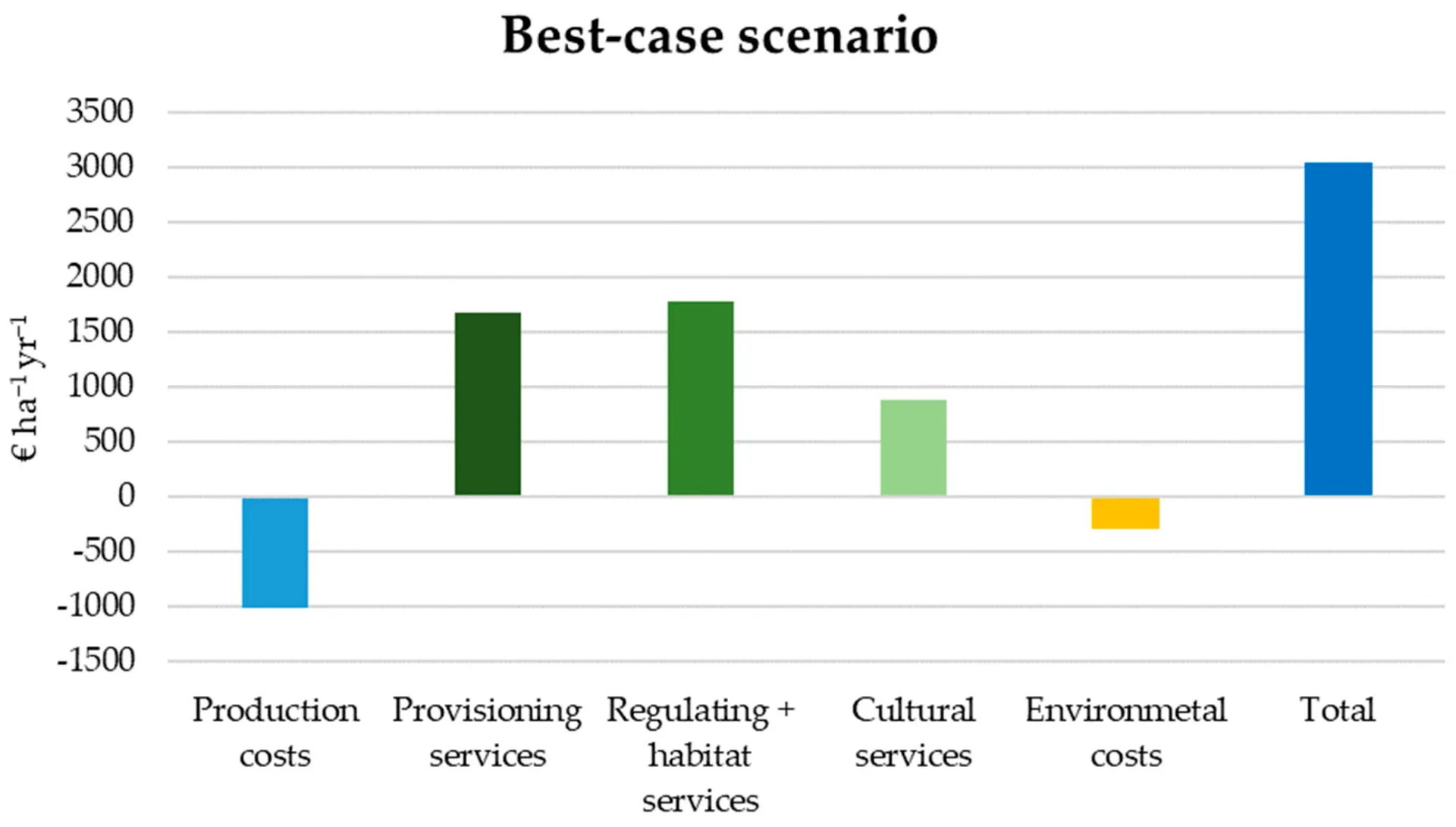
Monetized internal and external costs and benefits - Worst Case
ADVANCING SUSTAINABLE BIOENERGY DEVELOPMENT
New, advanced technologies make it possible to produce climate neutral fuels from non-forest and non-food energy crops. The benefits of cultivation and use of these energy crops for transport fuels and electricity goes beyond the benefits of reducing greenhouse gas emissions. Terrestrial energy crop cultivation and aquatic energy crop harvesting reverses land and water degradation, increases biodiversity and carbon sequestration and improves land fertility. We call this
Deep Green Biomass. Moreover, deploying these energy crops for the production of advanced biofuels will positively impact social-economic structures and energy independence and reduce the need for involuntary migration and deforestation: Deep Green Energy.
Deep Green Energy Partners works to accelerate deployment of deep green biomass for the production of advanced biofuels and biochemicals, to restore soil and water conditions and to optimize the overall ecological-economic effects of investments in the energy transition.
GHG emissions for both advanced biofuels and heat are far below those of fossil fuels. Moreover it is the only to produce GHG negative electricity or heat when technical CCS becomes available.
As raw biomass is voluminous, has to be transported from the field and contains 20-80% water at harvest, removing water and/or compressing the energy per mass unit at some stage in the value chain, which impacts the primary-final energy efficiencies. Thus the conversion method, i.e. drying, shredding, pelletization, gasification or liquefaction and it's moment in the value chain impact the final efficiency comparison. During the various conversion processes water and impurities are removed resulting in final fuels that burn cleaner than fossil fuels and emit less harmful substances.
Changing will take time and money, energy system have time spans of between 20 yeaare long e su but not doing it will cost more to all those countries, companies and consumers that don't profit from fossil fuels production. The projected emissions from fossil energy alone will already have used up the remaining carbon budget of ~200GtCO2eq for 1.5°C GW by 2028. And supposing we would be able to keep all other anthropogenic emissions at current levels, emissions from energy would have exhausted the remaining carbon budget of ~1150GtCO2eq for 2°C GW by around 2043. So we better assess our options how best to replace as much fossil fuels as possible before we have run out of the financial means to do so.
As the focus has been on global warming and the emissions this has led to modelling the monetized financial cost and the potentially avoided cost of GW by renewable energy as policy drivers. The impacts on biodiversity and ecosystems are however far more challenging to asses as ecosystems are unique, local, site-specific and the impacts of incremental and irreversible ecosystem losses result in rapidly nearing ecosystem collapses. Moreover, as most of the ecosystem cost for energy incur in the mining, processing and equipment production outside, and beyond the control of the country of deployment it makes the supply chain costs to ecosystems highly dependable on difficult to influence resource extraction practices.
Moreover, the financial benefits of renewable energy can always be positive as these are set by the production cost in a semi-monopolistic market largely controlled by governments. As we have recently seen projected cost for e.g. wind energy were far lower than actual cost but these can be simply compensated by increased prices that are justified by increasing the "cost" for CO2eq
emissions up to the objective cost of about Eur 180 per ton CO2eq. As there is no objective price for the cost for ecosystem losses and the successive feedback loops, monetizing ecosystem services is only useful ecosystem impacts: it is either positive or negative.
ADVANCING SUSTAINABLE BIOENERGY DEVELOPMENT
New, advanced technologies make it possible to produce climate neutral fuels from non-forest and non-food energy crops. The benefits of cultivation and use of these energy crops for transport fuels and electricity goes beyond the benefits of reducing greenhouse gas emissions. Terrestrial energy crop cultivation and aquatic energy crop harvesting reverses land and water degradation, increases biodiversity and carbon sequestration and improves land fertility. We call this
Deep Green Biomass. Moreover, deploying these energy crops for the production of advanced biofuels will positively impact social-economic structures and energy independence and reduce the need for involuntary migration and deforestation: Deep Green Energy.
Deep Green Energy Partners works to accelerate deployment of deep green biomass for the production of advanced biofuels and biochemicals, to restore soil and water conditions and to optimize the overall ecological-economic effects of investments in the energy transition.
All energy increases and deployment options come however with their particular impacts on climate change and the environment, like GHG emissions, deforestation, habitat destruction or soil, water and air pollutionThe impacts on biodiversity and ecosystems from primary energy extraction/generation are however more challenging to asses as ecosystems are unique and local, site and technology-specific. Moreover, the cost and impacts of incremental, irreversible ecosystems losses increase almost exponentially as ecosystems are interconnected and the collaps of one system spills over to other systems .
In other words unless energy is produced with positive ecosystem (natural capital) effects the impacts on global GDP (produced capital) will be always negative, no matter the financial profits or GHG emissions, unless the positive impacts of negative GHG emissions (i.e. net carbon removal) off-set the ecosystem damages.
ADVANCING SUSTAINABLE BIOENERGY DEVELOPMENT
New, advanced technologies make it possible to produce climate neutral fuels from non-forest and non-food energy crops. The benefits of cultivation and use of these energy crops for transport fuels and electricity goes beyond the benefits of reducing greenhouse gas emissions. Terrestrial energy crop cultivation and aquatic energy crop harvesting reverses land and water degradation, increases biodiversity and carbon sequestration and improves land fertility. We call this
Deep Green Biomass. Moreover, deploying these energy crops for the production of advanced biofuels will positively impact social-economic structures and energy independence and reduce the need for involuntary migration and deforestation: Deep Green Energy.
Deep Green Energy Partners works to accelerate deployment of deep green biomass for the production of advanced biofuels and biochemicals, to restore soil and water conditions and to optimize the overall ecological-economic effects of investments in the energy transition.
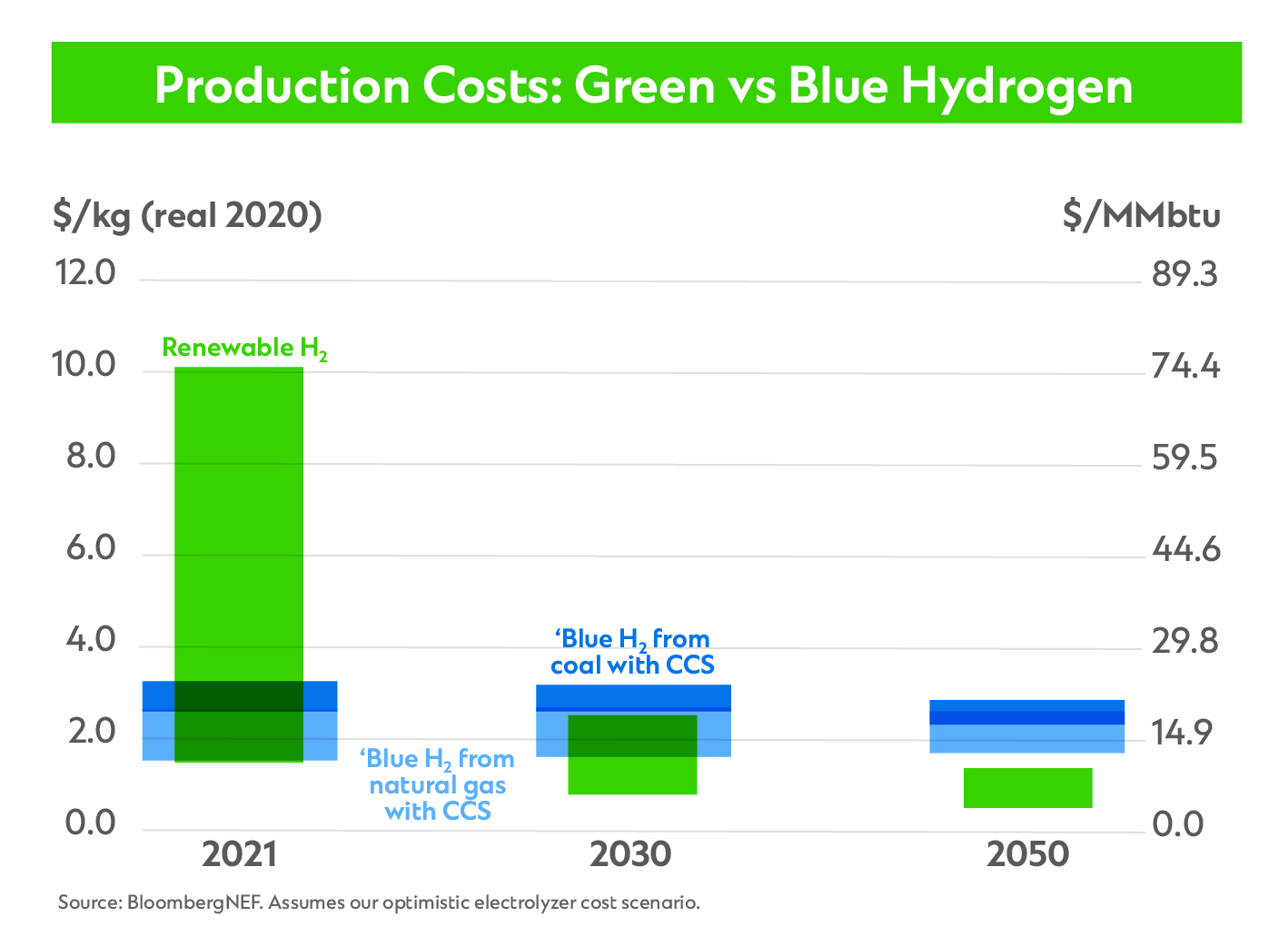
The plannend large scale conversion of fossil fuels to hydrogen will amplify this effect as long as viable carbon capture is not available. Moreover, given the cost difference between fossil "Blue or Grey" hydrogen and ''Green" hydrogen form surplus low-carbon electricity as well as the availability difference for both hydrogen production, hydrogen will likely remain fossil based if it is starts-out as Blue or Gray and emissions will increase in parallel.
ADVANCING SUSTAINABLE BIOENERGY DEVELOPMENT
New, advanced technologies make it possible to produce climate neutral fuels from non-forest and non-food energy crops. The benefits of cultivation and use of these energy crops for transport fuels and electricity goes beyond the benefits of reducing greenhouse gas emissions. Terrestrial energy crop cultivation and aquatic energy crop harvesting reverses land and water degradation, increases biodiversity and carbon sequestration and improves land fertility. We call this
Deep Green Biomass. Moreover, deploying these energy crops for the production of advanced biofuels will positively impact social-economic structures and energy independence and reduce the need for involuntary migration and deforestation: Deep Green Energy.
Deep Green Energy Partners works to accelerate deployment of deep green biomass for the production of advanced biofuels and biochemicals, to restore soil and water conditions and to optimize the overall ecological-economic effects of investments in the energy transition.
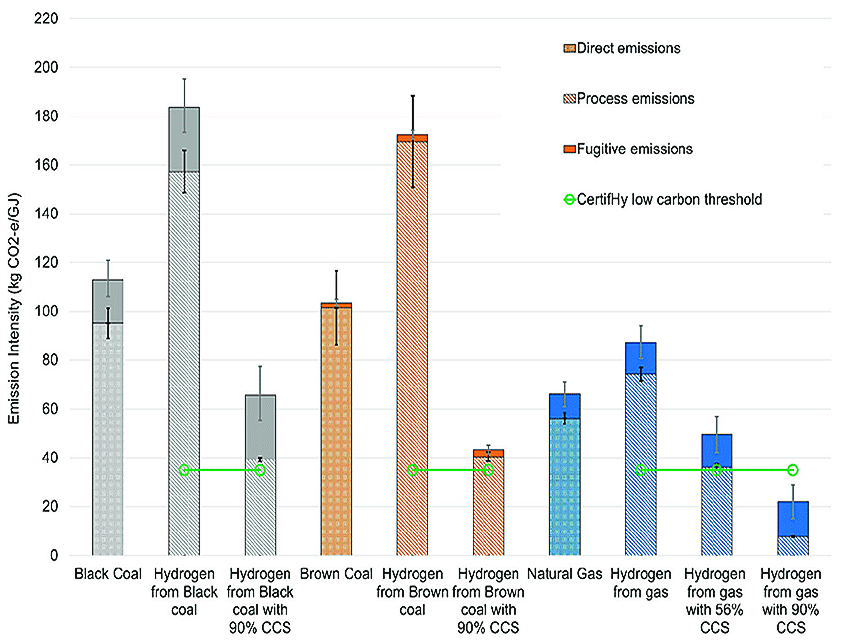
When factoring the
methane leakages from the natural gas supply chain on average
1-2% average the difference between GHG emissions from gas and coal are more equal.
Hydrogen faces the same leakage problems as natural gas, which worsen if the current gas infrastructure is deployed
as hydrogen is a much smaller molecule than methane (natural gas).
Replacing electricity by hydrogen reduces the energy efficiency considerably. The efficiency of net-zero hydrogen from electricity is about 60%: 20%- 30% of energy is lost in the process of creating hydrogen, than the hydrogen must then be compressed and stored, losing at least another 10%.
When used directly in combustion engines efficiency losses from hydrogen and E-fuels are about 75%.
Electrification of applications that rely on high density fuels and represent most of the total energy use, heavy transport, industry, centralized urban heating/cooling is however difficult and therefore converting electricity to high density hydrogen (or E-fuels) is promoted as the solution. Hydrogen however has to be produced using energy sources as "feedstock", thus any emissions from it's production have to be added to the emissions from the production of it's feedstock. And when this feedstock consists of grid electricity it increases emissions substantially. If not burned directly but stored to be used for electricity at a later time, another 30% is lost when converting the hydrogen back into electricity leaving only 30–40% of the primary energy used to produce electricity at best.
ADVANCING SUSTAINABLE BIOENERGY DEVELOPMENT
New, advanced technologies make it possible to produce climate neutral fuels from non-forest and non-food energy crops. The benefits of cultivation and use of these energy crops for transport fuels and electricity goes beyond the benefits of reducing greenhouse gas emissions. Terrestrial energy crop cultivation and aquatic energy crop harvesting reverses land and water degradation, increases biodiversity and carbon sequestration and improves land fertility. We call this
Deep Green Biomass. Moreover, deploying these energy crops for the production of advanced biofuels will positively impact social-economic structures and energy independence and reduce the need for involuntary migration and deforestation: Deep Green Energy.
Deep Green Energy Partners works to accelerate deployment of deep green biomass for the production of advanced biofuels and biochemicals, to restore soil and water conditions and to optimize the overall ecological-economic effects of investments in the energy transition.
When bioenergy is deployed for electricity it is less efficient compared to low-carbon renewables, but compared to coal, natural gas and nuclear, at conversion efficiency rates of between 30-35%, 33-60%, 33-45% respectively, biomass is comparable or better with a conversion efficiency rate of between 35-85%. Net-GHG emissions from biomass are always lower than those of fossil fuels, and close to, or lower than those of non-carbon renewables and nuclear depending from where it is sourced.
The conversion efficiencies for advanced biofuels for transport are 50%-60% compared to oil and gas, and 70-100% compared to hydrogen. Deployed for industrial heat the energy efficiency of biomass is comparable or a little below to those fossil fuels. GHG emissions for both advanced biofuels and heat are far below those of fossil fuels. Moreover it is the only to produce GHG negative electricity or heat when technical CCS becomes available.
As raw biomass is voluminous, has to be transported from the field and contains 20-80% water at harvest, removing water and/or compressing the energy per mass unit at some stage in the value chain, which impacts the primary-final energy efficiencies. Thus the conversion method, i.e. drying, shredding, pelletization, gasification or liquefaction and it's moment in the value chain impact the final efficiency comparison. During the various conversion processes water and impurities are removed resulting in final fuels that burn cleaner than fossil fuels and emit less harmful substances.
ADVANCING SUSTAINABLE BIOENERGY DEVELOPMENT
New, advanced technologies make it possible to produce climate neutral fuels from non-forest and non-food energy crops. The benefits of cultivation and use of these energy crops for transport fuels and electricity goes beyond the benefits of reducing greenhouse gas emissions. Terrestrial energy crop cultivation and aquatic energy crop harvesting reverses land and water degradation, increases biodiversity and carbon sequestration and improves land fertility. We call this
Deep Green Biomass. Moreover, deploying these energy crops for the production of advanced biofuels will positively impact social-economic structures and energy independence and reduce the need for involuntary migration and deforestation: Deep Green Energy.
Deep Green Energy Partners works to accelerate deployment of deep green biomass for the production of advanced biofuels and biochemicals, to restore soil and water conditions and to optimize the overall ecological-economic effects of investments in the energy transition.
Bioenergy can be renewable, sustainable, both or neither. Biomass is only renewable when it can be regenerated faster than it is being used, i.e. when it is additionally planted for the specific purpose to provide energy, and carbon is sequestered by its regrowth at a least the same rate as it used for combustion. Biomass is only sustainable when it is renewable, does not compete for land and water with food production, carbon sequestration or biodiversity, it's direct positive impacts on ecosystems outweigh it's negative ones and it is economical viable, i.e. it has a positive score for financial, GDP and ecosystems services.
Trees and waste thus don't qualify. Planted trees for bioenergy take at least 20-30 years to grow and recover the carbon from their combustion and is mostly only economical viable by harvesting practices that have negative ecosystems impacts. Burning "true biowaste" might avoid the emissions from the fossil fuels it replaces but has no positive impact on ecosystems as such. Moreover, any potential positive carbon sequestration and other ecosystem benefits are already included in the life cycle of the product from which it is derived. Biowaste is therefore comparable to low-carbon renewable energy: maximum benefits are limited to the net avoided emissions by substitution of fossil fuels. The only type of biomass that can fulfill all sustainable criteria are energy crops. Energy crop cultivation not only provides the most efficient option for removing carbon from the atmosphere but also an ecological and economic viable business case as illustrated for Miscanthus cultivation for bioenergy in Germany.
ADVANCING SUSTAINABLE BIOENERGY DEVELOPMENT
New, advanced technologies make it possible to produce climate neutral fuels from non-forest and non-food energy crops. The benefits of cultivation and use of these energy crops for transport fuels and electricity goes beyond the benefits of reducing greenhouse gas emissions. Terrestrial energy crop cultivation and aquatic energy crop harvesting reverses land and water degradation, increases biodiversity and carbon sequestration and improves land fertility. We call this
Deep Green Biomass. Moreover, deploying these energy crops for the production of advanced biofuels will positively impact social-economic structures and energy independence and reduce the need for involuntary migration and deforestation: Deep Green Energy.
Deep Green Energy Partners works to accelerate deployment of deep green biomass for the production of advanced biofuels and biochemicals, to restore soil and water conditions and to optimize the overall ecological-economic effects of investments in the energy transition.
The global land area dedicated to energy crops needed for below 2C GW scenarios was projected to be between 180 million ha and 1084 million ha. About 500 million ha of suitable land is readily available without conflicting with forests, other natural lands or agricultural land
and the remainder will become available from agricultural lands that are already degrading and will be abandoned
as their exploitation will no longer be viable within the next decades and on which (af)forestation is not viable.
The carbon and thus energy sequestration rate of various energy crops differ considerably between species and climate zones. In temperate climate zones Miscanthus sequesters on average about ~38 GtCO2
annually per hectare (ha/y) (with substantial differences between e.g Germany and Spain),
Napier grass in (sub)-tropical climate zones
in e.g. Zimbabwe can however sequester ~170 GtCO2
per ha/y. As a rule of thumb: the worse the soil and land conditions, the lower the yield without preliminary soil improvements but the higher the carbon sequestration rates and ecosystem benefits. Between 18-30% of al CO2 is stored away in soils.
An average yield of 28.15 tDM represents between ~ 475 GJ in gross primary energy. Deducting 10% to compensate for panting and harvest leaves ~ 435 GJ net bioenergy for the production of electricity and fuels. As the conversion efficiency ratios for biomass, fossil fuels and low-carbon energy to electricity and fuels are different we have to assess how this 435 GJ is best deployed.
A case study for Miscanthus in Germany
is illustrative for how energy crop cultivation even in the worst case scenario still delivers net GHG, ecosystem services and economic gains at a yield of 15tDM/ha, a CO2
emission price of ~ EUR 26/ton and a Miscanthus sale price of EUR 80/tDM. In the average, or middle of the road scenario and using the 2023 EU ETS price of EUR 80 the average total monetized benefits would increase from ~ EUR 1.800 per ha/year to ~ EUR 4.000 ha/y, of which ~EUR 1.500 are attributable to increased ecosystem services.
ADVANCING SUSTAINABLE BIOENERGY DEVELOPMENT
New, advanced technologies make it possible to produce climate neutral fuels from non-forest and non-food energy crops. The benefits of cultivation and use of these energy crops for transport fuels and electricity goes beyond the benefits of reducing greenhouse gas emissions. Terrestrial energy crop cultivation and aquatic energy crop harvesting reverses land and water degradation, increases biodiversity and carbon sequestration and improves land fertility. We call this
Deep Green Biomass. Moreover, deploying these energy crops for the production of advanced biofuels will positively impact social-economic structures and energy independence and reduce the need for involuntary migration and deforestation: Deep Green Energy.
Deep Green Energy Partners works to accelerate deployment of deep green biomass for the production of advanced biofuels and biochemicals, to restore soil and water conditions and to optimize the overall ecological-economic effects of investments in the energy transition.
Extrapolating these numbers, cultivating 0.5 billion hectares with the mean yield for of 16.3 tDM for Miscanthus would capture about ~19 GtCO2 annually, and if 0.5 billion hectares would be located in the (sub) tropics and planted with Napier grass with a mean yield for of 40 tDMs would be about 47 GtCO2..
Together this would be 66 GtCO2 of which 25%, 16.5 CtCO2
is stored below ground for soil and ecosystem improvement. This is more than the potential maximum by optimizing land-management practices without the inevitable land use change from climate change, climate change will drive more agriculture land out of business and energy crops are the far more sustainable and carbon sequestration efficient new occupants of those lands. An average yield of 28.15 tDM represents between ~ 475 GJ in gross primary energy. Deducting 10% to compensate for panting and harvest leaves ~ 435 GJ net bioenergy for the production of electricity and fuels. As the conversion efficiency ratios for biomass, fossil fuels and low-carbon energy to electricity and fuels are different we have to assess how this 435 GJ is best deployed.
If all German energy crops would be converted to isobutanol to replace fossil petrol
this would reduce the value of net CO2 profits by 0.6tn (-2.1tn from combustion and + 1.5 tn from avoided emissions by substitution). Leaving a net of 3.4 trillion in overall profits.
ADVANCING SUSTAINABLE BIOENERGY DEVELOPMENT
New, advanced technologies make it possible to produce climate neutral fuels from non-forest and non-food energy crops. The benefits of cultivation and use of these energy crops for transport fuels and electricity goes beyond the benefits of reducing greenhouse gas emissions. Terrestrial energy crop cultivation and aquatic energy crop harvesting reverses land and water degradation, increases biodiversity and carbon sequestration and improves land fertility. We call this
Deep Green Biomass. Moreover, deploying these energy crops for the production of advanced biofuels will positively impact social-economic structures and energy independence and reduce the need for involuntary migration and deforestation: Deep Green Energy.
Deep Green Energy Partners works to accelerate deployment of deep green biomass for the production of advanced biofuels and biochemicals, to restore soil and water conditions and to optimize the overall ecological-economic effects of investments in the energy transition.
Energy Today about 1 million hectares are planted with dedicated energy crops worldwide The theoretical potential for additional above and belowground carbon sequestration by improving agricultural land management practices is ~13.74 Gt carbon (C)/year, which equals 50 GtCO2eq/year, 25% more than today's total energy emissions and ~20% of the emissions in 2050.
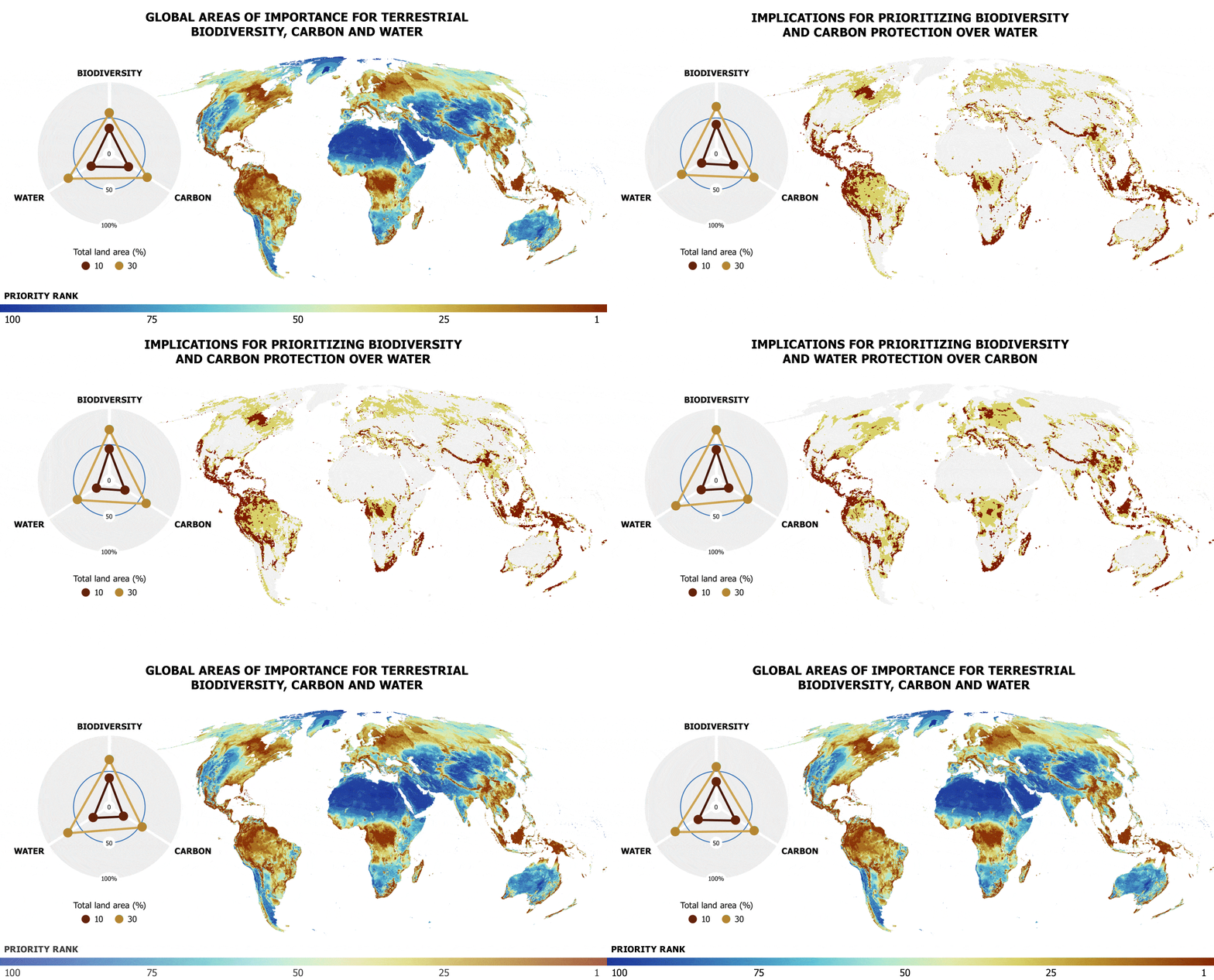
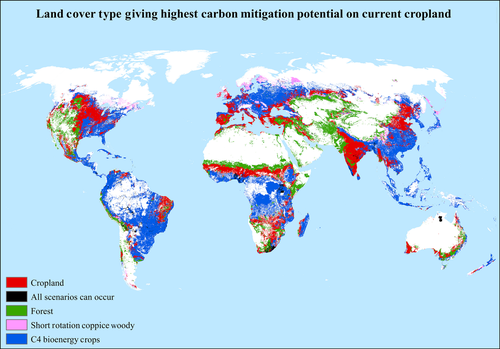
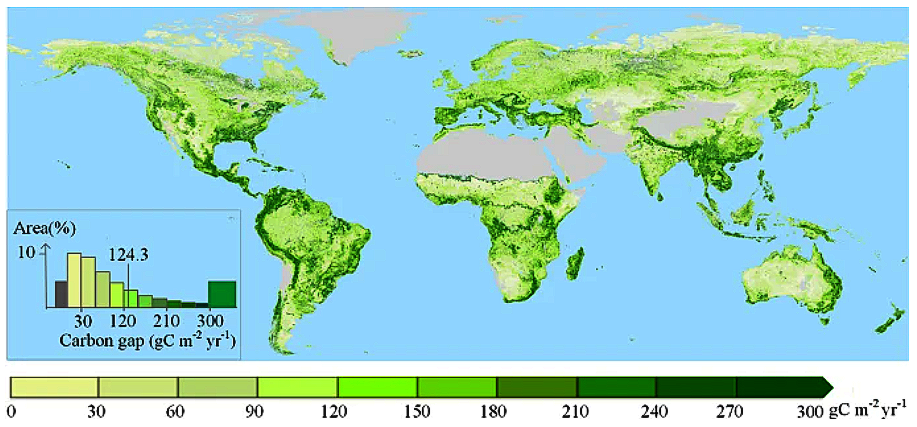
Global areas suitable and available for energy crops to the end of the century, Land suitability for energy crops under scenarios of climate change and land-use
ADVANCING SUSTAINABLE BIOENERGY DEVELOPMENT
New, advanced technologies make it possible to produce climate neutral fuels from non-forest and non-food energy crops. The benefits of cultivation and use of these energy crops for transport fuels and electricity goes beyond the benefits of reducing greenhouse gas emissions. Terrestrial energy crop cultivation and aquatic energy crop harvesting reverses land and water degradation, increases biodiversity and carbon sequestration and improves land fertility. We call this
Deep Green Biomass. Moreover, deploying these energy crops for the production of advanced biofuels will positively impact social-economic structures and energy independence and reduce the need for involuntary migration and deforestation: Deep Green Energy.
Deep Green Energy Partners works to accelerate deployment of deep green biomass for the production of advanced biofuels and biochemicals, to restore soil and water conditions and to optimize the overall ecological-economic effects of investments in the energy transition.
As meaningful and energy viable technical carbon capture is not to be expected within the next few decades (see above), bioenergy is the only relevant option to stay anywhere near 2°C GW, but therefore it has be sourced from sustainable biomass sources. Biomass is only sustainable when it is a) renewable, i.e. when it is additionally planted for the specific purpose to provide energy, and carbon is sequestered by its regrowth at a least the same rate as it used for combustion b) does not compete for land and water with food production, carbon sequestration or biodiversity and c) has direct positive impacts on ecosystems.
. Dedicated planted energy crops provides the most efficient option for restoring part of the 133Gt carbon the world’s soils have lost. if we assume no carbon capture or closed system energy production and all additional carbon sequestration comes from sustainable biomass we could theoretically burn all the additional harvest for electricity, heat and transport and still remove ~12.5 GtCO2eq/year. Trees and waste thus don't qualify. Planted trees take at least 20-30 years to grow and recover the carbon from their combustion. Burning "true biowaste" might avoid the emissions from the fossil fuels it replaces but has no positive impact on ecosystems as such. Moreover, any potential positive carbon sequestration and other ecosystem benefits are already included in the life cycle of the product that ........ . Biowaste is therefore comparable to low-carbon renewable energy: maximum benefits are limited to the net avoided emissions by substitution of fossil fuels. The only type of biomass that can fulfill all sustainable criteria are energy crops. Energy crop cultivation not only provides the most efficient option for restoring part of the
133Gt carbon the world’s soils have lost but also an ecological and economic viable business case for bioenergy.
Bioenergy could theoretically help to decarbonize ~50% of all global GHG emissions, depending on land availability and carbon sequestration rates. The potential for sustainable, additional above and belowground carbon sequestration by improving land management practices is however ~13.74 Gt carbon (C)/year, which equals 50 GtCO2eq/year, 25% more than today's total energy emissions and ~20% of the emissions in 2050. About 20-30% of all CO2
sequestered by vegetation is stored below ground from where it restores soil health and ecosystems. Thus, if we assume no carbon capture or closed system energy production and all additional carbon sequestration comes from sustainable biomass we could theoretically burn all the additional harvest for electricity, heat and transport and still remove ~12.5 GtCO2eq/year.
ADVANCING SUSTAINABLE BIOENERGY DEVELOPMENT
New, advanced technologies make it possible to produce climate neutral fuels from non-forest and non-food energy crops. The benefits of cultivation and use of these energy crops for transport fuels and electricity goes beyond the benefits of reducing greenhouse gas emissions. Terrestrial energy crop cultivation and aquatic energy crop harvesting reverses land and water degradation, increases biodiversity and carbon sequestration and improves land fertility. We call this
Deep Green Biomass. Moreover, deploying these energy crops for the production of advanced biofuels will positively impact social-economic structures and energy independence and reduce the need for involuntary migration and deforestation: Deep Green Energy.
Deep Green Energy Partners works to accelerate deployment of deep green biomass for the production of advanced biofuels and biochemicals, to restore soil and water conditions and to optimize the overall ecological-economic effects of investments in the energy transition.
Energy crops are the only type of biomass that can fulfill all sustainable criteria. Energy crop cultivation not only provides the most efficient option for restoring the 133Gt carbon the world’s soils have lost but also an economical viable business case. The global land area dedicated to energy crops needed for below 2C GW scenarios was projected to be between 180 million ha and 1084 million ha. About 500 million ha of suitable land is readily available without conflicting with forests, other natural lands or agricultural land
and the remainder will become available from agricultural lands that are already degrading and will be abandoned
as their exploitation will no longer be viable within the next decades and on which (af)forestation is not viable.
The carbon and thus energy sequestration rate of various energy crops differ considerably between species and climate zones. In temperate climate zones Miscanthus sequesters on average about ~38 GtCO2 annually per hectare (ha/y) (with substantial differences between e.g Germany and Spain),
Napier grass in (sub)-tropical climate zones
in e.g. Zimbabwe can however sequester ~170 GtCO2
per ha/y. As a rule of thumb: the worse the soil and land conditions, the lower the yield but the higher the carbon sequestration rates and ecosystem benefits. A case study for Miscanthus in Germany
is illustrative for how energy crop cultivation even in the worst case scenario still delivers net GHG, ecosystem services and economic gains at a yield of 15tDM/ha, a CO2
emission price of ~ EUR 26/ton and a Miscanthus sale price of EUR 80/tDM. In the average, or middle of the road scenario and using the 2023 EU ETS price of EUR 80 the average total monetized benefits would increase from ~ EUR 1.800 per ha/year to ~ EUR 4.000 ha/y, of which ~EUR 1.500 are attributable to increased ecosystem services.
ADVANCING SUSTAINABLE BIOENERGY DEVELOPMENT
New, advanced technologies make it possible to produce climate neutral fuels from non-forest and non-food energy crops. The benefits of cultivation and use of these energy crops for transport fuels and electricity goes beyond the benefits of reducing greenhouse gas emissions. Terrestrial energy crop cultivation and aquatic energy crop harvesting reverses land and water degradation, increases biodiversity and carbon sequestration and improves land fertility. We call this
Deep Green Biomass. Moreover, deploying these energy crops for the production of advanced biofuels will positively impact social-economic structures and energy independence and reduce the need for involuntary migration and deforestation: Deep Green Energy.
Deep Green Energy Partners works to accelerate deployment of deep green biomass for the production of advanced biofuels and biochemicals, to restore soil and water conditions and to optimize the overall ecological-economic effects of investments in the energy transition.
Extrapolating these numbers, cultivating 0.5 billion hectares with the mean yield for of 16.3 tDM for Miscanthus would capture about ~19 GtCO2 annually, and if 0.5 billion hectares would be located in the (sub) tropics and planted with Napier grass with a mean yield for of 40 tDMs would be about 47 GtCO2..
Together this would be 66 GtCO2 of which 25%, 16.5 CtCO2
is stored below ground for soil and ecosystem improvement. This is more than the potential maximum by optimizing land-management practices without the inevitable land use change from climate change, climate change will drive more agriculture land out of business and energy crops are the far more sustainable and carbon sequestration efficient new occupants of those lands. An average yield of 28.15 tDM represents between ~ 475 GJ in gross primary energy. Deducting 10% to compensate for panting and harvest leaves ~ 435 GJ net bioenergy for the production of electricity and fuels. As the conversion efficiency ratios for biomass, fossil fuels and low-carbon energy to electricity and fuels are different we have to assess how this 435 GJ is best deployed.
If all German energy crops would be converted to isobutanol to replace fossil petrol
this would reduce the value of net CO2 profits by 0.6tn (-2.1tn from combustion and + 1.5 tn from avoided emissions by substitution). Leaving a net of 3.4 trillion in overall profits.
When factoring the
methane leakages from the natural gas supply chain
(between 0.65 and 66.2%) the difference between GHG emissions from gas and coal are about equal when accounting the estimated
1-2% average supply chain leakages. Hydrogen faces the same leakage problems as natural gas, which worsen if the current gas infrastructure is deployed
as hydrogen is a much smaller molecule than methane (natural gas).
So, until carbon capture is large scale available and effective hydro, solar and wind are the best options for electricity from both an energy conversion and GHG emissions perspective. Second place is shared by biomass and nuclear. Actual GHG emissions for biomass depending on the carbon sequestration rate during growth of the particular biomass deployed or the avoided emissions from the particular bio-waste decay versus it's combustion for electricity. Third place is for fossil fuels and fourth place is shared by hydrogen and other E-fuels.
Biomass and hydrogen are regarded as the two options to complement the replacement of fossil fuels by hydro, solar, wind and nuclear. As shown below, without efficient carbon capture hydrogen will increase emissions by 50-100%, while when carbon capture is available electricity from fossil fuels, become close to GHG neutral, except for the leaked emissions, and biomass GHG emissions become negative. Hydrogen is therefore basically only interesting from a mid-term GHG perspective when it is produced from surplus hydro, solar or wind electricity and used in situ. Biomass and fossil fuels are simply more efficiently deployed for electricity directly than when first converted to hydrogen.
ADVANCING SUSTAINABLE BIOENERGY DEVELOPMENT
New, advanced technologies make it possible to produce climate neutral fuels from non-forest and non-food energy crops. The benefits of cultivation and use of these energy crops for transport fuels and electricity goes beyond the benefits of reducing greenhouse gas emissions. Terrestrial energy crop cultivation and aquatic energy crop harvesting reverses land and water degradation, increases biodiversity and carbon sequestration and improves land fertility. We call this
Deep Green Biomass. Moreover, deploying these energy crops for the production of advanced biofuels will positively impact social-economic structures and energy independence and reduce the need for involuntary migration and deforestation: Deep Green Energy.
Deep Green Energy Partners works to accelerate deployment of deep green biomass for the production of advanced biofuels and biochemicals, to restore soil and water conditions and to optimize the overall ecological-economic effects of investments in the energy transition.
Depending on the energy used throughout the supply chain, actual GHG savings for electric cars are between
35% and 75% and
emission savings from electric heat pumps are between 30% and 60%
compared to gas heating under normal climate conditions. In conclusion: energy in the form electricity is most efficiently produced, conversion and GHG emissions, from renewables, electricity is the most efficient energy option for low density energy demand.
Like said the total primary energy use in 2020 was 611 EJ, of which 63 %, i.e., 385.8 EJ are used for fuel production and industrial processes. The first pie shows the total primary energy supply were used for fuel production and industrial processes. The next pies show the primary energy, conversion losses and final energy consumption for heat and fuels.
ADVANCING SUSTAINABLE BIOENERGY DEVELOPMENT
New, advanced technologies make it possible to produce climate neutral fuels from non-forest and non-food energy crops. The benefits of cultivation and use of these energy crops for transport fuels and electricity goes beyond the benefits of reducing greenhouse gas emissions. Terrestrial energy crop cultivation and aquatic energy crop harvesting reverses land and water degradation, increases biodiversity and carbon sequestration and improves land fertility. We call this
Deep Green Biomass. Moreover, deploying these energy crops for the production of advanced biofuels will positively impact social-economic structures and energy independence and reduce the need for involuntary migration and deforestation: Deep Green Energy.
Deep Green Energy Partners works to accelerate deployment of deep green biomass for the production of advanced biofuels and biochemicals, to restore soil and water conditions and to optimize the overall ecological-economic effects of investments in the energy transition.
The conversion losses from the current energy mix for producing fuels and heat are 14 %. About 87% of all energy for heat and fuels still comes from fossil sources and by far most of the remaining energy from biomass. GHG emissions from thermal energy and fuel production more or less the same emissions apply as for electricity, so after compensating for leakage all fossil sources are about the same. There is however a substantial difference in the energy conversion efficiencies to thermal energy. Natural gas has the highest thermal conversion rate with barely any losses, oil is second with 87%, biomass third with 80% and coal takes last place again with 70%.
Hydrogen and E-fuels have thermal efficiencies comparable to gas, making their deployment in industry as substitute from a GHG perspective more attractive but again, only when produced in situ from surplus electricity or with efficient carbon capture deployment. In transport hydrogen or E-fuels are a factor 3 or more less GHG efficient than electricity and advanced biofuels and when compared to first generation biofuels they are at best at par.
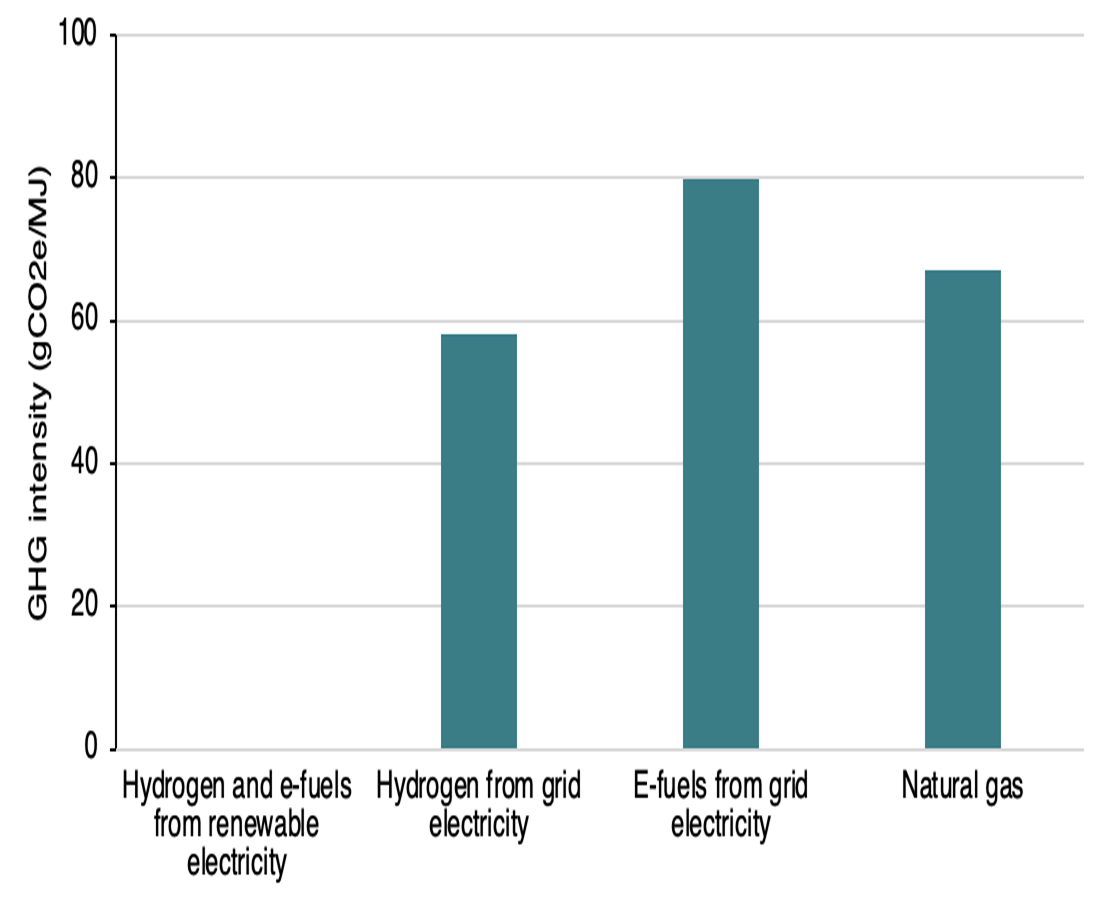
GHG emissions from various energy sources are well documented and relatively easy to assess and therefore simple to price. This has led to modelling the monetized financial cost and the avoided cost of GW by the alternatives for renewable energy as policy drivers. The impacts on biodiversity and ecosystems are far more challenging to asses as ecosystems are unique, local, site-specific and the impacts of incremental, irreversible species loss brings us rapidly closer to ecosystem collapses. Moreover, as most of the ecosystem cost for energy incur in the mining, processing and equipment production outside, and beyond the control of the country of deployment it makes the supply chain costs to ecosystems highly dependable on difficult to influence resource extraction practices.
Moreover, the financial benefits of renewable energy can always be positive as these are set by the production cost in a semi-monopolistic market largely controlled by governments. As we have recently seen projected cost for e.g. wind energy were far lower than actual cost but these can be simply compensated by increased prices that are justified by increasing the "cost" for CO2eq
emissions up to the objective cost of about Eur 180 per ton CO2eq. As there is no objective price for the cost for ecosystem losses and the successive feedback loops, monetizing ecosystem services is only useful ecosystem impacts: it is either positive or negative.
The ecosystem impacts of solar, wind and
hydro energy production differ considerably depending on the specifics by location but are always negative and can not be compensated internally by the production system. A holistic assessment for e.g Pakistan
of the potential energy mix including hydro, wind and solar for the year 2030 is illustrative: a total positive economic impact of up to USD 9617 million per year, with a complete loss of USD 1259 million per year in ecosystem services values and all three renewables contributing to the loss of ecosystem services. The ecosystem impacts of bioenergy on the other hand can be both positive or negative depending on it's source and how it is deployed.
ADVANCING SUSTAINABLE BIOENERGY DEVELOPMENT
New, advanced technologies make it possible to produce climate neutral fuels from non-forest and non-food energy crops. The benefits of cultivation and use of these energy crops for transport fuels and electricity goes beyond the benefits of reducing greenhouse gas emissions. Terrestrial energy crop cultivation and aquatic energy crop harvesting reverses land and water degradation, increases biodiversity and carbon sequestration and improves land fertility. We call this
Deep Green Biomass. Moreover, deploying these energy crops for the production of advanced biofuels will positively impact social-economic structures and energy independence and reduce the need for involuntary migration and deforestation: Deep Green Energy.
Deep Green Energy Partners works to accelerate deployment of deep green biomass for the production of advanced biofuels and biochemicals, to restore soil and water conditions and to optimize the overall ecological-economic effects of investments in the energy transition.
The picture for electricity is pretty clear: when produced from renewables they produce far less GHG emissions than fossil fuels unless carbon capture is deployed. When factoring the
methane leakages from the natural gas supply chain
the difference between GHG emissions from gas and coal are about equal at the estimated actual 1-2% average supply chain leakages. Front loaded GHG emissions will likely consume the remaining 1.5 C carbon budget. Hydrogen faces the same leakage problems as natural gas, which worsen if the current gas infrastructure is deployed
as hydrogen is a much smaller molecule than methane (natural gas) and causes additional GHG emissions unless it is produced from surplus renewable electricity and used in situ.
Renewable energy production is necessary to halt climate change and reverse associated biodiversity losses. However, generating the required technologies and infrastructure will drive an increase in the production of many metals, creating new mining threats for biodiversity. Mining activities are therefore putting increasing pressure on forests, Key Biodiversity Areas, protected areas and World Heritage sites globally, as mining advances into more remote, logistically challenging regions that have formerly been left untouched. Expanding mining activities in these locations, combined with declining ore grades, requires more invasive and energyintensive mineral extraction methods.
We need low carbon energy but the harder we push it, the faster we will reach the tipping points we are trying to avoid. There is only one solution to resolve the paradoxes of the energy transition: energy crops. Energy crops provide (close to) GHG neutral energy, regenerate and improve ecosystems and its supply chain can be close to circular.
We need low carbon energy but the harder we push it, the faster we will reach the tipping points we try to avoid.
There is only one solution to solve the paradoxes of the energy transition: energy crops. Energy crops provide (close to) GHG neutral energy, regenerate and improve ecosystems and its supply chain can be close to circular.
This is however not as easy as it sounds as impacts of energy production and use depend on specific business practices and technologies that fluctuate with time.
ADVANCING SUSTAINABLE BIOENERGY DEVELOPMENT
New, advanced technologies make it possible to produce climate neutral fuels from non-forest and non-food energy crops. The benefits of cultivation and use of these energy crops for transport fuels and electricity goes beyond the benefits of reducing greenhouse gas emissions. Terrestrial energy crop cultivation and aquatic energy crop harvesting reverses land and water degradation, increases biodiversity and carbon sequestration and improves land fertility. We call this
Deep Green Biomass. Moreover, deploying these energy crops for the production of advanced biofuels will positively impact social-economic structures and energy independence and reduce the need for involuntary migration and deforestation: Deep Green Energy.
Deep Green Energy Partners works to accelerate deployment of deep green biomass for the production of advanced biofuels and biochemicals, to restore soil and water conditions and to optimize the overall ecological-economic effects of investments in the energy transition.
Oil and gas are the most energy efficient options for high density thermal energy and fuels nergy for industry and heavy duty transport is most enegyefficiently from
Besides, the end-user equipment for hydrogen is almost absent today and they are expensive to produce. Biomass in comparison, has lower losses when used for power or heating, similar losses when used as transport fuel, can be deployed in heat and power plants and most transport modes with no or little adaption to infrastructure or end-user equipment and is cheaper to produce.
For , biomass is the only renewable option to replace fossil fuels. The impacts and efficiencies of bioenergy differ according to biomass source, the type of energy generated, production technology and the availability of carbon capture. For transport are GHG neutral.or ~75% of all energy use by 2050, biomass is the only renewable option to replace fossil fuels. The impacts and efficiencies of bioenergy differ according to biomass source, the type of energy generated, production technology and the availability of carbon capture. The emissions from hydrogen for electricty a + b , 90% conversion loss
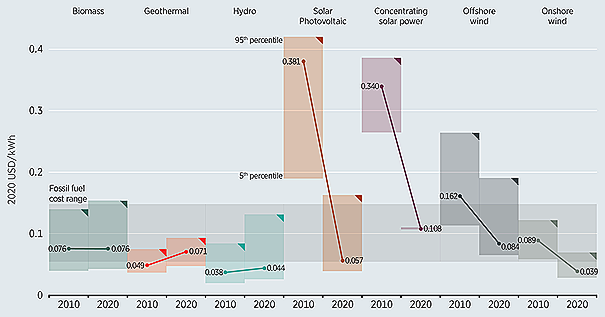
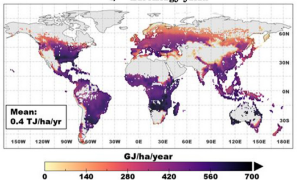
Holding global warming will require removing increasing amounts of CO2
from the atmosphere. Firstly, hard-to-abate carbon and methane emissions, i.e. 80% of all energy use, will have to be balanced with removals in order to achieve net-zero CO2 emissions from energy. CO2
emissions can be avoided by capturing CO2
from production processes in fossil and industry for either re-use or storage (CCUS). Carbon capture and removal can also happen through carbon sequestration by biomass (carbon farming).
CCUS at or before the smokestacks from refineries, factories and power plants is the most energy and cost efficient option as the carbon content in the captured stream is far more concentrated than in the air. CCUS can be retrofiitted to most industrial installations, but today about only 0.01% of all carbon emissions are captured at smokestacks and the technical, economic, and institutional feasibility is doubted. Direct air capture DAC(CS) has the advantage that it can be applied anywhere in the world but as the CO2
content in the captured air stream is low it's energy use outbalances it's benefits and DACCS is still in an experimental phase. Carbon farming is therefore the only reliable option for carbon sequestration for the next decades.
Electrification requires more energy production facilities like e.g. windturbines, solar panels or power plants, additional distribution infrastructure as well as end-user equipment which causes a lot of additional short term emissions. Electrification is largely a trade-off between emission intensity and material intensity over time. A recent comparison of
energy requirements and carbon emissions for a low-carbon energy transition shows that the initial push for a transition is likely to cause a 10–34% decline in net energy available to society. Moreover, it finds that the carbon emissions associated with the transition to
a low-carbon energy system are substantial, ranging from 70 to 395 GtCO2
(with a cross-scenario average of 195 GtCO2, 3 times the global annual emissions). The share of carbon emissions
for the energy system will increase by 10% today to 27% in 2050, and in some cases may take up all remaining emissions available to society under 1.5 °C pathways. Which partly explains the projected growth in fossil fuel production.
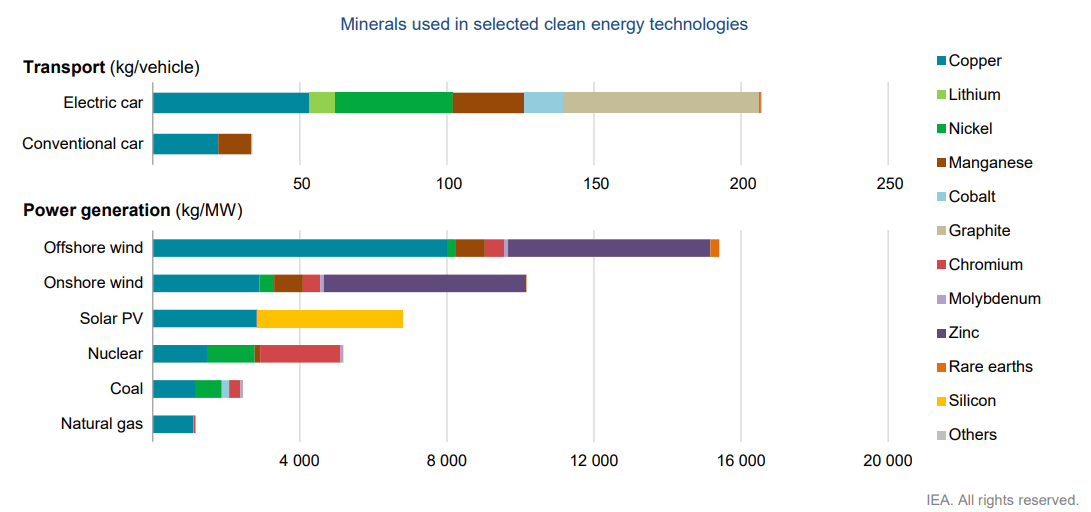
ADVANCING SUSTAINABLE BIOENERGY DEVELOPMENT
New, advanced technologies make it possible to produce climate neutral fuels from non-forest and non-food energy crops. The benefits of cultivation and use of these energy crops for transport fuels and electricity goes beyond the benefits of reducing greenhouse gas emissions. Terrestrial energy crop cultivation and aquatic energy crop harvesting reverses land and water degradation, increases biodiversity and carbon sequestration and improves land fertility. We call this
Deep Green Biomass. Moreover, deploying these energy crops for the production of advanced biofuels will positively impact social-economic structures and energy independence and reduce the need for involuntary migration and deforestation: Deep Green Energy.
Deep Green Energy Partners works to accelerate deployment of deep green biomass for the production of advanced biofuels and biochemicals, to restore soil and water conditions and to optimize the overall ecological-economic effects of investments in the energy transition.
Besides additional emissions electrification also requires additional mining which inevitably causes land clearing, toxic pollution and habitat destruction which both conflict with the need for terrestrial and aquatic biodiversity preservation. Most mining areas (82%) target materials needed for renewable energy production, and the areas that overlap with protected nature areas and remaining wilderness. Besides, mining also requires a lot of water and produces a lot of brine, which adds to the already growing water stress and food insecurity, especially in those mining areas that are already suffering from droughts. Mineral and metal mining requirements for electricity distribution infrastructure are about the same for all renewable options. But the additional mineral requirements of solar, wind and batteries are in the range of 400%-4000%, and those minerals are often found in the middle of critical ecosystems.
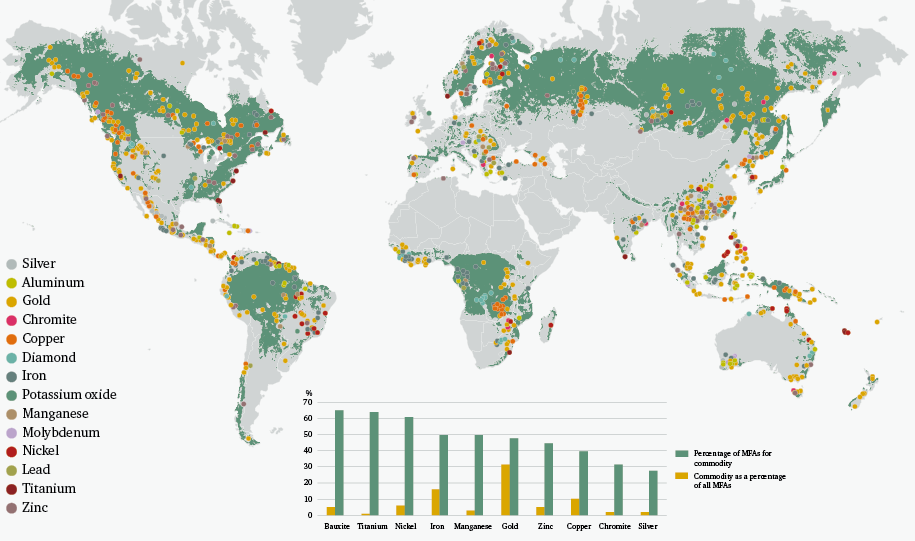
ADVANCING SUSTAINABLE BIOENERGY DEVELOPMENT
New, advanced technologies make it possible to produce climate neutral fuels from non-forest and non-food energy crops. The benefits of cultivation and use of these energy crops for transport fuels and electricity goes beyond the benefits of reducing greenhouse gas emissions. Terrestrial energy crop cultivation and aquatic energy crop harvesting reverses land and water degradation, increases biodiversity and carbon sequestration and improves land fertility. We call this
Deep Green Biomass. Moreover, deploying these energy crops for the production of advanced biofuels will positively impact social-economic structures and energy independence and reduce the need for involuntary migration and deforestation: Deep Green Energy.
Deep Green Energy Partners works to accelerate deployment of deep green biomass for the production of advanced biofuels and biochemicals, to restore soil and water conditions and to optimize the overall ecological-economic effects of investments in the energy transition.
Besides impacts from mining and distribution all renewable electricity options come with their own external environmental impacts that are largely situation dependent and therefore difficult to quantify. The general assumption is however that the external impacts on ecosystems from wind, solar and hydro energy generation are negative while that of biomass can be positive or negative depending on the biomass source. In summary: renewable electricity is neither green nor sustainable with the possible exception of sustainable biomass, and as renewable electricity supply is set to grow, so is the chance that the threats to biodiversity surpass those averted by climate change mitigation.
ADVANCING SUSTAINABLE BIOENERGY DEVELOPMENT
New, advanced technologies make it possible to produce climate neutral fuels from non-forest and non-food energy crops. The benefits of cultivation and use of these energy crops for transport fuels and electricity goes beyond the benefits of reducing greenhouse gas emissions. Terrestrial energy crop cultivation and aquatic energy crop harvesting reverses land and water degradation, increases biodiversity and carbon sequestration and improves land fertility. We call this
Deep Green Biomass. Moreover, deploying these energy crops for the production of advanced biofuels will positively impact social-economic structures and energy independence and reduce the need for involuntary migration and deforestation: Deep Green Energy.
Deep Green Energy Partners works to accelerate deployment of deep green biomass for the production of advanced biofuels and biochemicals, to restore soil and water conditions and to optimize the overall ecological-economic effects of investments in the energy transition.
Biomass can be a flexible deployed as a sustainable substitute for heating and cooking, electricity generation, the production of liquid or gaseous fuels for transport or other large numbers of chemicals, materials, and special products currently made from fossil energy. Demand for all sorts of bioenergy is growing as it is the only renewable option that can be used directly, replace or be blended with fossil fuels and sequesters CO2. The fact that biomass and bioenergy systems can be sustainable has made them a popular commodity, which however doesn't mean that they actually are.
Monetized internal and external costs and benefits - Best Case
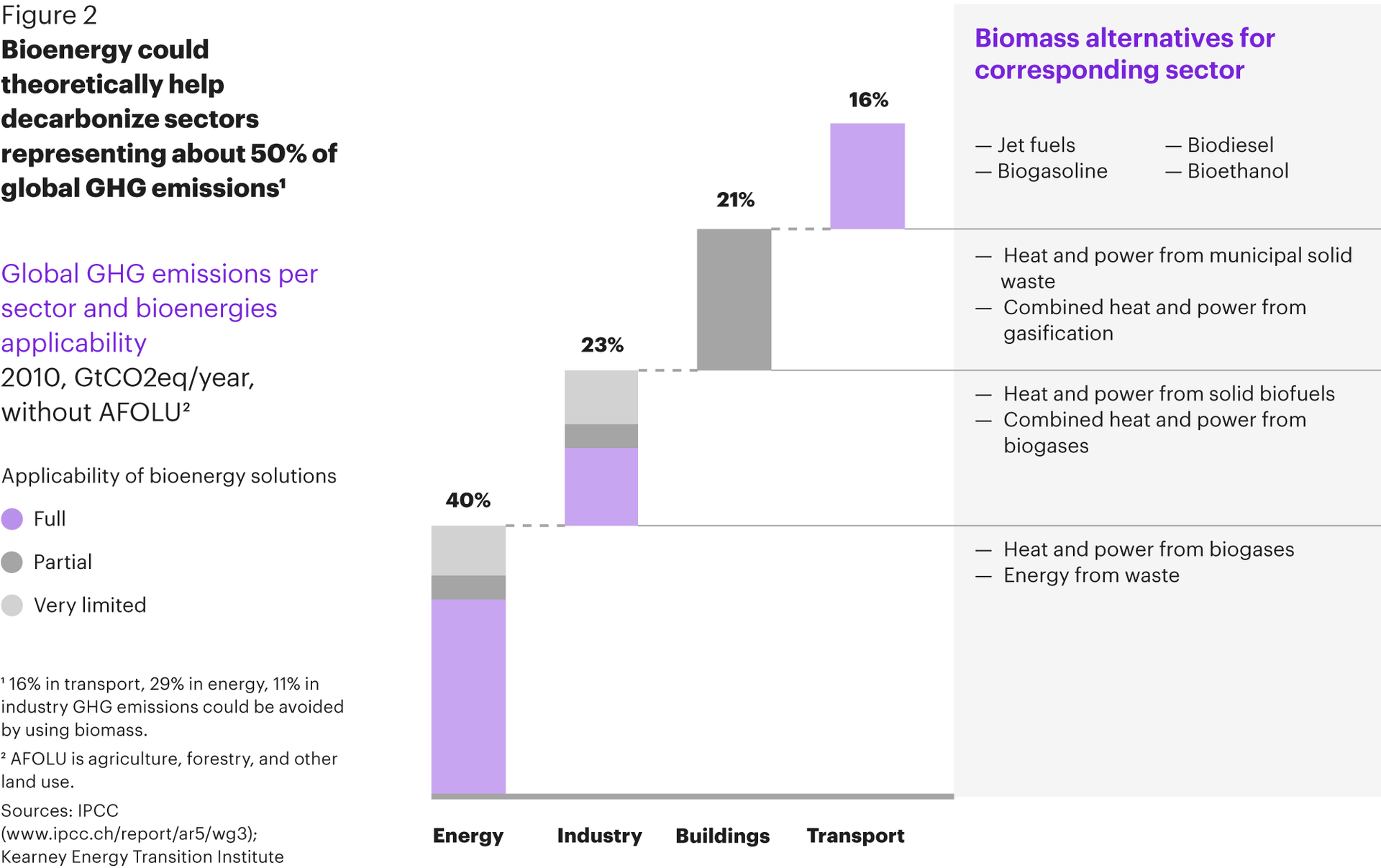
Monetized internal and external costs and benefits - Worst Case
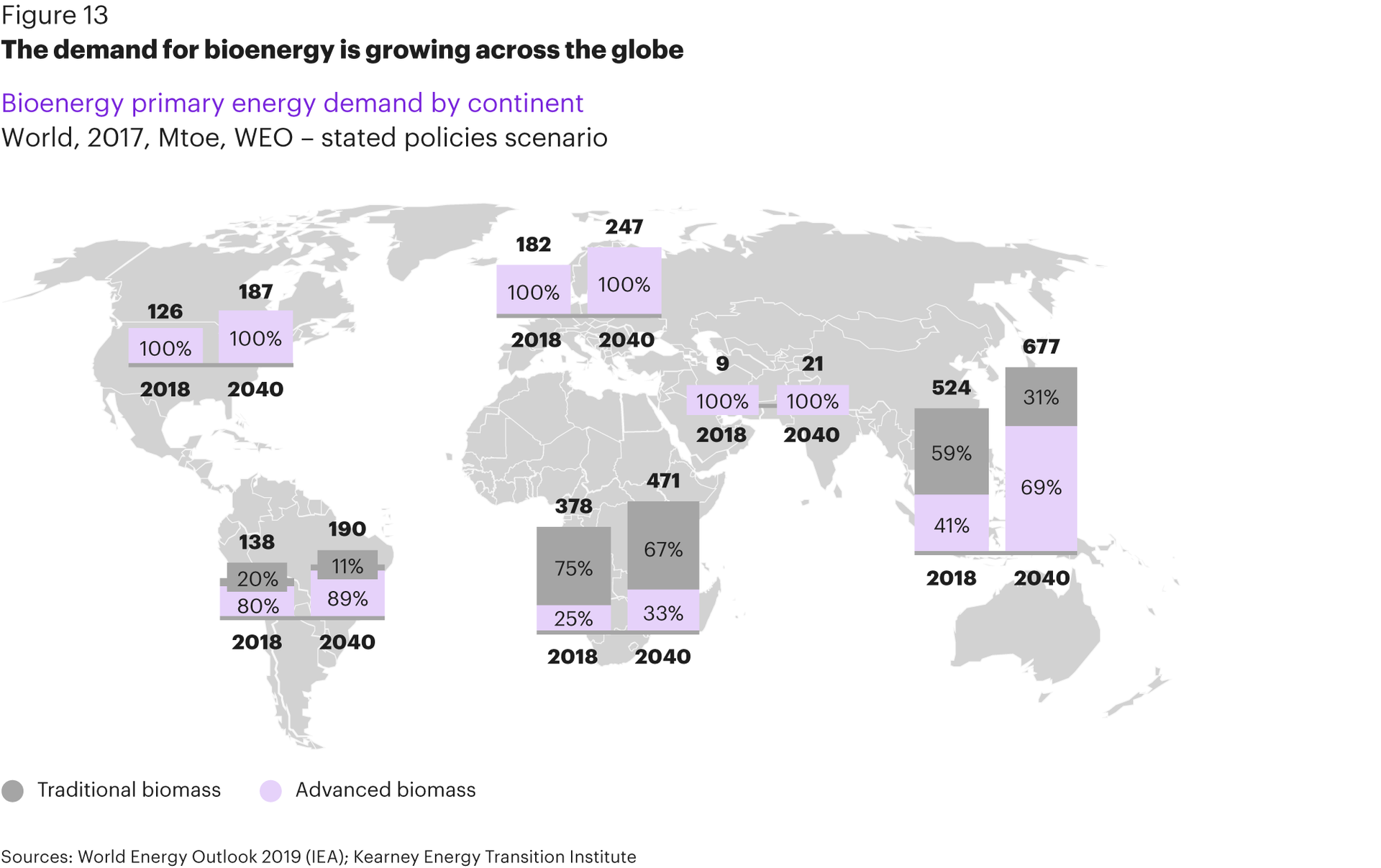
ADVANCING SUSTAINABLE BIOENERGY DEVELOPMENT
New, advanced technologies make it possible to produce climate neutral fuels from non-forest and non-food energy crops. The benefits of cultivation and use of these energy crops for transport fuels and electricity goes beyond the benefits of reducing greenhouse gas emissions. Terrestrial energy crop cultivation and aquatic energy crop harvesting reverses land and water degradation, increases biodiversity and carbon sequestration and improves land fertility. We call this
Deep Green Biomass. Moreover, deploying these energy crops for the production of advanced biofuels will positively impact social-economic structures and energy independence and reduce the need for involuntary migration and deforestation: Deep Green Energy.
Deep Green Energy Partners works to accelerate deployment of deep green biomass for the production of advanced biofuels and biochemicals, to restore soil and water conditions and to optimize the overall ecological-economic effects of investments in the energy transition.
Trees burn many times faster than they grow and food crops require a lot of fertilizers, pesticides, water and land which translates into deforestation, pollution and the consequent loss of ecosystem services. Biowaste from slaughter houses, livestock, kitchens, industry and households often have better uses than combustion (e.g. animal feed or lubricants). Moreover, their direct combustion in traditional bioenergy use for heating or cooking or causes more GHG and other air pollution, particulate matter and nitrious oxides, than is offset by the growth of the biomass they originate from. So unless biomass is either converted before combustion, e.g. by torrefaction, gasification or liquification or emissions are captured, net emissions are in between other renewable energy sources and fossil fuels.
When GHG's are however captured in the process or at smokestacks biomass emissions become negative as shown in the electricity and biofuel LCAs. Solid biomass combustion for heat and electricity in modern large-scale plants has an energy conversion of over 85% while modern combined heat and power system (CHP) of different smaller sizes have conversion efficiencies of between 70-80% and
90% lower NOx emissions than natural gas boilers and gas engines. Second generation or advanced biofuels for transport
have an energy efficiency of ~50%.
The sustainebility
Monetized internal and external costs and benefits - Best Case
Monetized internal and external costs and benefits - Worst Case
ADVANCING SUSTAINABLE BIOENERGY DEVELOPMENT
New, advanced technologies make it possible to produce climate neutral fuels from non-forest and non-food energy crops. The benefits of cultivation and use of these energy crops for transport fuels and electricity goes beyond the benefits of reducing greenhouse gas emissions. Terrestrial energy crop cultivation and aquatic energy crop harvesting reverses land and water degradation, increases biodiversity and carbon sequestration and improves land fertility. We call this
Deep Green Biomass. Moreover, deploying these energy crops for the production of advanced biofuels will positively impact social-economic structures and energy independence and reduce the need for involuntary migration and deforestation: Deep Green Energy.
Deep Green Energy Partners works to accelerate deployment of deep green biomass for the production of advanced biofuels and biochemicals, to restore soil and water conditions and to optimize the overall ecological-economic effects of investments in the energy transition.
It takes time and long-term investments to develop new supply chains and infrastructure from mines to solar panels, wind turbines, distribution networks, batteries, electric vehicles and other equipment to waist management. The skilled technical labor force is already tight and scarcity will increase significantly: the demand for blue- and white-collar workers to develop and construct wind and solar assets in the European Union, for example, is expected to increase by
a factor of between three and four by 2030. Labor shortages will be further exacerbated by increasing demand for workers to operate and maintain these wind and solar projects and to scale up the energy back-bone networks and local grids. Network upgrades will also require considerable investments, the delivered cost of electricity in a net zero 2050 were therefore estimated to be
25% higher in 2050 than 2020 levels, but that was before the 2023 cost increases for e.g. ofshore wind by 40%.
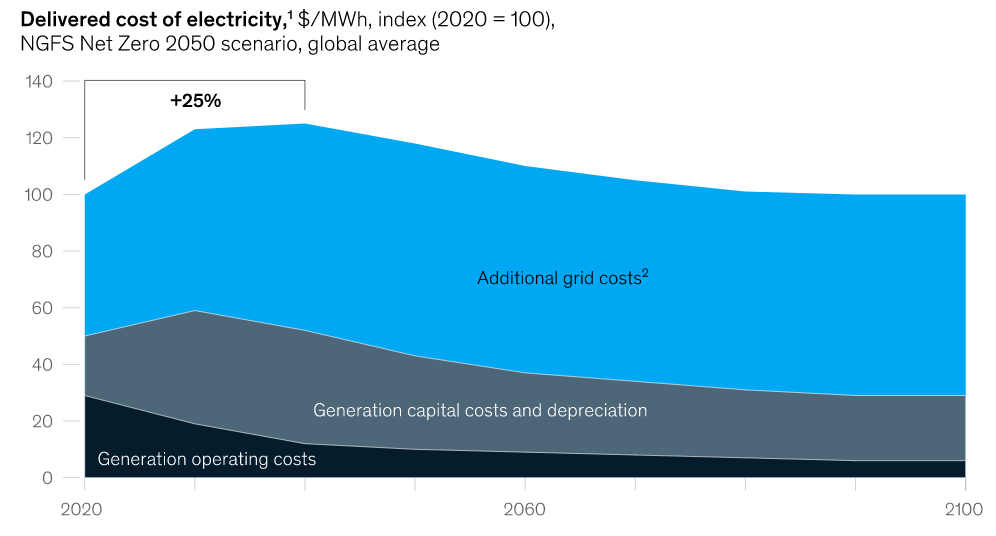
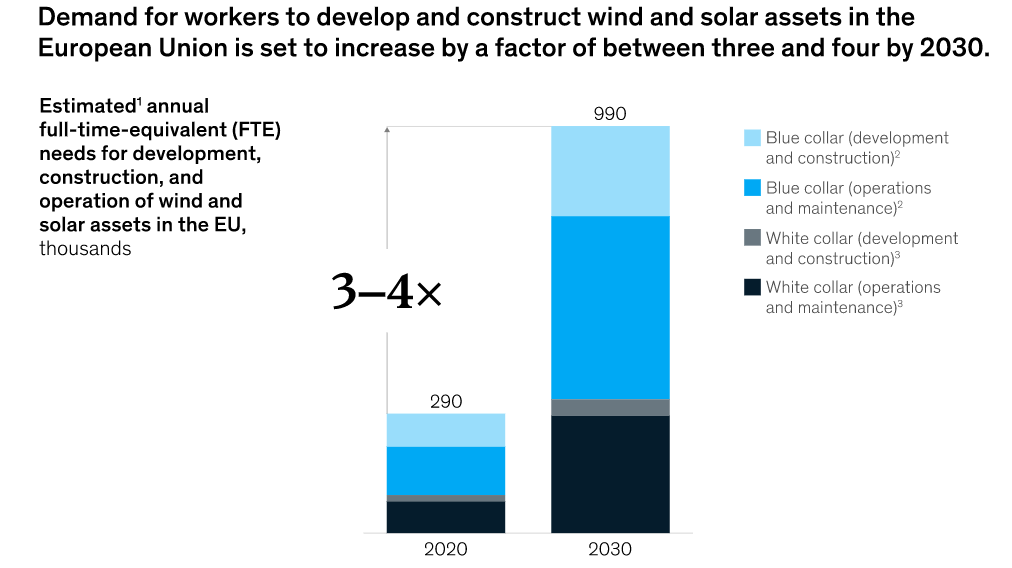
How actual emissions and cost compare for a predominantly wind or a solar to a predominantly gas derived electricity system is also unclear yet. Reductions in operating and other emissions from, and costs for solar and wind generation could be offset by an increase of both associated with grid flexibility, delivery security, transmission, and distribution. Emissions reductions between
20% and 40% are typically assumed but might actually be around 10–20%
when the share of e.g. wind increases versus gas.
A recent comparison of
energy requirements and carbon emissions for a low-carbon energy transition (all options) of fourteen mitigation pathways compatible with 1.5 °C of warming finds: "we find that the initial push for a transition is likely to cause a 10–34% decline in net energy available to society. Moreover, we find that the carbon emissions associated with the transition to a low-carbon energy system are substantial, ranging from 70 to 395 GtCO2
(with a cross-scenario average of 195 GtCO2, which equals 3 times the global annual emissions). The share of carbon emissions for
the energy system will increase by 10% today to 27% in 2050, and in some cases may take up all remaining emissions available to society under 1.5 °C pathways."
A future cost comparison between a carbon and non-carbon system is further complicated by the concentration of essential resources for carbon and non-carbon electricity in a limited number of countries. Mining and geopolitical developments therefore have a large impact on supply and prices. Middle of the road cost projections assume a more or less efficient functioning global economy enabling least cost pathways for specific solutions, but as the world is becoming more competitive and multi-polarized these projections become more uncertain. As non-carbon energy is a trade-off between material intensity and emission intensity, a non-carbon electricity system will not only cause additional emissions and financial costs but also habitat and biodiversity losses.
ADVANCING SUSTAINABLE BIOENERGY DEVELOPMENT
New, advanced technologies make it possible to produce climate neutral fuels from non-forest and non-food energy crops. The benefits of cultivation and use of these energy crops for transport fuels and electricity goes beyond the benefits of reducing greenhouse gas emissions. Terrestrial energy crop cultivation and aquatic energy crop harvesting reverses land and water degradation, increases biodiversity and carbon sequestration and improves land fertility. We call this
Deep Green Biomass. Moreover, deploying these energy crops for the production of advanced biofuels will positively impact social-economic structures and energy independence and reduce the need for involuntary migration and deforestation: Deep Green Energy.
Deep Green Energy Partners works to accelerate deployment of deep green biomass for the production of advanced biofuels and biochemicals, to restore soil and water conditions and to optimize the overall ecological-economic effects of investments in the energy transition.
Mining sites now cover a land area estimated to be 0.5% of the global ice-free land surface but they by land clearing, toxic pollution and habitat destruction, and as rivers end in lakes or seas this puts mining in conflict with both terrestrial and aquatic biodiversity preservation. Most mining areas (82%) target materials needed for renewable energy production, and the areas that overlap with protected areas and remaining wilderness contain a greater density of mines (the indicator of threat severity to critical ecosystems) compared to the overlapping mining areas that target other materials. Mining also requires a lot of water and produces a lot of brine, which adds to the already growing water stress and food insecurity, especially in those mining areas that are already suffering from droughts.
Thus, as renewable non-carbon energy supply grows so does the chance that these new threats to biodiversity surpass those averted by climate change mitigation. And although it is too early to tell, it is hard to imagine how deep sea mining would not negatively affect seas and oceans.
ADVANCING SUSTAINABLE BIOENERGY DEVELOPMENT
New, advanced technologies make it possible to produce climate neutral fuels from non-forest and non-food energy crops. The benefits of cultivation and use of these energy crops for transport fuels and electricity goes beyond the benefits of reducing greenhouse gas emissions. Terrestrial energy crop cultivation and aquatic energy crop harvesting reverses land and water degradation, increases biodiversity and carbon sequestration and improves land fertility. We call this
Deep Green Biomass. Moreover, deploying these energy crops for the production of advanced biofuels will positively impact social-economic structures and energy independence and reduce the need for involuntary migration and deforestation: Deep Green Energy.
Deep Green Energy Partners works to accelerate deployment of deep green biomass for the production of advanced biofuels and biochemicals, to restore soil and water conditions and to optimize the overall ecological-economic effects of investments in the energy transition.
The
land-use for non-carbon renewable energy for windturbines, solar panels, water reservoirs, infrastructure and mining is relatively limited. Their impacts are however not: noise and horizon pollution, habitat destruction moreover it
Mining sites now cover a land area estimated to be 0.5% of the global ice-free land surface but they potentially influence 40% of Earth’s land surface
by land clearing, toxic pollution and habitat destruction, and as rivers end in lakes or seas this puts mining in conflict with both terrestrial and aquatic biodiversity. Most mining areas (82%) target materials needed for renewable energy production, and the areas that overlap with protected areas and remaining wilderness contain a greater density of mines (the indicator of threat severity) compared to the overlapping mining areas that target other materials. Mining also requires a lot of water, which adds to the already growing water stress and food insecurity in those mining areas that are already suffering from droughts.
Thus, as renewable non-carbon energy supply grows so does the chance that these new threats to biodiversity surpass those averted by climate change mitigation. And although it is too early to tell, it is hard to imagine how deep sea mining would not negatively affect seas and oceans.
Holding the global average temperature increase below 1.5°C or 2°C
will require removing increasing amounts of CO2
from the atmosphere. Firstly, hard-to-abate greenhouse gas emissions will have to be balanced with removals in order to achieve net-zero CO2 emissions in less than thirty years. Secondly, from then onwards, vast amounts of CO2
will have to be captured from the air for many decades, cleaning up the atmosphere and returning atmospheric CO2 to climate-safe levels.
ADVANCING SUSTAINABLE BIOENERGY DEVELOPMENT
New, advanced technologies make it possible to produce climate neutral fuels from non-forest and non-food energy crops. The benefits of cultivation and use of these energy crops for transport fuels and electricity goes beyond the benefits of reducing greenhouse gas emissions. Terrestrial energy crop cultivation and aquatic energy crop harvesting reverses land and water degradation, increases biodiversity and carbon sequestration and improves land fertility. We call this
Deep Green Biomass. Moreover, deploying these energy crops for the production of advanced biofuels will positively impact social-economic structures and energy independence and reduce the need for involuntary migration and deforestation: Deep Green Energy.
Deep Green Energy Partners works to accelerate deployment of deep green biomass for the production of advanced biofuels and biochemicals, to restore soil and water conditions and to optimize the overall ecological-economic effects of investments in the energy transition.
Basically, all emissions from energy must either cease, or be completely offset by the permanent removal of greenhouse gases from the atmosphere to halt global warming. In other words; when the avoided emissions (reductions) from conventional mitigation techniques, solar, wind, hydro, nuclear and traditional biofuels are insufficient carbon capture and removal approaches must be scaled up as illustrated below. Aside from absolute energy consumption decrease, carbon capture and removal are the only options to effectively stop energy induced global warming.
ADVANCING SUSTAINABLE BIOENERGY DEVELOPMENT
New, advanced technologies make it possible to produce climate neutral fuels from non-forest and non-food energy crops. The benefits of cultivation and use of these energy crops for transport fuels and electricity goes beyond the benefits of reducing greenhouse gas emissions. Terrestrial energy crop cultivation and aquatic energy crop harvesting reverses land and water degradation, increases biodiversity and carbon sequestration and improves land fertility. We call this
Deep Green Biomass. Moreover, deploying these energy crops for the production of advanced biofuels will positively impact social-economic structures and energy independence and reduce the need for involuntary migration and deforestation: Deep Green Energy.
Deep Green Energy Partners works to accelerate deployment of deep green biomass for the production of advanced biofuels and biochemicals, to restore soil and water conditions and to optimize the overall ecological-economic effects of investments in the energy transition.
Holding the global average temperature increase below 1.5°C or 2°C
will require removing increasing amounts of CO2
from the atmosphere. Firstly, hard-to-abate greenhouse gas emissions will have to be balanced with removals in order to achieve net-zero CO2 emissions in less than thirty years. Secondly, from then onwards, vast amounts of CO2
will have to be captured from the air for many decades, cleaning up the atmosphere and returning atmospheric CO2 to climate-safe levels.
"No or limited overshoot" IPCC scenarios rely on cumulative CO2 removal of
246–689 GtCO2 by 2100, and “higher overshoot” scenarios on as much as 1186 GtCO2. That is, if carbon removals start immediately (i.e., between 2020–2030) and reach up to 4–24 GtCO2
per year in 2100. We have two options for direct carbon dioxide removal (CDR), conventional CDR on land (e.g. soil and forest restoration, agroforestry, reforestation/afforestation) and novel CDR (e.g. BECCS, DACCS, biochar and ocean alkalinisation)
In 2030, scenarios that limit warming to 2°C require an
additional CDR of 0.96 (0 to 3.4) GtCO₂ per year,
compared with 2020, by 2050 the need for additional removals has increased to 4.8 (0.58 to 13) GtCO₂ per year. This would mean scaling up scaling up conventional CDR on land by 2050 by an estimate factor of 2.7 to 4.2, compared with 2020. Novel CDR has to be upscaled by an estimated factor 30 (0 to 540) by 2030 and a factor of 1,300 (260 to 4,900) by 2050 compared with 2020. Current NDCs and pledges include however additional annual removals of only 0.1 to 0.65 GtCO₂ by 2030 and 1.5 to 2.3 GtCO₂ by 2050. The actual needs for CDR in time are depending on emission reductions, renewable energy share, developments in the land-use and forestry sectors and CCS deployment.
ADVANCING SUSTAINABLE BIOENERGY DEVELOPMENT
New, advanced technologies make it possible to produce climate neutral fuels from non-forest and non-food energy crops. The benefits of cultivation and use of these energy crops for transport fuels and electricity goes beyond the benefits of reducing greenhouse gas emissions. Terrestrial energy crop cultivation and aquatic energy crop harvesting reverses land and water degradation, increases biodiversity and carbon sequestration and improves land fertility. We call this
Deep Green Biomass. Moreover, deploying these energy crops for the production of advanced biofuels will positively impact social-economic structures and energy independence and reduce the need for involuntary migration and deforestation: Deep Green Energy.
Deep Green Energy Partners works to accelerate deployment of deep green biomass for the production of advanced biofuels and biochemicals, to restore soil and water conditions and to optimize the overall ecological-economic effects of investments in the energy transition.
FUTURE ENERGY DEMAND AND SUPPLY
In the baseline below 2°C scenarios demand for
food and water will have increased by 30-50%, for
energy by 50%, overall
demand for materials will have grown by 80%,
greenhouse gas emissions by 60% and an additional 300 million hectares of rainforest
will have been lost and water and food stress will have become normal in half the world. For 2021 the overal recycling rate is less then 9%, that of carbon capture 0.12%,
and material consumption is growing at the rate of
3.2%
per year.
Governments are in aggregate planning
to produce around 110% more fossil fuels in 2030 than would be consistent with limiting global warming to 1.5°C, and 45% more than would be consistent with limiting warming to 2°C, on a global level. By 2040, this excess grows to 190% and 89%, respectively.
If historical operating patterns are maintained,33 and without additional abatement,34 estimated cumulative future CO2emissions from existing fossil fuel infrastructure, the majority of which is in the power sector, would, from 2018 until the endof its lifetime, amount to 660 [460–890] GtCO2. They would amount to 850 [600–1100] GtCO2 when unabated emissions fromcurrently planned infrastructure in the power sector is included. These estimates compare with cumulative global net CO2emissions from all sectors of 510 [330–710] GtCO2 until the time of reaching net zero CO2 emissions35 in pathways that limitwarming to 1.5°C (>50%) with no or limited overshoot, and 890 [640–1160] GtCO2 in pathways that limit warming to 2°C(>67%). (high confidence) (Table SPM.2) {2.7, Figure 2.26, Figure TS.8}
The challenges are evident: nations and companies at risk of being left with stranded assets (e.g. Russia, Australia, Brazil) are likely to try to slow down the transition, while those most likely to gain (e.g net energy importers like the EU and Japan) are pushing for faster action and countries in the middle (like India and China) stress the need for low carbon energy but also that they need more time to phase-out their coal reserves which is only fair as the largest historic emitters (the US and EU) should make the transition faster than they have to.
ADVANCING SUSTAINABLE BIOENERGY DEVELOPMENT
New, advanced technologies make it possible to produce climate neutral fuels from non-forest and non-food energy crops. The benefits of cultivation and use of these energy crops for transport fuels and electricity goes beyond the benefits of reducing greenhouse gas emissions. Terrestrial energy crop cultivation and aquatic energy crop harvesting reverses land and water degradation, increases biodiversity and carbon sequestration and improves land fertility. We call this
Deep Green Biomass. Moreover, deploying these energy crops for the production of advanced biofuels will positively impact social-economic structures and energy independence and reduce the need for involuntary migration and deforestation: Deep Green Energy.
Deep Green Energy Partners works to accelerate deployment of deep green biomass for the production of advanced biofuels and biochemicals, to restore soil and water conditions and to optimize the overall ecological-economic effects of investments in the energy transition.
Decarbonization will happen but accelerating already unrealistic targets are counter productive as geopolitical and financial interests will put up stronger resistance. The world will keep using fossil and other carbon fuels and we therefore have to make changes within the system if we want to avoid the world's food and water supply disappearing and climatic conditions turning unlivable in much of the world.
ADVANCING SUSTAINABLE BIOENERGY DEVELOPMENT
New, advanced technologies make it possible to produce climate neutral fuels from non-forest and non-food energy crops. The benefits of cultivation and use of these energy crops for transport fuels and electricity goes beyond the benefits of reducing greenhouse gas emissions. Terrestrial energy crop cultivation and aquatic energy crop harvesting reverses land and water degradation, increases biodiversity and carbon sequestration and improves land fertility. We call this
Deep Green Biomass. Moreover, deploying these energy crops for the production of advanced biofuels will positively impact social-economic structures and energy independence and reduce the need for involuntary migration and deforestation: Deep Green Energy.
Deep Green Energy Partners works to accelerate deployment of deep green biomass for the production of advanced biofuels and biochemicals, to restore soil and water conditions and to optimize the overall ecological-economic effects of investments in the energy transition.
Renewable non-carbon energy requires mainly materials (concrete, minerals and metals), water, organization, money and a skilled workforce and is therefore only sustainable when the damages and emissions from resource extraction, production and distribution are less than those from using fossil-based energy. Renewable carbon-energy comes from biomass and is only sustainable when the particular biomass used is a) renewable, i.e. when it is additionally planted for the specific purpose of deployment, and carbon is sequestered by its regrowth at the same (or greater) rate as carbon is emitted from its combustion or other use, and b) does not compete for land and water with food production, carbon sequestration and biodiversity.
ADVANCING SUSTAINABLE BIOENERGY DEVELOPMENT
New, advanced technologies make it possible to produce climate neutral fuels from non-forest and non-food energy crops. The benefits of cultivation and use of these energy crops for transport fuels and electricity goes beyond the benefits of reducing greenhouse gas emissions. Terrestrial energy crop cultivation and aquatic energy crop harvesting reverses land and water degradation, increases biodiversity and carbon sequestration and improves land fertility. We call this
Deep Green Biomass. Moreover, deploying these energy crops for the production of advanced biofuels will positively impact social-economic structures and energy independence and reduce the need for involuntary migration and deforestation: Deep Green Energy.
Deep Green Energy Partners works to accelerate deployment of deep green biomass for the production of advanced biofuels and biochemicals, to restore soil and water conditions and to optimize the overall ecological-economic effects of investments in the energy transition.
Renewable energy technologies for electricity and fuels are already widely deployed. Electrification has three main advantages: improving energy efficiencies (less energy required), less (net) emissions and more diversity in resources. Thus incremental carbon emissions are reduced and energy security and independence increase. In the most positive IAE scenario the share of electricity in total final energy consumption stays more or less stable at 20% of which only 40% comes from non-carbon sources, we will need more renewable carbon energy for both electricity and fuels. The first advantage of biomass has the advantage that it is carbon neutral by nature. The second advantage is that bio-carbon can replace, or be blended with fossil-carbon in almost all solid, gas and liquid fuels, which reduces scale-up time and costs vis-a-vis non-carbon alternatives and further increases energy security and independence. The third advantage is unique, the possibility of emissions negative energy through carbon capture and storage, which is a requirement for the current policies scenario.
Life cycle GHG emissions electricity
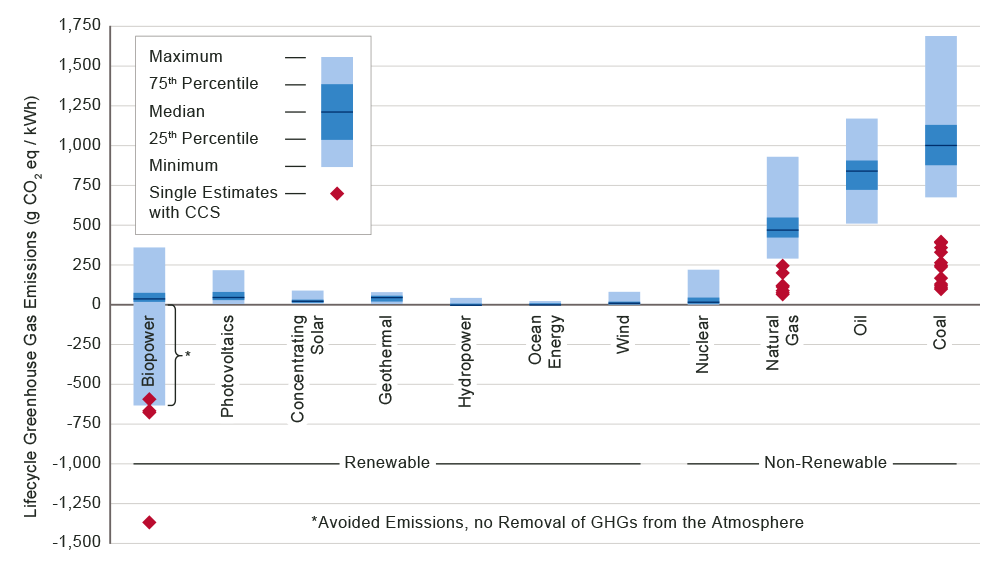
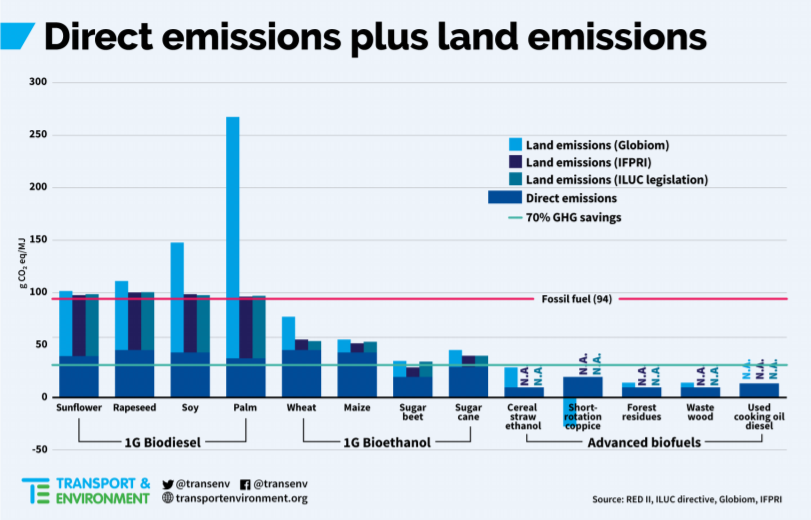
As shown above, today's investments for a 1.5°C scenario are falling short by a factor 6 to 7 in the linked efficiency/electricity and transport sectors, i.e decarbonization, and a factor 10 to 31 for agriculture, forestry and other land-use (AFOLU) sectors. In stated policy scenarios the share of fossil fuels in the energy mix is expected to fall from around
80% to just above 60% by 2050
by when overall energy use will have increased by
50%
and emissions by
60% or more. So simple math tells us that the current strategies and investments, primarily focused on energy decarbonization will not halt global warming nor the growing consumption of fossil fuels.
But there is more that hampers decarbonization: building a new production, distribution, equipment and recycling chain requires substantial amounts of additional, scarce materials, a skilled workforce that is already in short supply today and a lot of fossil energy. Whether the projected cost benefits or increased energy security from solar and wind will materialize in a more competitive and divided world is doubtful. Resources are unevenly concentrated in the world and increasingly weaponized, prices are already ricing fast and the "transition" has only just began. Rising interest rates, inflation, geopolitical conflicts, climate damages and price rises reduce both global investment appetite and ability. This will affect the developing world the most, which is where industrial production and energy demand will grow the most and where climate investments already need to increase the most.
ADVANCING SUSTAINABLE BIOENERGY DEVELOPMENT
New, advanced technologies make it possible to produce climate neutral fuels from non-forest and non-food energy crops. The benefits of cultivation and use of these energy crops for transport fuels and electricity goes beyond the benefits of reducing greenhouse gas emissions. Terrestrial energy crop cultivation and aquatic energy crop harvesting reverses land and water degradation, increases biodiversity and carbon sequestration and improves land fertility. We call this
Deep Green Biomass. Moreover, deploying these energy crops for the production of advanced biofuels will positively impact social-economic structures and energy independence and reduce the need for involuntary migration and deforestation: Deep Green Energy.
Deep Green Energy Partners works to accelerate deployment of deep green biomass for the production of advanced biofuels and biochemicals, to restore soil and water conditions and to optimize the overall ecological-economic effects of investments in the energy transition.
Basically, all emissions from energy must either cease, or be completely offset by the permanent removal of greenhouse gases from the atmosphere to halt global warming. In other words; when the avoided emissions (reductions) from conventional mitigation techniques, solar, wind, hydro, nuclear and traditional biofuels are insufficient carbon capture and removal approaches must be scaled up as illustrated below. Aside from absolute energy consumption decrease, carbon capture and removal are the only options to effectively stop energy induced global warming.
ADVANCING SUSTAINABLE BIOENERGY DEVELOPMENT
New, advanced technologies make it possible to produce climate neutral fuels from non-forest and non-food energy crops. The benefits of cultivation and use of these energy crops for transport fuels and electricity goes beyond the benefits of reducing greenhouse gas emissions. Terrestrial energy crop cultivation and aquatic energy crop harvesting reverses land and water degradation, increases biodiversity and carbon sequestration and improves land fertility. We call this
Deep Green Biomass. Moreover, deploying these energy crops for the production of advanced biofuels will positively impact social-economic structures and energy independence and reduce the need for involuntary migration and deforestation: Deep Green Energy.
Deep Green Energy Partners works to accelerate deployment of deep green biomass for the production of advanced biofuels and biochemicals, to restore soil and water conditions and to optimize the overall ecological-economic effects of investments in the energy transition.
For carbon capture we have two options: nature based (carbon and energy farming) or technology based (CCUS). In both options the captured carbon can be (partially) used to produce energy (carbon recycling), to be stored (carbon removal) or used for other purposes (carbon reuse). Carbon capture from fossil fuels at smokestacks of power plants and factories reduces emissions by 90%. Substitution of fossil fuels by dedicated grown energy crops results in the same situation in net carbon removals of between 50-90%. When the same energy crops are used to substitute fossil fuels in transport (advanced biofuels) emissions emissions from transport are reduced by 85-105%. Energy crops are the only option to produce energy with positive effects on soil quality and water supply and future food production.
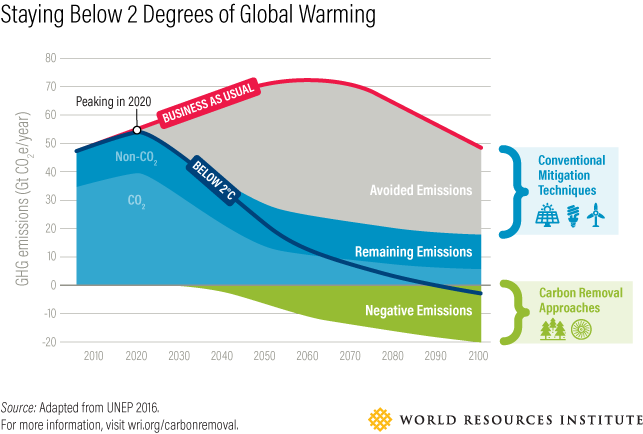
ADVANCING SUSTAINABLE BIOENERGY DEVELOPMENT
New, advanced technologies make it possible to produce climate neutral fuels from non-forest and non-food energy crops. The benefits of cultivation and use of these energy crops for transport fuels and electricity goes beyond the benefits of reducing greenhouse gas emissions. Terrestrial energy crop cultivation and aquatic energy crop harvesting reverses land and water degradation, increases biodiversity and carbon sequestration and improves land fertility. We call this
Deep Green Biomass. Moreover, deploying these energy crops for the production of advanced biofuels will positively impact social-economic structures and energy independence and reduce the need for involuntary migration and deforestation: Deep Green Energy.
Deep Green Energy Partners works to accelerate deployment of deep green biomass for the production of advanced biofuels and biochemicals, to restore soil and water conditions and to optimize the overall ecological-economic effects of investments in the energy transition.
ENERGY DEMAND PROJECTIONS
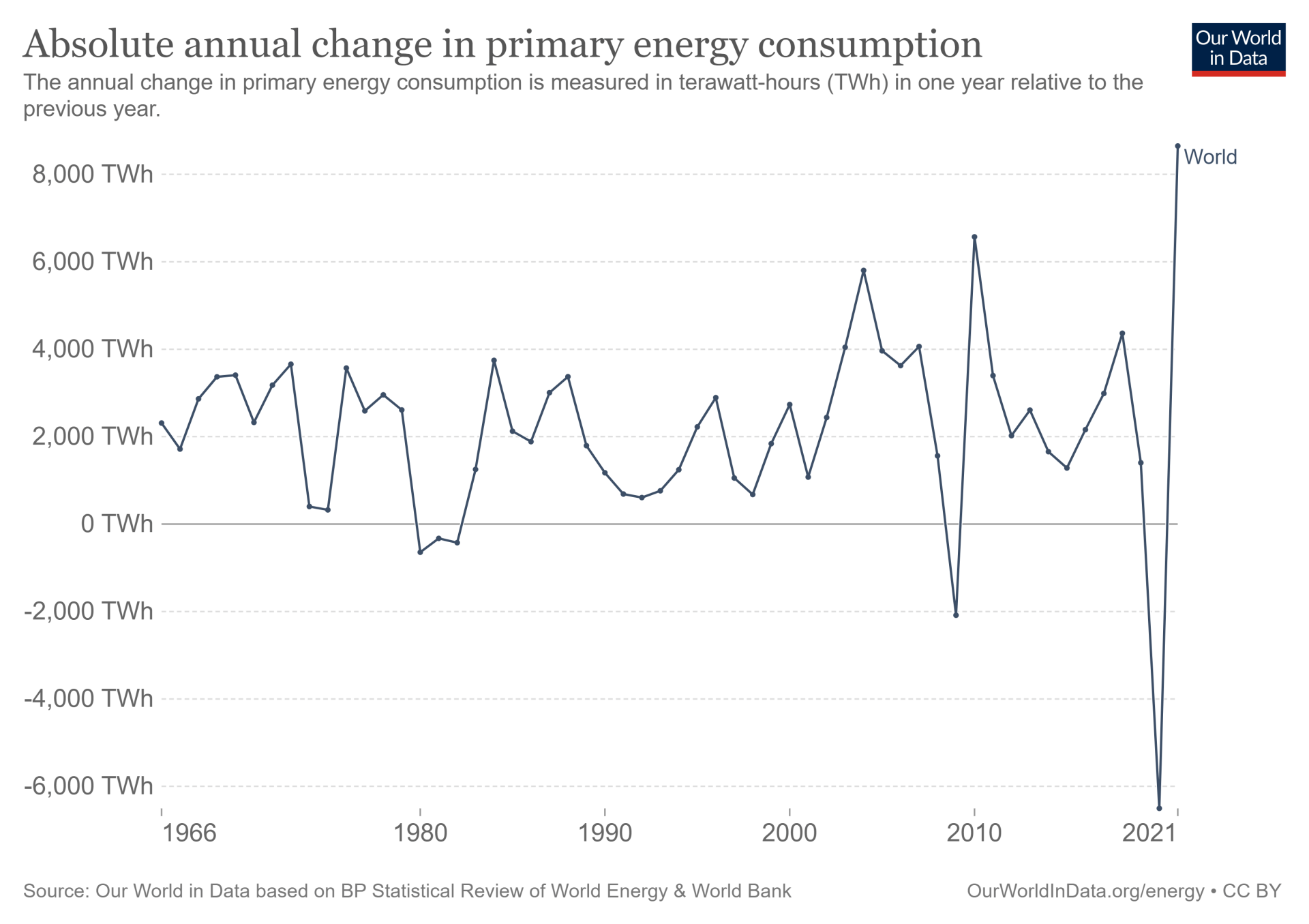
Demand for energy is growing across countries in the world, as people get richer and populations increase. If this increased demand is not offset by improvements in energy efficiency elsewhere, then our global energy consumption will continue to grow year-on-year. Global energy consumption has increased nearly every year for more than half a century. The exceptions to this are in the early 1980s and 2009 following the financial crisis and during the Corona pandemic. Global energy consumption continues to grow, but it does seem to be slowing – averaging around 1% to 2% per year. Global energy efficiency offsets, expressed as energy intensity of GDP (total energy consumption per unit of world GDP) have steadily, but (too) slowly decreased over the last decades to offset overall demand increases.
ADVANCING SUSTAINABLE BIOENERGY DEVELOPMENT
New, advanced technologies make it possible to produce climate neutral fuels from non-forest and non-food energy crops. The benefits of cultivation and use of these energy crops for transport fuels and electricity goes beyond the benefits of reducing greenhouse gas emissions. Terrestrial energy crop cultivation and aquatic energy crop harvesting reverses land and water degradation, increases biodiversity and carbon sequestration and improves land fertility. We call this
Deep Green Biomass. Moreover, deploying these energy crops for the production of advanced biofuels will positively impact social-economic structures and energy independence and reduce the need for involuntary migration and deforestation: Deep Green Energy.
Deep Green Energy Partners works to accelerate deployment of deep green biomass for the production of advanced biofuels and biochemicals, to restore soil and water conditions and to optimize the overall ecological-economic effects of investments in the energy transition.
ENERGY EFICIENCY INCREASES
ADVANCING SUSTAINABLE BIOENERGY DEVELOPMENT
New, advanced technologies make it possible to produce climate neutral fuels from non-forest and non-food energy crops. The benefits of cultivation and use of these energy crops for transport fuels and electricity goes beyond the benefits of reducing greenhouse gas emissions. Terrestrial energy crop cultivation and aquatic energy crop harvesting reverses land and water degradation, increases biodiversity and carbon sequestration and improves land fertility. We call this
Deep Green Biomass. Moreover, deploying these energy crops for the production of advanced biofuels will positively impact social-economic structures and energy independence and reduce the need for involuntary migration and deforestation: Deep Green Energy.
Deep Green Energy Partners works to accelerate deployment of deep green biomass for the production of advanced biofuels and biochemicals, to restore soil and water conditions and to optimize the overall ecological-economic effects of investments in the energy transition.
Increased energy efficiency by electrification plays a dominant role in decreasing energy intensity as electric equipment is much more efficient than their equivalents powered directly by fossil fuels. Electric heat pumps, for example are three times more efficient than burning fossil fuels for heat, and electric motors are two to three times more efficient than combustion motors. But this equation only works when electricity is generated by solar, wind, hydro, nuclear or renewable biomass. When produced from fossil fuels or wood an electric car for example becomes comparable to a diesel. Energy efficiency and electrification is happening but not fast enough.
Between 1990-2020 The US and the EU have succeeded to cut their energy intensity (total primary energy per unit GDP) by 1-2% per year. This was partly achieved by outsourcing production to other parts of the world and partly thanks to energy efficiency increases. Energy intensity however increased in Asia (especially in India and China), Australia, the Middle East, Africa and Latin America. Mean Global energy intensity decline has slowed down to 1.1% (from 1.5%/year on average), for 2°C global warming scenarios a 3.5% year on year decline is required.
ADVANCING SUSTAINABLE BIOENERGY DEVELOPMENT
New, advanced technologies make it possible to produce climate neutral fuels from non-forest and non-food energy crops. The benefits of cultivation and use of these energy crops for transport fuels and electricity goes beyond the benefits of reducing greenhouse gas emissions. Terrestrial energy crop cultivation and aquatic energy crop harvesting reverses land and water degradation, increases biodiversity and carbon sequestration and improves land fertility. We call this
Deep Green Biomass. Moreover, deploying these energy crops for the production of advanced biofuels will positively impact social-economic structures and energy independence and reduce the need for involuntary migration and deforestation: Deep Green Energy.
Deep Green Energy Partners works to accelerate deployment of deep green biomass for the production of advanced biofuels and biochemicals, to restore soil and water conditions and to optimize the overall ecological-economic effects of investments in the energy transition.
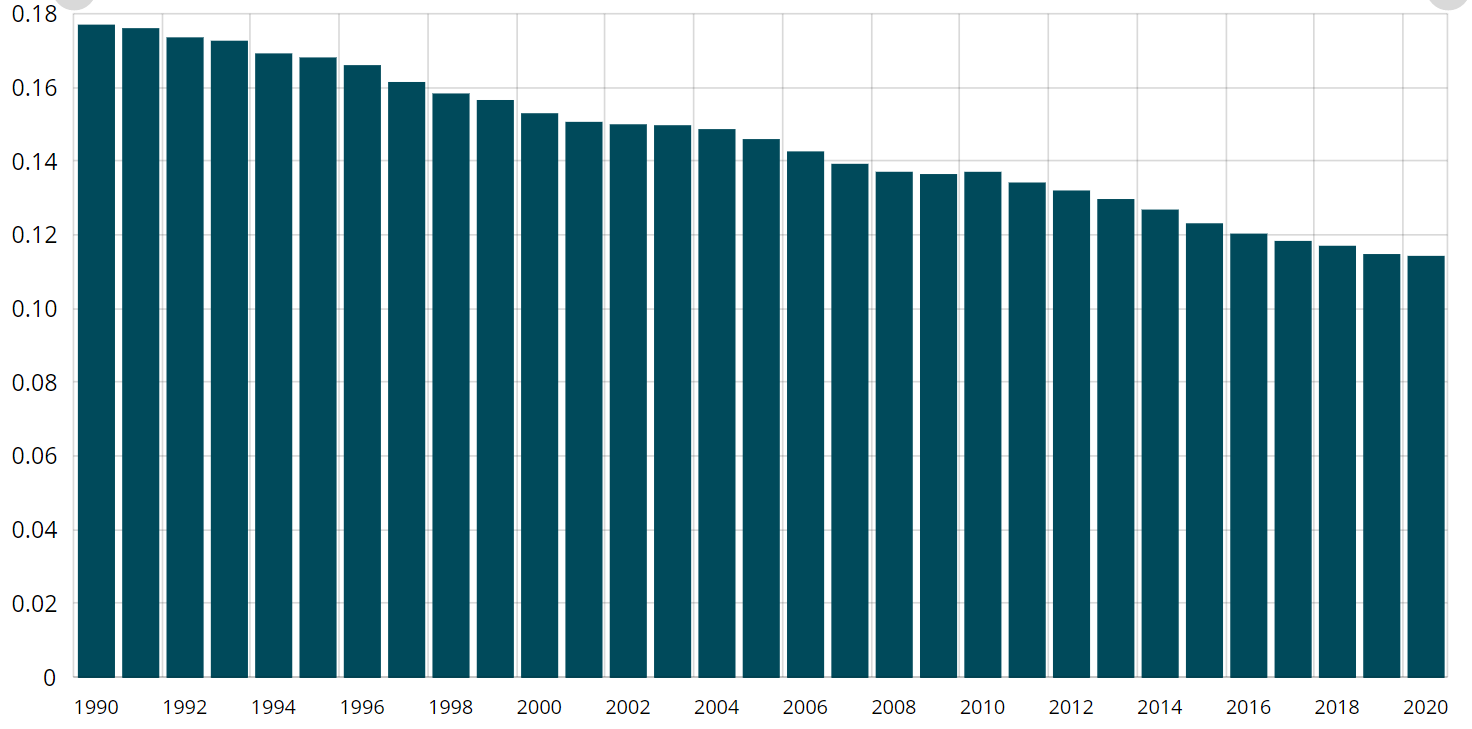
ADVANCING SUSTAINABLE BIOENERGY DEVELOPMENT
New, advanced technologies make it possible to produce climate neutral fuels from non-forest and non-food energy crops. The benefits of cultivation and use of these energy crops for transport fuels and electricity goes beyond the benefits of reducing greenhouse gas emissions. Terrestrial energy crop cultivation and aquatic energy crop harvesting reverses land and water degradation, increases biodiversity and carbon sequestration and improves land fertility. We call this
Deep Green Biomass. Moreover, deploying these energy crops for the production of advanced biofuels will positively impact social-economic structures and energy independence and reduce the need for involuntary migration and deforestation: Deep Green Energy.
Deep Green Energy Partners works to accelerate deployment of deep green biomass for the production of advanced biofuels and biochemicals, to restore soil and water conditions and to optimize the overall ecological-economic effects of investments in the energy transition.
Second to electrification, behavioral changes like adjusting temperatures for heating and cooling, switching transport modes, and increasing recycling and isolation play an important part in reducing energy intensity. Depending on the various energy scenarios the combination of electrification, increasing renewable shares, behavioral changes, recycling and other efficiency increases overall energy demand will plateau between 2040 and 2100 or never.
Future energy demand projections based on historic consumption patterns project a 50% increase by 2050 and carry annual CO2 emissions from this sector 24.7% higher. In these projections the consumption of fossil fuels remains more or less the same and the incremental demand is supplied by renewable energy. The too slow decrease of energy intensity and continuous GDP growth makes a fast reduction the growth for overall energy demand unlikely and a transition to a low-carbon energy system more difficult. As new low-carbon energy production must not only displace existing fossil fuels in the energy mix but also meet additional demand. An additional factor that will impact future overal energy demand will be climate change, as temperatures rise so does energy consumption.
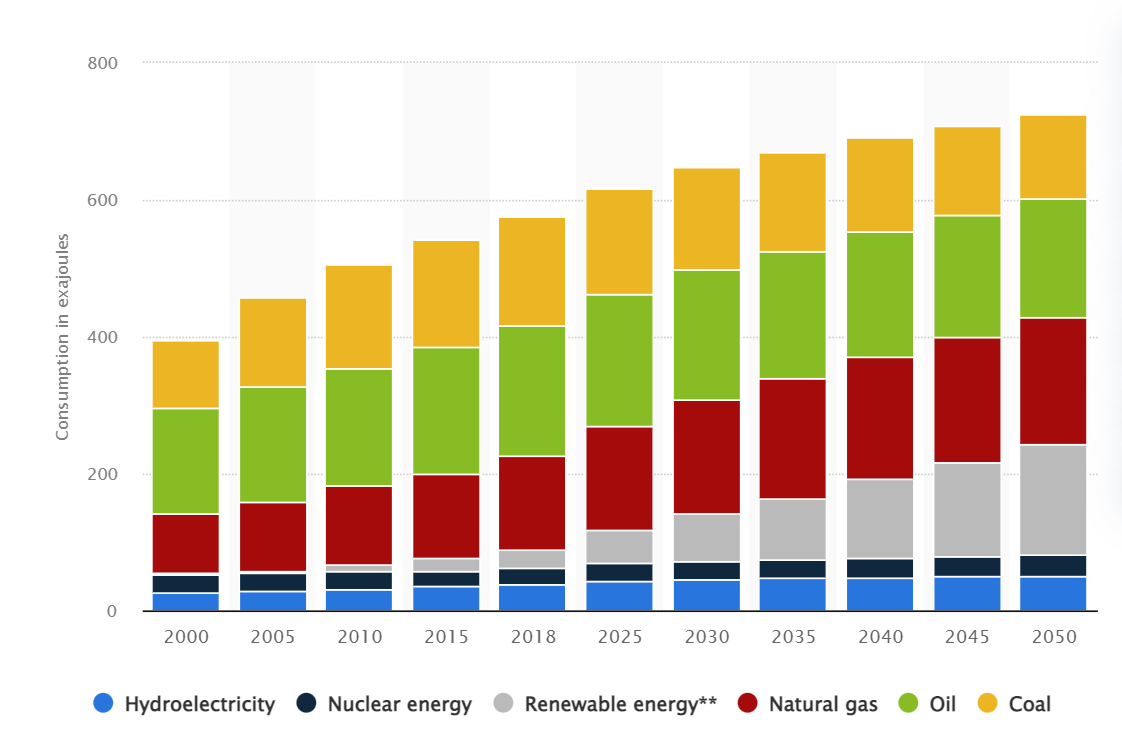
ADVANCING SUSTAINABLE BIOENERGY DEVELOPMENT
New, advanced technologies make it possible to produce climate neutral fuels from non-forest and non-food energy crops. The benefits of cultivation and use of these energy crops for transport fuels and electricity goes beyond the benefits of reducing greenhouse gas emissions. Terrestrial energy crop cultivation and aquatic energy crop harvesting reverses land and water degradation, increases biodiversity and carbon sequestration and improves land fertility. We call this
Deep Green Biomass. Moreover, deploying these energy crops for the production of advanced biofuels will positively impact social-economic structures and energy independence and reduce the need for involuntary migration and deforestation: Deep Green Energy.
Deep Green Energy Partners works to accelerate deployment of deep green biomass for the production of advanced biofuels and biochemicals, to restore soil and water conditions and to optimize the overall ecological-economic effects of investments in the energy transition.
ADDITIONAL DEMAND DUE TO CLIMATE CHANGE
Future energy demand will increase due to climate change and extreme weather events (e.g airco, heating, refrigeration, indoor entertainment) but the magnitude depends on many interacting sources of uncertainty. An extensive assessment of the impacts across 210 socioeconomic and climate scenarios, shows that in moderate, 1.5-1.7°C, global warming scenarios global climate-exposed energy demand (before adaptation) increases around 11–27% by 2050, and in 3°C plus scenarios around 25–58% vis-avis 2010. This climate driven increase in energy demand comes on top of the increase due to socioeconomic developments which would mean that globally, 2050 baseline energy demand would be about twice of today's.
Adaption to climate change will also cause additional energy demand as many of the adaptation actions that individuals and industries have implemented so far are energy-intensive(e.g. water pumping, desalinization, and water purification, climate conditioning in buildings, storage and for industrial processes). Adapting to climate change by means of the energy habits as we did in the past will increase the global demand for electricity by 7% and for fuels by 1% by 2050 and by 18% and 2.5% by 2100 under the current socioeconomic trends and mitigation policies. In the short to medium term, much of the added capacity for power generation will remain fossil-fuel based. The overall amount of energy required for adaptation in 2100 is equal to 20% of the global final energy demand in 2019 in a 3 °C scenario. Including climate change driven demand and increased energy efficiencies a 75% overall consumption increase by 2050, to about 700 EJ, seems a realistic estimate.,
ADVANCING SUSTAINABLE BIOENERGY DEVELOPMENT
New, advanced technologies make it possible to produce climate neutral fuels from non-forest and non-food energy crops. The benefits of cultivation and use of these energy crops for transport fuels and electricity goes beyond the benefits of reducing greenhouse gas emissions. Terrestrial energy crop cultivation and aquatic energy crop harvesting reverses land and water degradation, increases biodiversity and carbon sequestration and improves land fertility. We call this
Deep Green Biomass. Moreover, deploying these energy crops for the production of advanced biofuels will positively impact social-economic structures and energy independence and reduce the need for involuntary migration and deforestation: Deep Green Energy.
Deep Green Energy Partners works to accelerate deployment of deep green biomass for the production of advanced biofuels and biochemicals, to restore soil and water conditions and to optimize the overall ecological-economic effects of investments in the energy transition.
ENERGY SUPPLY & SOURCES
While the chances of reaching net-zero by 2050 are low, the various net-zero scenarios are nevertheless illustrative for the options and limitations we have to reduce emissions from energy to stay as close to 2°C global warming as possible. Net-zero 2050 scenarios aim to reduce net energy emissions as fast as technically, financially or reasonably possible based on the prevailing interest in any particular scenario. Mean averages of the various scenarios are therefore the best indication of how much low-emissions energy can be realistically produced by 2050.
A detailed assessment of the energy systems of 177 net-zero scenarios, published in Nature, gives the following averages for net zero scenarios. Renewable energy sources account for 60% of primary energy on average (compared to 14% today), with slightly less than half of that renewable energy derived from biomass. Electricity makes up approximately half of final energy consumed (compared to 20% today), which highlighs the extent to which solid, liquid, and gaseous fuels remain prevalent in the scenarios even when emissions reach net-zero. In net-zero 2C (plus) scenarios the median energy consumption is 580 etajoules (EJ), (range 345–857EJ). This would mean that the average renewable energy share is 348 EJ of which is 170 EJ comes from biomass.
ADVANCING SUSTAINABLE BIOENERGY DEVELOPMENT
New, advanced technologies make it possible to produce climate neutral fuels from non-forest and non-food energy crops. The benefits of cultivation and use of these energy crops for transport fuels and electricity goes beyond the benefits of reducing greenhouse gas emissions. Terrestrial energy crop cultivation and aquatic energy crop harvesting reverses land and water degradation, increases biodiversity and carbon sequestration and improves land fertility. We call this
Deep Green Biomass. Moreover, deploying these energy crops for the production of advanced biofuels will positively impact social-economic structures and energy independence and reduce the need for involuntary migration and deforestation: Deep Green Energy.
Deep Green Energy Partners works to accelerate deployment of deep green biomass for the production of advanced biofuels and biochemicals, to restore soil and water conditions and to optimize the overall ecological-economic effects of investments in the energy transition.
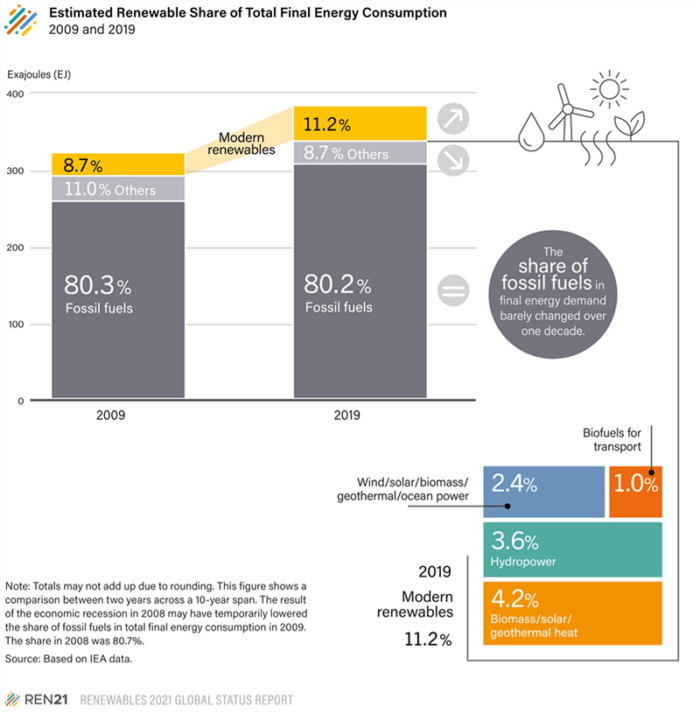
For 2°C global warming an average carbon intensity reduction (the amount of carbon per unit of energy) of 3.5% per year is required between 2020 and 2050, and for 1.5°C this would be about 7.7%. Global carbon intensity decreased on average by 0.3% per year (however with large regional variations). The share of fossil fuels therefore remains about the same but in absolute terms keeps fossil consumption keeps increasing. Existing generation and distribution capacity proves hard to replace and when the world got out of lockdown global CO2 emissions rebounded to their highest level in history due to the increase of coal as it was the only or cheapest option availbale. The ban of Russian gas after the invasion of the Ukraine has a similar effect on coal and nuclear use in Europe. Carbon by carbon fuel substitution (gas and biomass for coal) in combination with carbon capture will therefore play an important role to lower energy emissions in the next decades while solar, wind, nuclear and other low-carbon renewable energy options are rolled out.
Therefore we will have to look for more options to reduce emissions from about 50-75% of the energy system. Moreover we have to do it fast to reduce emissions and global warming "overshoots" that drive drive global temperatures above 1.5-2°C over time. According to the IPCC global emissions from energy should peak in 2025 and be net-zero by 2050 to stand a chance of
avoiding climate change spinning out of control.
ADVANCING SUSTAINABLE BIOENERGY DEVELOPMENT
New, advanced technologies make it possible to produce climate neutral fuels from non-forest and non-food energy crops. The benefits of cultivation and use of these energy crops for transport fuels and electricity goes beyond the benefits of reducing greenhouse gas emissions. Terrestrial energy crop cultivation and aquatic energy crop harvesting reverses land and water degradation, increases biodiversity and carbon sequestration and improves land fertility. We call this
Deep Green Biomass. Moreover, deploying these energy crops for the production of advanced biofuels will positively impact social-economic structures and energy independence and reduce the need for involuntary migration and deforestation: Deep Green Energy.
Deep Green Energy Partners works to accelerate deployment of deep green biomass for the production of advanced biofuels and biochemicals, to restore soil and water conditions and to optimize the overall ecological-economic effects of investments in the energy transition.
The importance and timing of peak emissions widely agreed, e.g. S&P Global, McKenzie and the IEA as damages from overshoots exponentially increase and adaption measures become more difficult to implement. Under a 1.5°C scenario the world would need to reduce emissions by 43% by 2030 and the world must act even sooner to avoid overshooting 1.5°C or 2°C. Currently, the world is not projected to stop emissions growth by 2025 and is on a path toward global warming of about 3.2°C degrees. To limit overshoots due to energy emissions must a) be reduced, for which carbon capture is the only option and b). be compensated by
additional carbon removals to return global warming to 1.5°C or 2°C levels for which carbon and energy farming is the only effective option today.
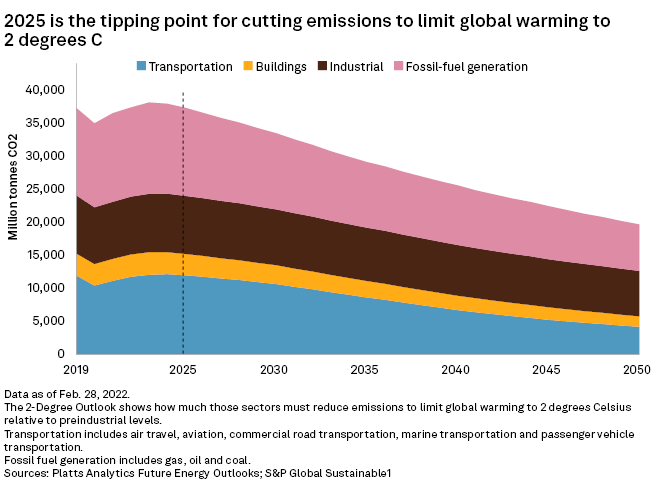
ADVANCING SUSTAINABLE BIOENERGY DEVELOPMENT
New, advanced technologies make it possible to produce climate neutral fuels from non-forest and non-food energy crops. The benefits of cultivation and use of these energy crops for transport fuels and electricity goes beyond the benefits of reducing greenhouse gas emissions. Terrestrial energy crop cultivation and aquatic energy crop harvesting reverses land and water degradation, increases biodiversity and carbon sequestration and improves land fertility. We call this
Deep Green Biomass. Moreover, deploying these energy crops for the production of advanced biofuels will positively impact social-economic structures and energy independence and reduce the need for involuntary migration and deforestation: Deep Green Energy.
Deep Green Energy Partners works to accelerate deployment of deep green biomass for the production of advanced biofuels and biochemicals, to restore soil and water conditions and to optimize the overall ecological-economic effects of investments in the energy transition.
The impacts of renewable non-carbon and bio-carbon based energy differ considerably and therefore we start with the non-carbon variant. The
land-use for non-carbon renewable energy for windturbines, solar panels, reservoirs, infrastructure is relatively limited and the same applies to the land-use required mining. Mining sites now cover a land area estimated to be 0.5% of the global ice-free land surface but they potentially influence 40% of Earth’s land surface
by land clearing, toxic pollution and habitat destruction. About 8% of the so influenced lands coincide with protected natural areas, 7% with key biodiversity areas, and 16% with remaining wilderness. And as rivers end in lakes or seas this puts mining in conflict with both terrestrial and aquatic biodiversity.
Most mining areas (82%) target materials needed for renewable energy production, and areas that overlap with protected areas and remaining wilderness contain a greater density of mines (the indicator of threat severity) compared to the overlapping mining areas that target other materials. Although it is too early to tell it is har to imagine how deep sea mining would not affect seas and oceans.
Mining also uses water which adding to water stress and food insecurity in those areas that are already suffering from droughts. Thus, as renewable non-carbon energy supply grows so does the chance that these new threats to biodiversity surpass those averted by climate change mitigation.
ADVANCING SUSTAINABLE BIOENERGY DEVELOPMENT
New, advanced technologies make it possible to produce climate neutral fuels from non-forest and non-food energy crops. The benefits of cultivation and use of these energy crops for transport fuels and electricity goes beyond the benefits of reducing greenhouse gas emissions. Terrestrial energy crop cultivation and aquatic energy crop harvesting reverses land and water degradation, increases biodiversity and carbon sequestration and improves land fertility. We call this
Deep Green Biomass. Moreover, deploying these energy crops for the production of advanced biofuels will positively impact social-economic structures and energy independence and reduce the need for involuntary migration and deforestation: Deep Green Energy.
Deep Green Energy Partners works to accelerate deployment of deep green biomass for the production of advanced biofuels and biochemicals, to restore soil and water conditions and to optimize the overall ecological-economic effects of investments in the energy transition.
Renewable non-carbon energy requires mainly materials (concrete, minerals and metals), water, organization, money and a skilled workforce and is therefore only sustainable when the damages and emissions from resource extraction, production and distribution are less than those from using fossil-based energy.
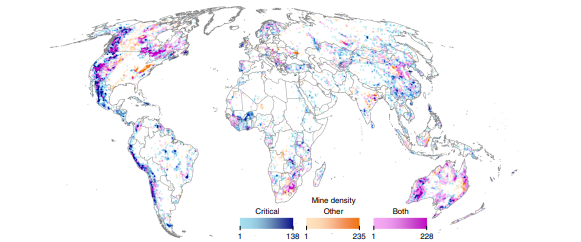
ADVANCING SUSTAINABLE BIOENERGY DEVELOPMENT
New, advanced technologies make it possible to produce climate neutral fuels from non-forest and non-food energy crops. The benefits of cultivation and use of these energy crops for transport fuels and electricity goes beyond the benefits of reducing greenhouse gas emissions. Terrestrial energy crop cultivation and aquatic energy crop harvesting reverses land and water degradation, increases biodiversity and carbon sequestration and improves land fertility. We call this
Deep Green Biomass. Moreover, deploying these energy crops for the production of advanced biofuels will positively impact social-economic structures and energy independence and reduce the need for involuntary migration and deforestation: Deep Green Energy.
Deep Green Energy Partners works to accelerate deployment of deep green biomass for the production of advanced biofuels and biochemicals, to restore soil and water conditions and to optimize the overall ecological-economic effects of investments in the energy transition.
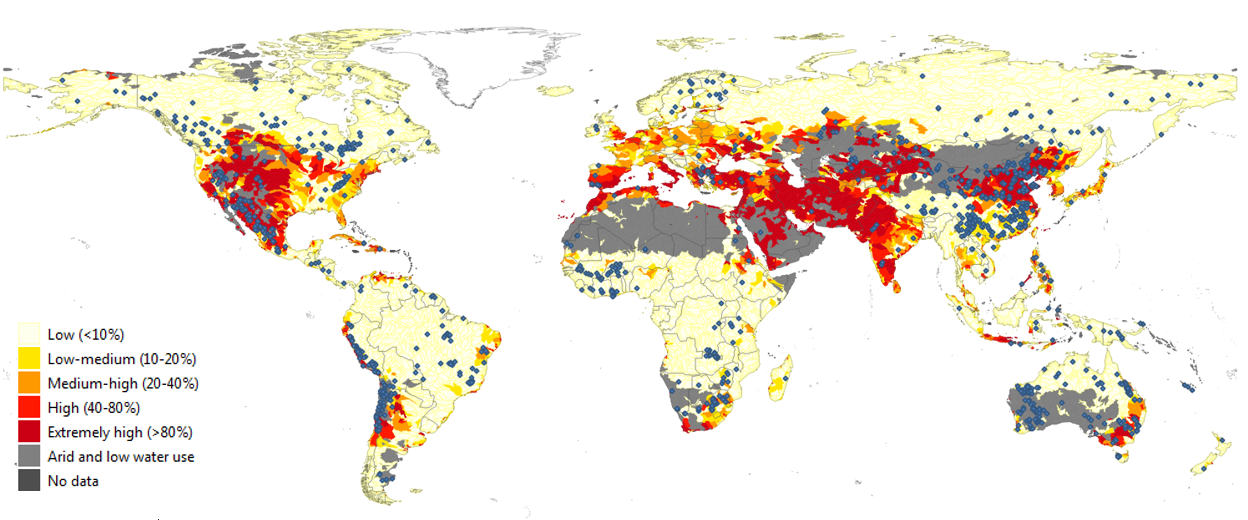
ADVANCING SUSTAINABLE BIOENERGY DEVELOPMENT
New, advanced technologies make it possible to produce climate neutral fuels from non-forest and non-food energy crops. The benefits of cultivation and use of these energy crops for transport fuels and electricity goes beyond the benefits of reducing greenhouse gas emissions. Terrestrial energy crop cultivation and aquatic energy crop harvesting reverses land and water degradation, increases biodiversity and carbon sequestration and improves land fertility. We call this
Deep Green Biomass. Moreover, deploying these energy crops for the production of advanced biofuels will positively impact social-economic structures and energy independence and reduce the need for involuntary migration and deforestation: Deep Green Energy.
Deep Green Energy Partners works to accelerate deployment of deep green biomass for the production of advanced biofuels and biochemicals, to restore soil and water conditions and to optimize the overall ecological-economic effects of investments in the energy transition.
ELECTRICITY & HEAT
About 42% of all energy related emissions, or 30% of total emissions come from electricity and heat for industry and households. Carbon capture technologies today capture around 90% of emissions and this percentage can be increased to close to 100%. For new power/heat plants CCUS, can be integrated in new plant designs. CCUS can also be retrofitted onto current power and industrial plants that may otherwise still be emitting around a quarter of today's annual energy-sector emissions in 2050. In combination with energy crops (replacing fossil fuels) CCUS has the unique option to actually remove carbon from the atmosphere while providing electricity and heat.
ADVANCING SUSTAINABLE BIOENERGY DEVELOPMENT
New, advanced technologies make it possible to produce climate neutral fuels from non-forest and non-food energy crops. The benefits of cultivation and use of these energy crops for transport fuels and electricity goes beyond the benefits of reducing greenhouse gas emissions. Terrestrial energy crop cultivation and aquatic energy crop harvesting reverses land and water degradation, increases biodiversity and carbon sequestration and improves land fertility. We call this
Deep Green Biomass. Moreover, deploying these energy crops for the production of advanced biofuels will positively impact social-economic structures and energy independence and reduce the need for involuntary migration and deforestation: Deep Green Energy.
Deep Green Energy Partners works to accelerate deployment of deep green biomass for the production of advanced biofuels and biochemicals, to restore soil and water conditions and to optimize the overall ecological-economic effects of investments in the energy transition.
Expanding the use of bioenergy can be very efficient, but only when it is produced from either biowaste that truly has no other use or from dedicated grown biomass. Most biowaste however already has other uses, trees
take too long to grow and only become carbon efficient once grown, existing forests
have different ecosystem purposes,
energy crops
are therefore the only option to provide the massive amounts of biomass for emissions neutral bioenergy and simultaneous carbon removal shown below first for electricity and heat (BECCS) and than for transport fuels.
ADVANCING SUSTAINABLE BIOENERGY DEVELOPMENT
New, advanced technologies make it possible to produce climate neutral fuels from non-forest and non-food energy crops. The benefits of cultivation and use of these energy crops for transport fuels and electricity goes beyond the benefits of reducing greenhouse gas emissions. Terrestrial energy crop cultivation and aquatic energy crop harvesting reverses land and water degradation, increases biodiversity and carbon sequestration and improves land fertility. We call this
Deep Green Biomass. Moreover, deploying these energy crops for the production of advanced biofuels will positively impact social-economic structures and energy independence and reduce the need for involuntary migration and deforestation: Deep Green Energy.
Deep Green Energy Partners works to accelerate deployment of deep green biomass for the production of advanced biofuels and biochemicals, to restore soil and water conditions and to optimize the overall ecological-economic effects of investments in the energy transition.
BECCS
Life cycle GHG emissions electricity
When energy crops are deployed for electricity or heat global warming potential (GWP) is at par with wind and solar but comes with many potential positive ecosystem effects
that wind and solar are lacking. Combined with CCUS it offers the unique option to provide carbon negative (more carbon is removed from - than emitted to the atmosphere) heat for industrial processes, electricity and e-fuels like hydrogen. In the graphic on the left the life cycle greenhouse gas emissions (all emissions from planting to burning) for bio-energy based electricity and various transport fuels are compared. The average additional carbon removal from the atmosphere by energy crops is about 1 ton per hectare.
ADVANCING SUSTAINABLE BIOENERGY DEVELOPMENT
New, advanced technologies make it possible to produce climate neutral fuels from non-forest and non-food energy crops. The benefits of cultivation and use of these energy crops for transport fuels and electricity goes beyond the benefits of reducing greenhouse gas emissions. Terrestrial energy crop cultivation and aquatic energy crop harvesting reverses land and water degradation, increases biodiversity and carbon sequestration and improves land fertility. We call this
Deep Green Biomass. Moreover, deploying these energy crops for the production of advanced biofuels will positively impact social-economic structures and energy independence and reduce the need for involuntary migration and deforestation: Deep Green Energy.
Deep Green Energy Partners works to accelerate deployment of deep green biomass for the production of advanced biofuels and biochemicals, to restore soil and water conditions and to optimize the overall ecological-economic effects of investments in the energy transition.
In net-zero scenarios, the median amount of annual carbon sequestration from BECCS increases in 1.5 °C, 2 °C and >2 °C scenarios, from 6.4 (range 0–16.7) to 8.0 (range 0–18.8) to 11.3 (range 3.7-16.4) Gt CO2, respectively, indicating that warmer scenarios must rely on greater amounts negative emissions technologies to reach net-zero emissions.
Electricity makes up approximately half of final energy consumed on average in net-zero scenarios (compared to 20% today), highlighting the extent to which solid, liquid, and gaseous fuels remain prevalent in the scenarios even when emissions reach net-zero. About 16% of all energy related emissions come from transport. Electrification of energy in transport is possible for passenger cars and light freight but for long distance and heavy transport liquid fuels will be needed. Substituting fossil fuels by advanced biofuels produced from energy crops are the only emissions neutral alternative for transport fuels as shown below.
ADVANCING SUSTAINABLE BIOENERGY DEVELOPMENT
New, advanced technologies make it possible to produce climate neutral fuels from non-forest and non-food energy crops. The benefits of cultivation and use of these energy crops for transport fuels and electricity goes beyond the benefits of reducing greenhouse gas emissions. Terrestrial energy crop cultivation and aquatic energy crop harvesting reverses land and water degradation, increases biodiversity and carbon sequestration and improves land fertility. We call this
Deep Green Biomass. Moreover, deploying these energy crops for the production of advanced biofuels will positively impact social-economic structures and energy independence and reduce the need for involuntary migration and deforestation: Deep Green Energy.
Deep Green Energy Partners works to accelerate deployment of deep green biomass for the production of advanced biofuels and biochemicals, to restore soil and water conditions and to optimize the overall ecological-economic effects of investments in the energy transition.
ADVANCED BIOFUELS
Liquid biofuels are classified in two main categories and several sub-categories according to the biomass and technologies deployed for their production. Conventional, or first generation (G1) biofuels such as ethanol and biodiesel produced from food crops using traditional technologies. Advanced, or second generation (2G) biofuels that are produced by converting additional chemicals that are contained in all biomass; hemicellulose, cellulose and lignin (“lignocellulosic matter’’) through advanced technologies. Direct emissions (from the fuel production and combustion cycle) and indirect emissions from land use change for the various fuels are shown on the right.
Advanced biofuels manufactured from various types of non-food biomass burn cleaner than either fossil or traditional biofuels. The net emissions of
advanced biofuels produced from energy crops are between 85% and 100% lower than those of fossil fuels. The negative emissions due to the high soil carbon sequestration of energy crops (short rotation coppice) makes them climate neutral. Advanced biofuels and energy crops are therefore key to neutralize emissions in the transport and heating sector.
ADVANCING SUSTAINABLE BIOENERGY DEVELOPMENT
New, advanced technologies make it possible to produce climate neutral fuels from non-forest and non-food energy crops. The benefits of cultivation and use of these energy crops for transport fuels and electricity goes beyond the benefits of reducing greenhouse gas emissions. Terrestrial energy crop cultivation and aquatic energy crop harvesting reverses land and water degradation, increases biodiversity and carbon sequestration and improves land fertility. We call this
Deep Green Biomass. Moreover, deploying these energy crops for the production of advanced biofuels will positively impact social-economic structures and energy independence and reduce the need for involuntary migration and deforestation: Deep Green Energy.
Deep Green Energy Partners works to accelerate deployment of deep green biomass for the production of advanced biofuels and biochemicals, to restore soil and water conditions and to optimize the overall ecological-economic effects of investments in the energy transition.
CARBON CAPTURE AND CARBON AND ENERY FARMING
ADVANCING SUSTAINABLE BIOENERGY DEVELOPMENT
New, advanced technologies make it possible to produce climate neutral fuels from non-forest and non-food energy crops. The benefits of cultivation and use of these energy crops for transport fuels and electricity goes beyond the benefits of reducing greenhouse gas emissions. Terrestrial energy crop cultivation and aquatic energy crop harvesting reverses land and water degradation, increases biodiversity and carbon sequestration and improves land fertility. We call this
Deep Green Biomass. Moreover, deploying these energy crops for the production of advanced biofuels will positively impact social-economic structures and energy independence and reduce the need for involuntary migration and deforestation: Deep Green Energy.
Deep Green Energy Partners works to accelerate deployment of deep green biomass for the production of advanced biofuels and biochemicals, to restore soil and water conditions and to optimize the overall ecological-economic effects of investments in the energy transition.
BECCS based electrification and e-fuels, and advanced biofuels for transport are the most effective and efficient option to reduce emissions from energy. Renewable and dedicated grown biomass, i.e. energy crops, is the essential element for all three. In net-zero scenarios the available land for energy crops is limited by the need for land for traditional food production. As net-zero is highly unlikely, worsening climatic conditions will gradually force food production indoors
leaving more land in need of restoration
for which energy crops are the best option in most cases. This means that much more land for energy crops are available than in net-zero scenarios and thus the greater amounts of negative emissions needed to reach net-zero emissions can be met by BECCS.
One of the realistic net-zero energy scenarios with the lowest use of energy crops is the Net Zero scenario from the International Energy Agency which can therefore serve as an indication of how much energy crops would be needed to meet demand for BECCS and advanced biofuels in >2 °C scenarios scenarios. In this scenario biomass use for energy will have to about double, modern bio energy will have to fourfold and traditional biomass must be phased out by 2050. Modern bioenergy covers all energy derived from biomass except that of the direct burning of wood, waste and dung (traditional biomass).
In the IEA Net Zero emissons by 2050 scenario (NZE), overall energy use decreases by 7% as a result of increased energy efficiency and savings and some change in human behavior. Electricity represents 50% of total energy use of which 90% comes from renewable sources and the and use of fossil fuels is 20% of what it is today. This remaining 20% is used for oil, chemicals and other products that can not be decarbonized, for which demand is expected to have grown by 100% in 2050. In order to reach Net Zero emissions from fossil fuels the remaining 20% of CO2
and methane emissions from fossil fuels are captured.
ADVANCING SUSTAINABLE BIOENERGY DEVELOPMENT
New, advanced technologies make it possible to produce climate neutral fuels from non-forest and non-food energy crops. The benefits of cultivation and use of these energy crops for transport fuels and electricity goes beyond the benefits of reducing greenhouse gas emissions. Terrestrial energy crop cultivation and aquatic energy crop harvesting reverses land and water degradation, increases biodiversity and carbon sequestration and improves land fertility. We call this
Deep Green Biomass. Moreover, deploying these energy crops for the production of advanced biofuels will positively impact social-economic structures and energy independence and reduce the need for involuntary migration and deforestation: Deep Green Energy.
Deep Green Energy Partners works to accelerate deployment of deep green biomass for the production of advanced biofuels and biochemicals, to restore soil and water conditions and to optimize the overall ecological-economic effects of investments in the energy transition.
NET-ZERO 2050 ENERGY SCENARIOS