ADVANCING SUSTAINABLE BIOENERGY DEVELOPMENT
New, advanced technologies make it possible to produce climate neutral fuels from non-forest and non-food energy crops. The benefits of cultivation and use of these energy crops for transport fuels and electricity goes beyond the benefits of reducing greenhouse gas emissions. Terrestrial energy crop cultivation and aquatic energy crop harvesting reverses land and water degradation, increases biodiversity and carbon sequestration and improves land fertility. We call this
Deep Green Biomass. Moreover, deploying these energy crops for the production of advanced biofuels will positively impact social-economic structures and energy independence and reduce the need for involuntary migration and deforestation: Deep Green Energy.
Deep Green Energy Partners works to accelerate deployment of deep green biomass for the production of advanced biofuels and biochemicals, to restore soil and water conditions and to optimize the overall ecological-economic effects of investments in the energy transition.
If we’re going to prevent the gravest dangers of global warming, we will need to reduce fossil fuel use and remove CO2 from the atmosphere. The global threats to climate, biodiversity and a healthy environment are mainly caused by the excessive use of non-renewable materials. Today about 80% and 99% of all energy and chemicals (including plastics and nitrogen fertilizers) are sourced from fossil fuels (primerally oil & gas) and are produced using fossil fuels. Cement and concrete, the other two most important materials on which modern societies are built, depend on high density energy for production, i.e. fossil fuels (primarily coal), and the mining of ores and minerals.
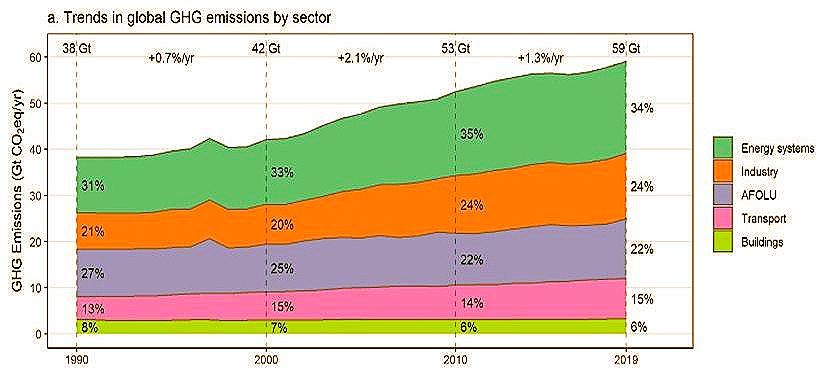
The extraction and processing of materials, fuels and food contribute half of total global greenhouse gas emissions and over 90% of biodiversity loss and water stress. Fossil fuel use accounts for ~72% of global GHG emissions. Excluding energy emissions the food system accounts for about 18%, cement for 3%, plastics and chemicals for 2.5% and fertilizers for 3.5%.
Global emission by industrial sector.
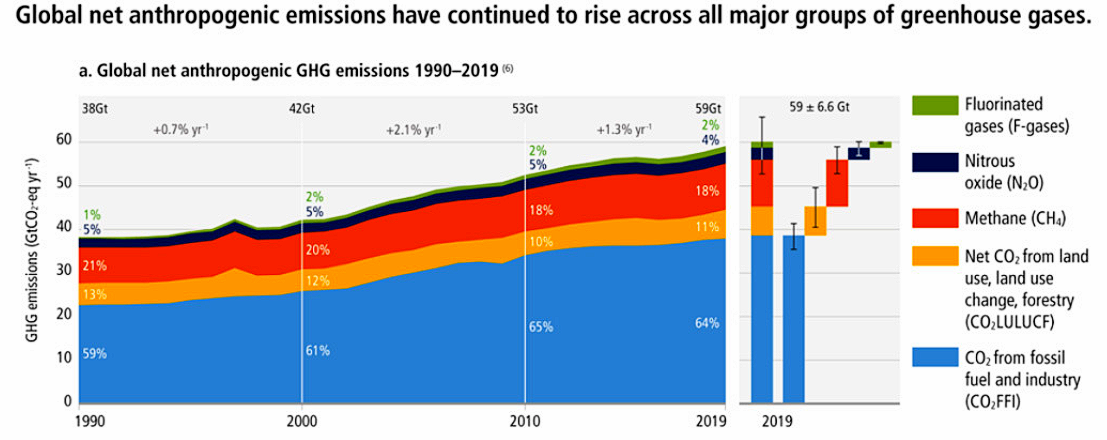
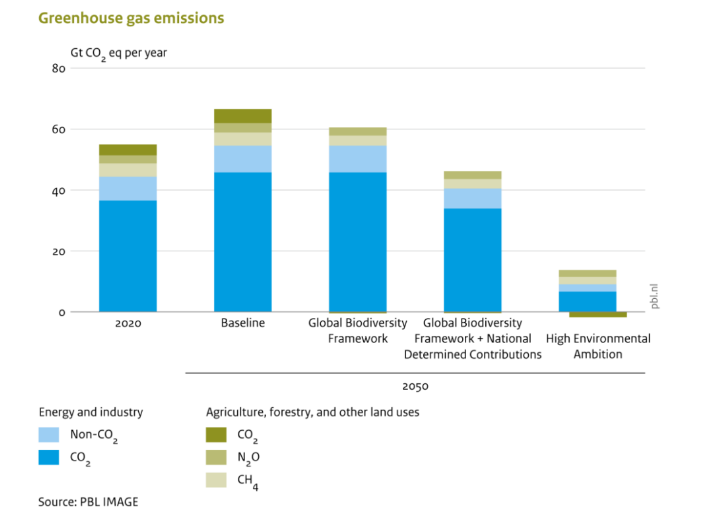
Global anthropogenic emissions by greenhouse gas and sector
ADVANCING SUSTAINABLE BIOENERGY DEVELOPMENT
New, advanced technologies make it possible to produce climate neutral fuels from non-forest and non-food energy crops. The benefits of cultivation and use of these energy crops for transport fuels and electricity goes beyond the benefits of reducing greenhouse gas emissions. Terrestrial energy crop cultivation and aquatic energy crop harvesting reverses land and water degradation, increases biodiversity and carbon sequestration and improves land fertility. We call this
Deep Green Biomass. Moreover, deploying these energy crops for the production of advanced biofuels will positively impact social-economic structures and energy independence and reduce the need for involuntary migration and deforestation: Deep Green Energy.
Deep Green Energy Partners works to accelerate deployment of deep green biomass for the production of advanced biofuels and biochemicals, to restore soil and water conditions and to optimize the overall ecological-economic effects of investments in the energy transition.
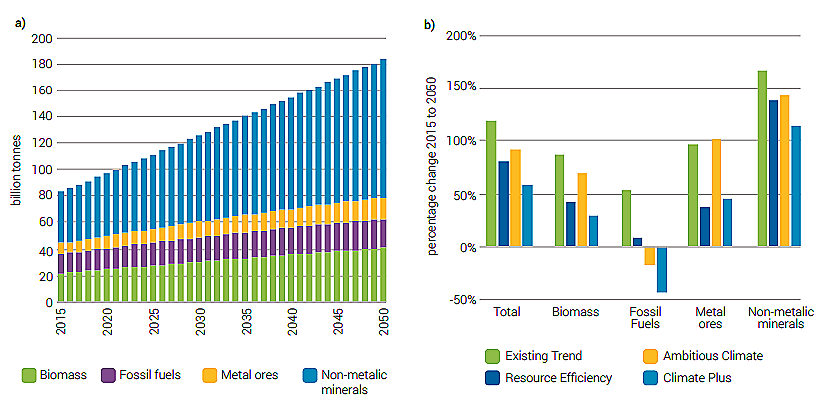
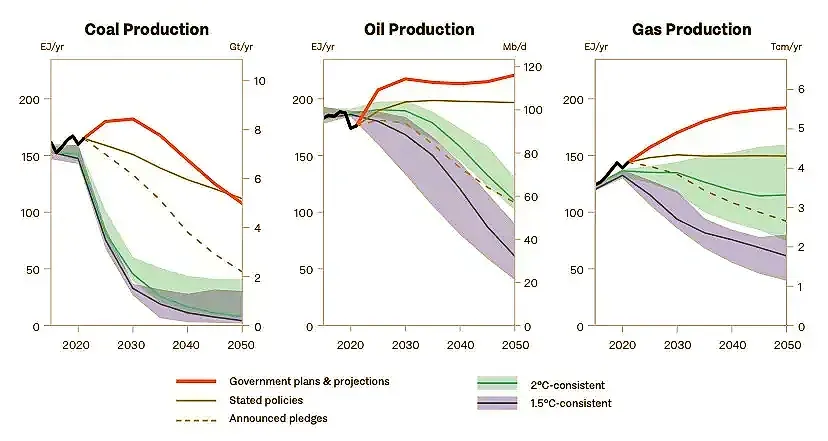
Fossil fuel production is expected to keep rising until around 2040 and by 2050 return to current levels. The total annual material extraction is expected to grow from a little over 100 billion tonnes today to 170-184 billion tonnes by 2050. By then the use of the only renewable resource, biomass is expected to have doubled and have a share of ~ 23% in overall resource extraction versus ~ 27% today. The shares of non-renewable resources by then will be respectively ~ 11% for fossil fuels and ores and ~ 55% for non-metallic minerals (like sand, rock or limestone) and plastic production will have more than doubled.
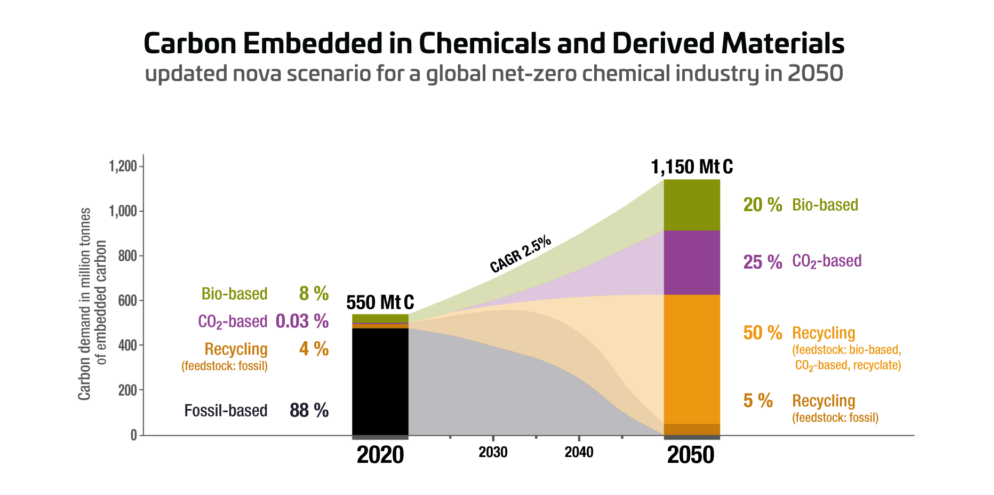
Carbion demand embedded in chemicals and derived maerials
Global resource extractions 2015-2050 in four different scenarios
Projected coal, oil and gas production, 2020-2050
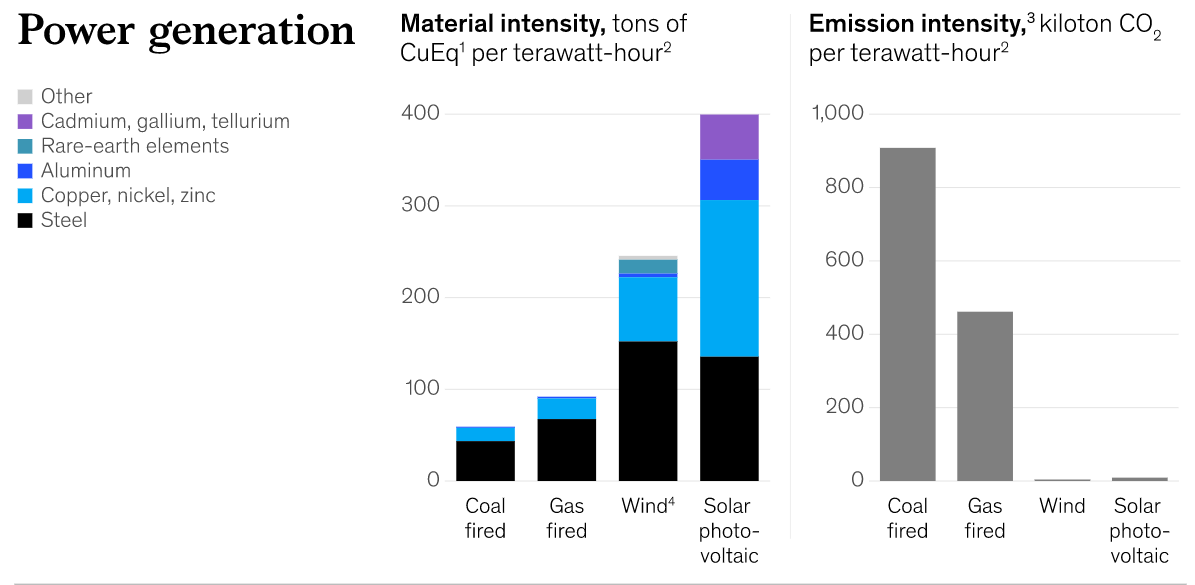
The trade-off between material and emissions intensity of low-carbon energy
ADVANCING SUSTAINABLE BIOENERGY DEVELOPMENT
New, advanced technologies make it possible to produce climate neutral fuels from non-forest and non-food energy crops. The benefits of cultivation and use of these energy crops for transport fuels and electricity goes beyond the benefits of reducing greenhouse gas emissions. Terrestrial energy crop cultivation and aquatic energy crop harvesting reverses land and water degradation, increases biodiversity and carbon sequestration and improves land fertility. We call this
Deep Green Biomass. Moreover, deploying these energy crops for the production of advanced biofuels will positively impact social-economic structures and energy independence and reduce the need for involuntary migration and deforestation: Deep Green Energy.
Deep Green Energy Partners works to accelerate deployment of deep green biomass for the production of advanced biofuels and biochemicals, to restore soil and water conditions and to optimize the overall ecological-economic effects of investments in the energy transition.
Biomass is the only renewable resource available that can provide the sustainable substitutes for energy and materials while sequestering carbon from the atmosphere. Biomass can replace most finite resources, and replacing fossil fuels, ores and minerals by biomass is the fastests option to increase circularity and reduce scarcity, conserve ecosystems and restore soils. This potential however only materializes when the biomass deployed is sustainable itself, i.e. it regenerates faster than it is consumed, stores sufficient carbon belowground and improves overall soil and environmental conditions.
As sustainable biomass is scarce, it has to be additional, and specifically planted for the purpose, for if not it will come at the expense of remaining ecosystems. We need
~ 55% of all the world's arable land for ecosystem preservation and restoration, which means we have the other half left to produce sustainable biomass for all our needs and to close the emissions gap. This is a little less than the land surface used today for food/feed crop production and livestock grazing. As
crop and livestock production will be forced to concentrate either indoors or on the limited land surface still suitable for viable production, many agricultural lands will be abandoned and in need of new vegetative cover to conserve and restore soil-carbon, -water and -nutrients.
Climate change will gradually limit food production in parts of the world
ADVANCING SUSTAINABLE BIOENERGY DEVELOPMENT
New, advanced technologies make it possible to produce climate neutral fuels from non-forest and non-food energy crops. The benefits of cultivation and use of these energy crops for transport fuels and electricity goes beyond the benefits of reducing greenhouse gas emissions. Terrestrial energy crop cultivation and aquatic energy crop harvesting reverses land and water degradation, increases biodiversity and carbon sequestration and improves land fertility. We call this
Deep Green Biomass. Moreover, deploying these energy crops for the production of advanced biofuels will positively impact social-economic structures and energy independence and reduce the need for involuntary migration and deforestation: Deep Green Energy.
Deep Green Energy Partners works to accelerate deployment of deep green biomass for the production of advanced biofuels and biochemicals, to restore soil and water conditions and to optimize the overall ecological-economic effects of investments in the energy transition.
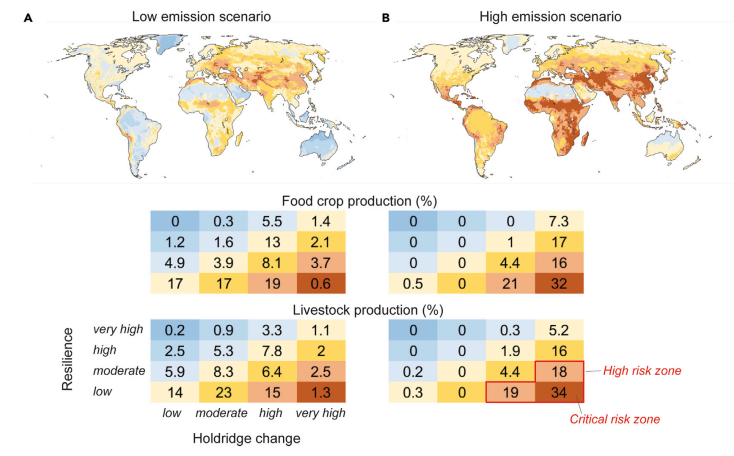
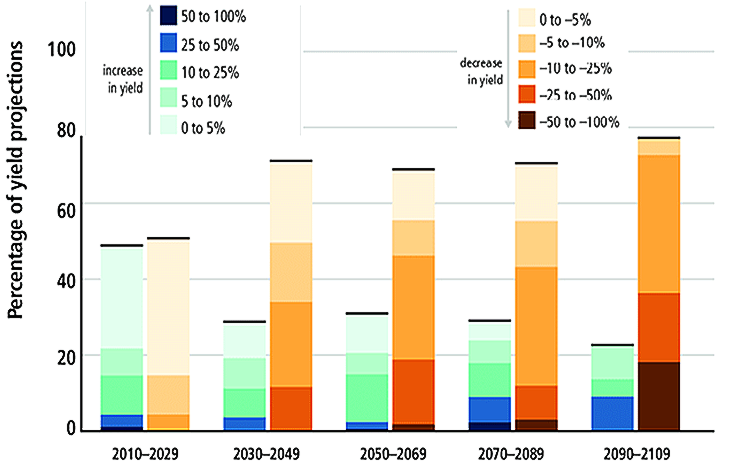
Crop yield increases are outpaced by yield declines as GW increases
ADVANCING SUSTAINABLE BIOENERGY DEVELOPMENT
New, advanced technologies make it possible to produce climate neutral fuels from non-forest and non-food energy crops. The benefits of cultivation and use of these energy crops for transport fuels and electricity goes beyond the benefits of reducing greenhouse gas emissions. Terrestrial energy crop cultivation and aquatic energy crop harvesting reverses land and water degradation, increases biodiversity and carbon sequestration and improves land fertility. We call this
Deep Green Biomass. Moreover, deploying these energy crops for the production of advanced biofuels will positively impact social-economic structures and energy independence and reduce the need for involuntary migration and deforestation: Deep Green Energy.
Deep Green Energy Partners works to accelerate deployment of deep green biomass for the production of advanced biofuels and biochemicals, to restore soil and water conditions and to optimize the overall ecological-economic effects of investments in the energy transition.
In all climate scenarios carbon dioxide removal (CDR) from the atmosphere is a prerequisite for staying anywhere near 2C global warming. How much CO2 needs to be removed depends on how fast we can reduce greenhouse gas emissions to net-zero, and then become net-negative. In most of the scenarios that limit global warming to 2C the projected cumulative CO2eq removal using carbon removal solutions are in the range of 100–1000 gigatons of GtCO2eq by the end of the century.
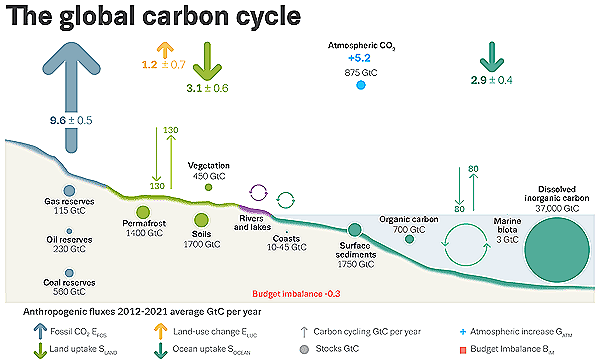
Forests and other land ecosystems absorbed ~ 3.1 gigatonnes carbon (GtC) from the atmosphere in the last decade while anthropogenic land-use emitted ~ 1.2 GtC.
The average amount of terrestrial CDR happening around the world was approximately 1.9 GtC per year of which
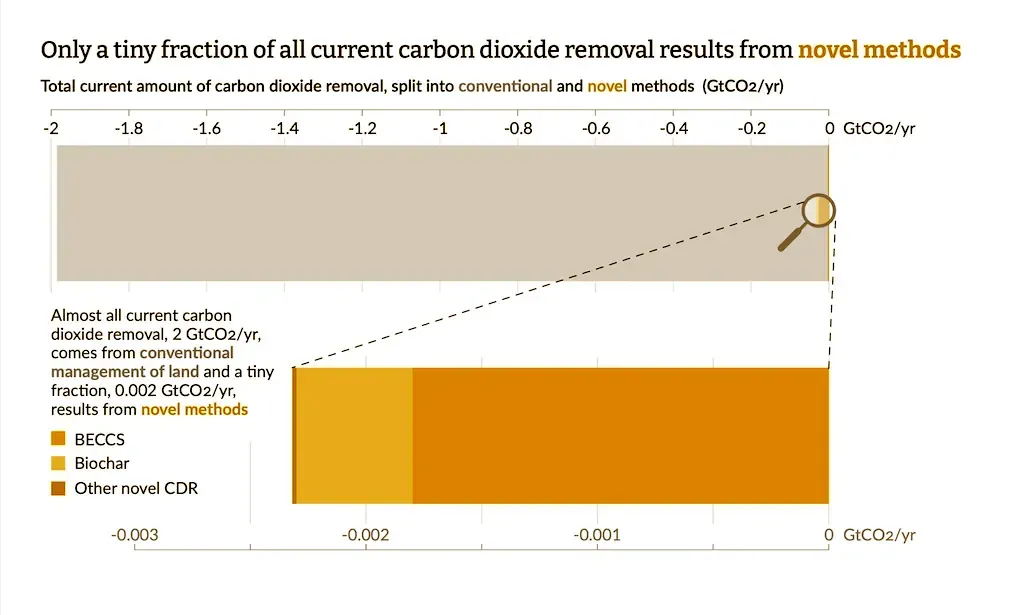
99.9% comes from "conventional CDR on land", i.e. by carbon sequestration by plants that was stored in aboveground biomass, soils and durable products like building materials. CDR is done almost completely by forests, hence forests are generally considered as the terrestrial carbon sinks. The remaining 0.1%, or 0.0023GtCO2eq is removed by “Novel” CDR methods like bioenergy with carbon capture and storage (BECCS), biochar, direct air carbon capture and storage (DACCS), enhanced rock weathering and coastal wetland (“blue carbon”) management.
Global carbon fluxes 2011-2020, the net terrestrial carbon flux was ~ 2 GtC (Land uptake (3.1) - Land use change (1.2).
Novel CDR projects often get the news coverage, they collectively account for just 0.1% of all current CDR deployment.
ADVANCING SUSTAINABLE BIOENERGY DEVELOPMENT
New, advanced technologies make it possible to produce climate neutral fuels from non-forest and non-food energy crops. The benefits of cultivation and use of these energy crops for transport fuels and electricity goes beyond the benefits of reducing greenhouse gas emissions. Terrestrial energy crop cultivation and aquatic energy crop harvesting reverses land and water degradation, increases biodiversity and carbon sequestration and improves land fertility. We call this
Deep Green Biomass. Moreover, deploying these energy crops for the production of advanced biofuels will positively impact social-economic structures and energy independence and reduce the need for involuntary migration and deforestation: Deep Green Energy.
Deep Green Energy Partners works to accelerate deployment of deep green biomass for the production of advanced biofuels and biochemicals, to restore soil and water conditions and to optimize the overall ecological-economic effects of investments in the energy transition.
Oceans absorb another ~ 2.9 GtC, thus the total carbon absorption was estimated ~ 6 GtC. The total anthropogenic emissions were estimated ~ 10.8 GtC (fossil fuels + land use). As CO2eq measurements of the atmosphere are accurate, the 5.2 GtC of annual additions to the atmosphere are accurate as well. This leaves a difference of ~ 0.4 GtC that is attributable to either lower carbon uptake by land and oceans or higher emissions than estimated. 1 GtC equals 3.667 GtCO2eq and thus we would need to sequester and store away around ~ 20 GtCO2eq a year to balance out our emissions today.
CDR is often criticized as it may lead to delayed efforts to mitigate emissions, which might be a valid argument but it is also meaningless as a timely reduction of emissions is mere wishful thinking as emissions will keep increasing in the next decades. Technical carbon capture at smokestacks, tale pipes or directly from the atmosphere is still at its infancy, and it will take at least a few decades for technologies to mature and scale-up meaningfully. Therefore nature based carbon capture and removal are the only realistic options at our disposal to avoid the tipping points and rapid, uncontrollable global warming and to buy us the time necessary for technical solutions to develop.
ADVANCING SUSTAINABLE BIOENERGY DEVELOPMENT
New, advanced technologies make it possible to produce climate neutral fuels from non-forest and non-food energy crops. The benefits of cultivation and use of these energy crops for transport fuels and electricity goes beyond the benefits of reducing greenhouse gas emissions. Terrestrial energy crop cultivation and aquatic energy crop harvesting reverses land and water degradation, increases biodiversity and carbon sequestration and improves land fertility. We call this
Deep Green Biomass. Moreover, deploying these energy crops for the production of advanced biofuels will positively impact social-economic structures and energy independence and reduce the need for involuntary migration and deforestation: Deep Green Energy.
Deep Green Energy Partners works to accelerate deployment of deep green biomass for the production of advanced biofuels and biochemicals, to restore soil and water conditions and to optimize the overall ecological-economic effects of investments in the energy transition.
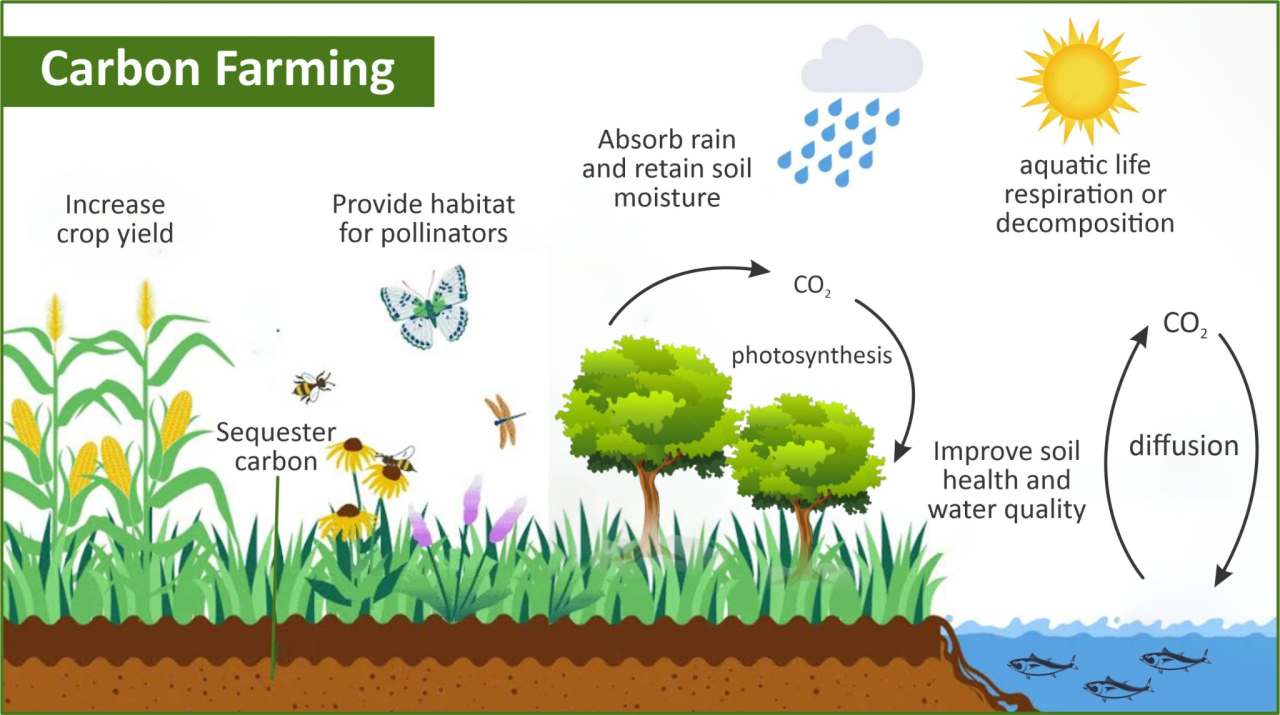
Carbon farming aims to increase the storage of carbon in plants biomass, soils and oceans (carbon sequestration) by drawing greenhouse gases from the atmosphere using the oldest process in the world: photosynthesis by plants and microorganisms like algae and soil microbes. Photosynthesis not only draws down CO2 but it also is the starting point of most of the biological and chemical processes that store away or recycle inorganic greenhouse gases (e.g. CO2, CH4, NOx), minerals and water into usable organic carbon that forms the basis for ecosystem services, food and renewable resources.
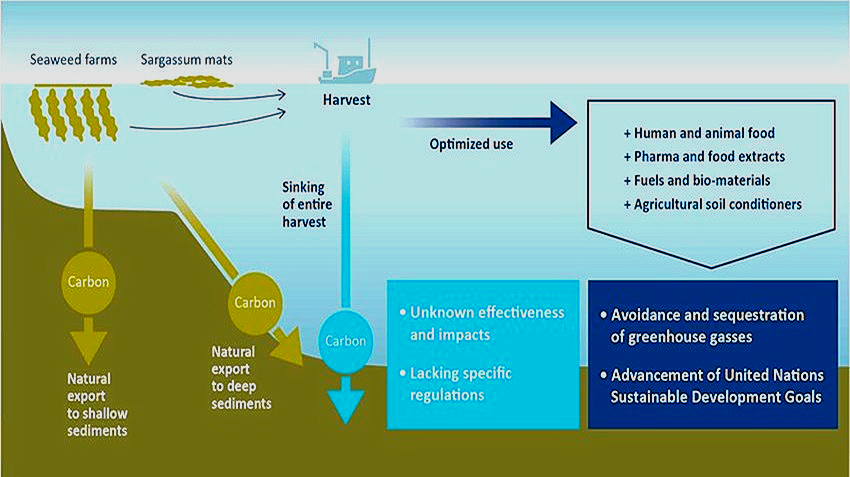
Where terrestrial (or land based) carbon farming is a long established practice for soil restoration, ocean carbon farming is still at an early stage of development and its effectiveness for carbon sequestration and positive/negative impacts on ocean ecosystems are yet unclear. Therefore for the next decades, terrestrial carbon farming is our only trustworthy and safe option for carbon removal.
Terrestrial carbon farming, the advantages and risks are well understood
Ocean carbon farming, promising but unknown effectiveness and impacts
ADVANCING SUSTAINABLE BIOENERGY DEVELOPMENT
New, advanced technologies make it possible to produce climate neutral fuels from non-forest and non-food energy crops. The benefits of cultivation and use of these energy crops for transport fuels and electricity goes beyond the benefits of reducing greenhouse gas emissions. Terrestrial energy crop cultivation and aquatic energy crop harvesting reverses land and water degradation, increases biodiversity and carbon sequestration and improves land fertility. We call this
Deep Green Biomass. Moreover, deploying these energy crops for the production of advanced biofuels will positively impact social-economic structures and energy independence and reduce the need for involuntary migration and deforestation: Deep Green Energy.
Deep Green Energy Partners works to accelerate deployment of deep green biomass for the production of advanced biofuels and biochemicals, to restore soil and water conditions and to optimize the overall ecological-economic effects of investments in the energy transition.
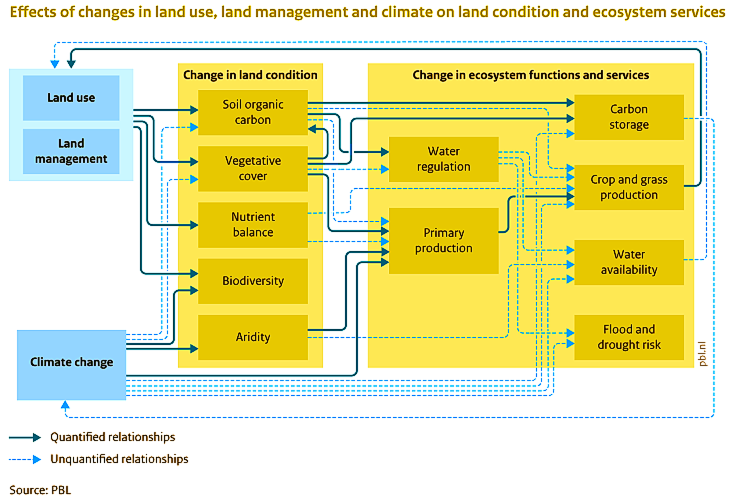
Effects of changes in land use, land management and climate on land conditions and ecosystems services.
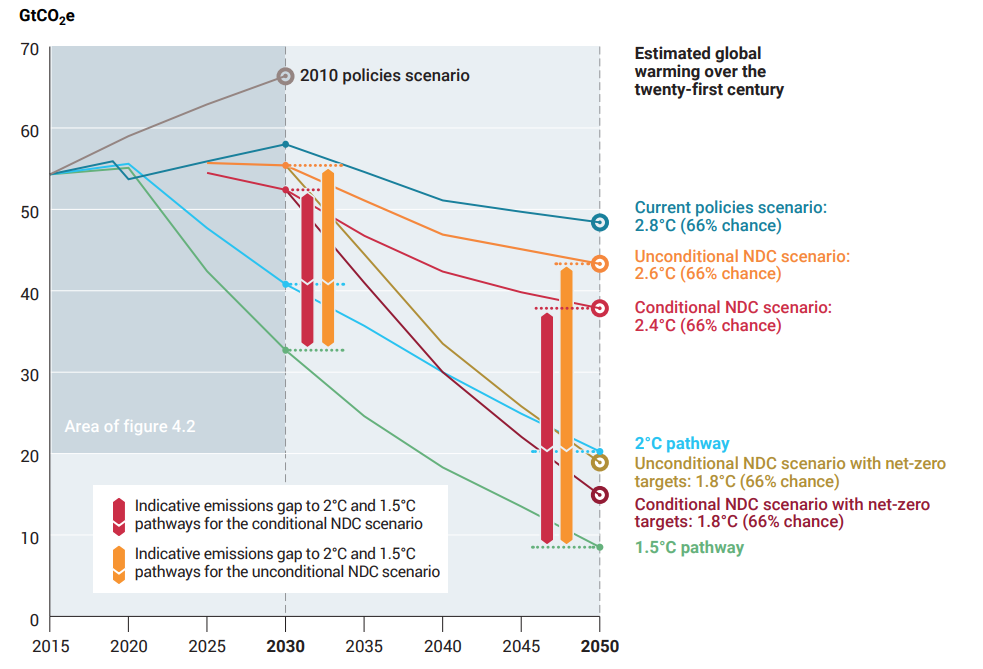
In current scenarios projected emissions exceed the threshhold for 2C global warming by ~ 30 GtCO2eq .
ADVANCING SUSTAINABLE BIOENERGY DEVELOPMENT
New, advanced technologies make it possible to produce climate neutral fuels from non-forest and non-food energy crops. The benefits of cultivation and use of these energy crops for transport fuels and electricity goes beyond the benefits of reducing greenhouse gas emissions. Terrestrial energy crop cultivation and aquatic energy crop harvesting reverses land and water degradation, increases biodiversity and carbon sequestration and improves land fertility. We call this
Deep Green Biomass. Moreover, deploying these energy crops for the production of advanced biofuels will positively impact social-economic structures and energy independence and reduce the need for involuntary migration and deforestation: Deep Green Energy.
Deep Green Energy Partners works to accelerate deployment of deep green biomass for the production of advanced biofuels and biochemicals, to restore soil and water conditions and to optimize the overall ecological-economic effects of investments in the energy transition.
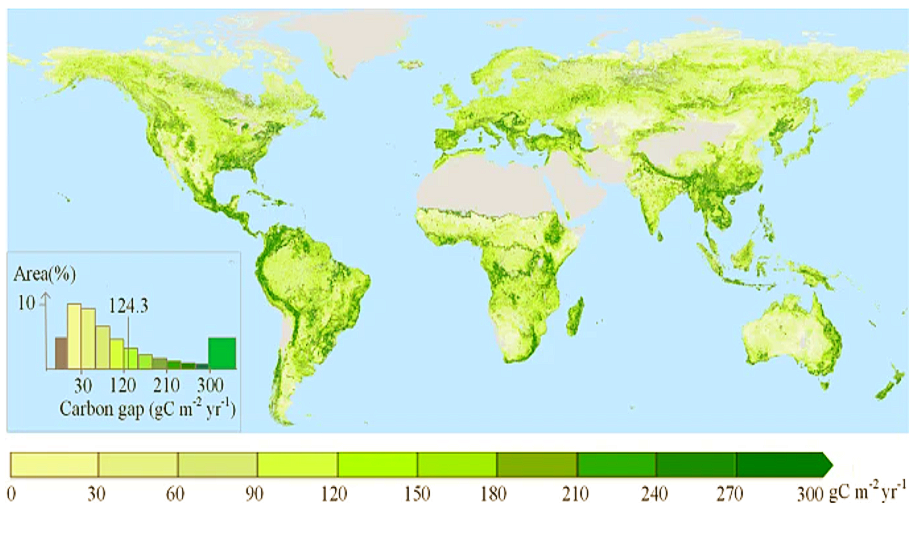
Increasing NPP involves both conserving present carbon stocks and sequestration capacity, and increasing future carbon sequestration and efficiencies by increasing NPP. The annual carbon flux between terrestrial biomass and the atmosphere is ~ 130 gigatonnes (Gt). By optimizing current land-management and present land-cover, global soils and terrestrial vegetation could annually sequester
about 13.74 gigatonnes of carbon (GtC) more than it does today. This equals ~ 50 GtCO2eq sequestration by above- and belowground plant and microbial biomass (1 GtC = 3,67 GtCO2) which would be just sufficient to close the emissions gap for 2°C GW in a business as usual scenario and more than sufficient if in the current policy scenario.
The actual gap between business as usual and a net-zero to be closed by carbon dioxide (CO2eq) removal (CDR) depends on how other technologies develop.
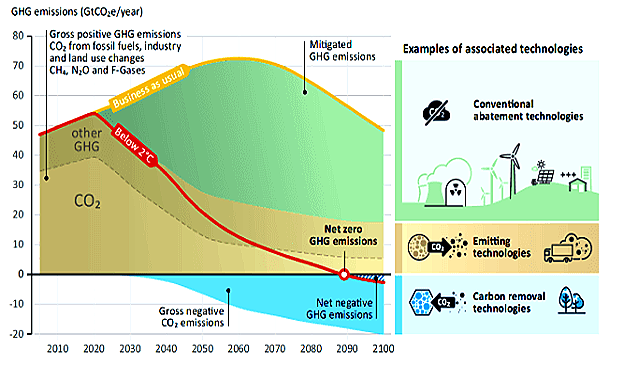
Global land vegetation can sequester an extra of 13.74 GtC per year.
ADVANCING SUSTAINABLE BIOENERGY DEVELOPMENT
New, advanced technologies make it possible to produce climate neutral fuels from non-forest and non-food energy crops. The benefits of cultivation and use of these energy crops for transport fuels and electricity goes beyond the benefits of reducing greenhouse gas emissions. Terrestrial energy crop cultivation and aquatic energy crop harvesting reverses land and water degradation, increases biodiversity and carbon sequestration and improves land fertility. We call this
Deep Green Biomass. Moreover, deploying these energy crops for the production of advanced biofuels will positively impact social-economic structures and energy independence and reduce the need for involuntary migration and deforestation: Deep Green Energy.
Deep Green Energy Partners works to accelerate deployment of deep green biomass for the production of advanced biofuels and biochemicals, to restore soil and water conditions and to optimize the overall ecological-economic effects of investments in the energy transition.
A recent analyses, of true versus default sequestration and emissions from forests, soils and other land-use indicates an actual mean annual terrestrial CDR of 1.7 GtCO2 over the period 2000–2020, largely determined by a sink on forest land (−6.4 Gt CO2), followed by source from deforestation (+4.4 Gt CO2), with smaller fluxes from organic soils (+0.9 Gt CO2) and other land uses (−0.6 Gt CO2). Thus actual net carbon sequestration in the previous 2 decades was lower than assumed previously.
In 2023, global land and soil carbon absorption fell below the average due to drought in the Amazon and fires in Canada and Siberia. If this trend is temporary because of the "El Nino" effect or persistent as it follows global warming is unclear. But as the Amazon is becoming a carbon source, the Congo Basin is the last stable forest carbon sink and the absorption forest land will likely decline further. Organic soil emissions are expected to increase ~ 40% as the world warms up and soils become drier and microbes break soil carbon down faster. The forest land area burned by wildfires has been increasing annually by 5.4% over the last 20 years, this pace speeds up as droughts and heatwaves increase, which in turn will speed up emissions from permafrost thaw.
Whether net carbon sequestration will increase by 2050 or not depends on whether carbon sequestration will sufficiently outpace carbon losses from land-use and climate change in the next 25 years.
ADVANCING SUSTAINABLE BIOENERGY DEVELOPMENT
New, advanced technologies make it possible to produce climate neutral fuels from non-forest and non-food energy crops. The benefits of cultivation and use of these energy crops for transport fuels and electricity goes beyond the benefits of reducing greenhouse gas emissions. Terrestrial energy crop cultivation and aquatic energy crop harvesting reverses land and water degradation, increases biodiversity and carbon sequestration and improves land fertility. We call this
Deep Green Biomass. Moreover, deploying these energy crops for the production of advanced biofuels will positively impact social-economic structures and energy independence and reduce the need for involuntary migration and deforestation: Deep Green Energy.
Deep Green Energy Partners works to accelerate deployment of deep green biomass for the production of advanced biofuels and biochemicals, to restore soil and water conditions and to optimize the overall ecological-economic effects of investments in the energy transition.
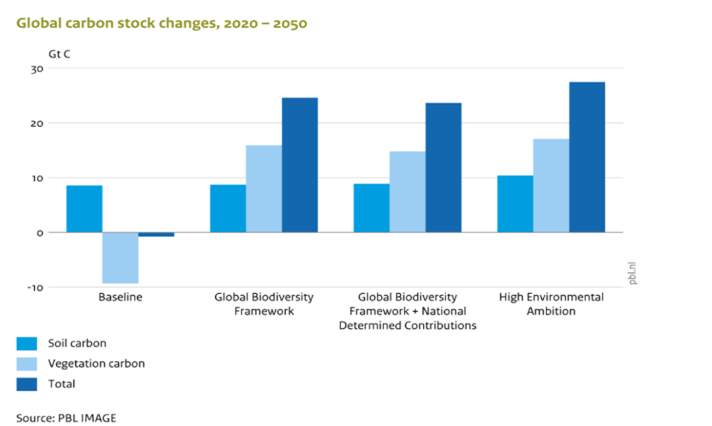
Carbon stocks, sequestration and biodiversity are strongly related and interdependent as soil and vegetation provide the habitat for all that lives, and soil microbes and animals take care of soil fertility, pollination and play their part in maintaining the Earth's chemical cycles and systems. Today ~ 18% of the world's land surface, including its carbon and biodiversity, is protected. In the current policy scenario (hereunder "Baseline" scenario), policies for energy and industry remain unchanged while governments have earmarked 1.2 billion hectares for improved carbon sequestration, forest and biodiversity conservation. In this scenario global carbon stocks in 2050 are projected to remain almost at current levels as soil carbon gains are offset by vegetative losses and global warming is projected to reach ~ 3.1°C in 2100.
In two more ambitious scenarios 30% of the terrestrial surface, and its carbon and biodiversity stocks, will be protected. In these scenarios land and water management efficiencies increase, forestry is kept sustainable levels, forest plantations are kept at Baseline levels to reduce pressure on natural forests and 50% of the world population adopts a healthy dinner (less livestock products), food waste is reduced by 50% and policies are brought in line with NDC's, an temperatures will rise by between 2.4-2.9 °C. In the "High Environmental Ambition Scenario" the protected land surface is further increased to 50%, the world population on healthy diet increases to 100% and polices are brought in line with the Paris Agreement, and GW is kept below 2°C. In all three scenarios carbon stocks increase by between 24-28 GtC.
Global carbon stocks under current policy (baseline) scenarios
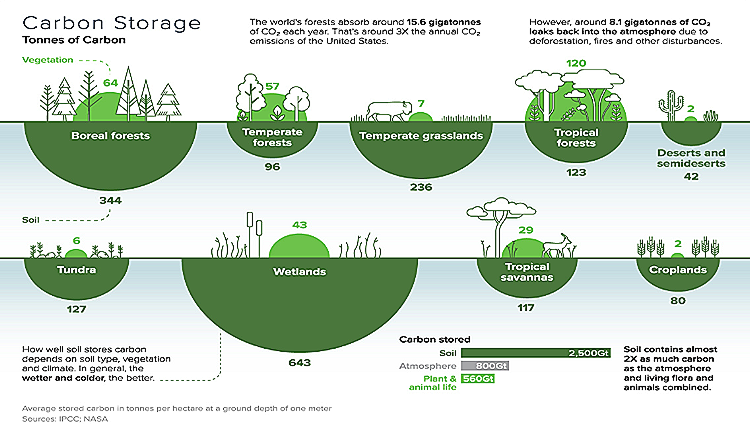
Carbon stocks in soils, plants and animals in various biomes.
Carbon sequestration rate (tons CO2 ha/year) of plantation forests and woodlots groups.
Carbon sequestration perennial C4 grasses, Short rotation coppice (willow) and short rotation forests (Poplar)
ADVANCING SUSTAINABLE BIOENERGY DEVELOPMENT
New, advanced technologies make it possible to produce climate neutral fuels from non-forest and non-food energy crops. The benefits of cultivation and use of these energy crops for transport fuels and electricity goes beyond the benefits of reducing greenhouse gas emissions. Terrestrial energy crop cultivation and aquatic energy crop harvesting reverses land and water degradation, increases biodiversity and carbon sequestration and improves land fertility. We call this
Deep Green Biomass. Moreover, deploying these energy crops for the production of advanced biofuels will positively impact social-economic structures and energy independence and reduce the need for involuntary migration and deforestation: Deep Green Energy.
Deep Green Energy Partners works to accelerate deployment of deep green biomass for the production of advanced biofuels and biochemicals, to restore soil and water conditions and to optimize the overall ecological-economic effects of investments in the energy transition.
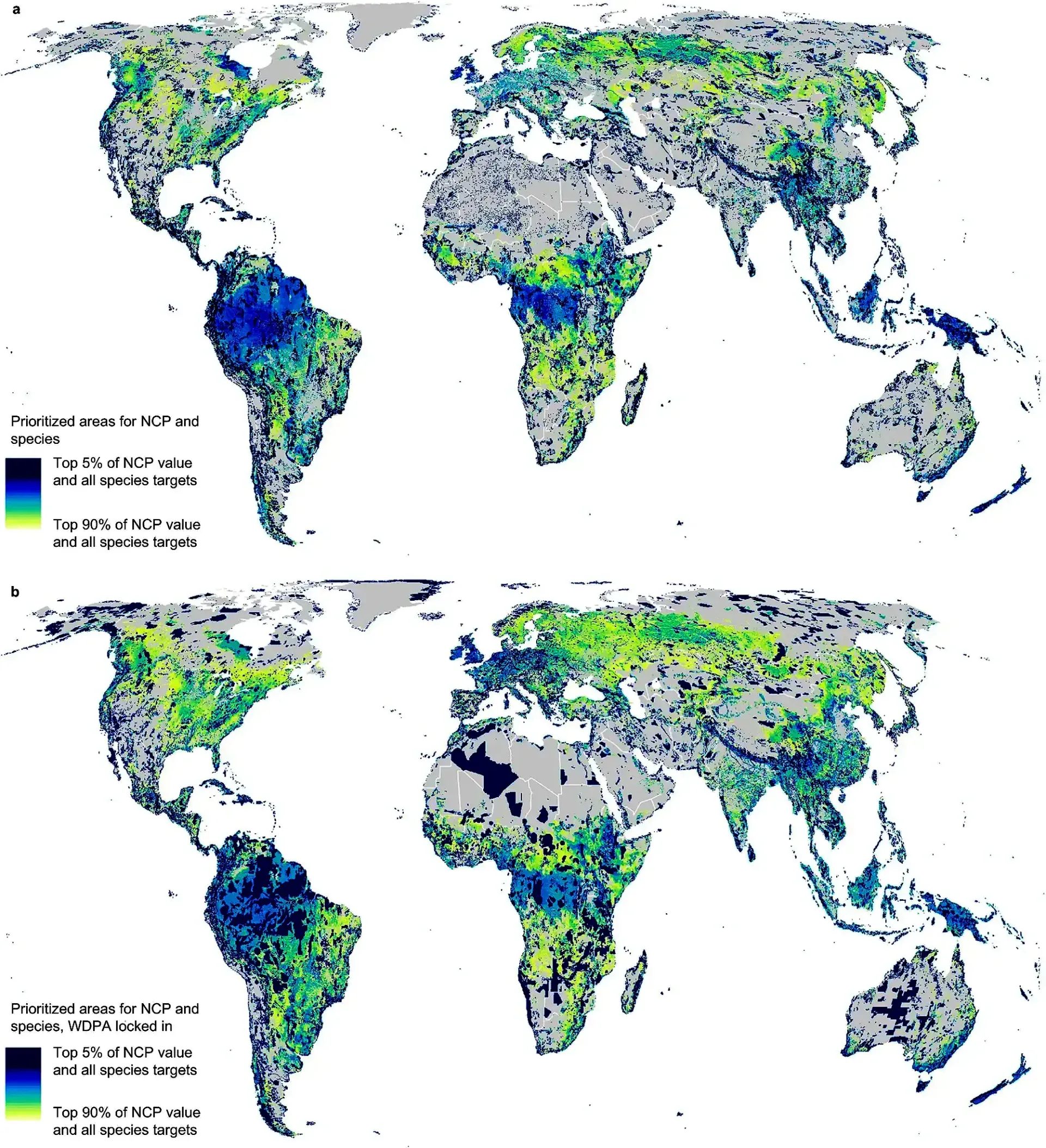
of d above, and various other high environmental ambition scenarios vegetation and soil carbon stocks increase, by protecting 30% of the terrestrial land surface by 2030 and 50% by 2050. Protecting the ecological most important 50% of terrestrial land area would conserve respectively 85.3% of the estimated total carbon stock, 89.8% of all clean water, meet 79% conservation targets of all species relevant to ecosystem preservations. This would include the present global carbon stocks and sequestration capacity that cannot regenerate within 25 years, the irrecoverable carbon. These irrecoverable carbon stocks are concentrated on about 30% of the land surface and could be preserved through various land management options, if timely action is taken. Practically all of that land is covered by the 50% the land surface of most ecological importance.
In these scenarios 90% of current levels of nature's contributions to people could be met and global warming would be limited to well below 2°C by the end of the century, under the condition that ~ two thirds of this land surface would be managed sustainably.
Prioritized areas for nature’s contributions to people (NCP) and biodiversity.
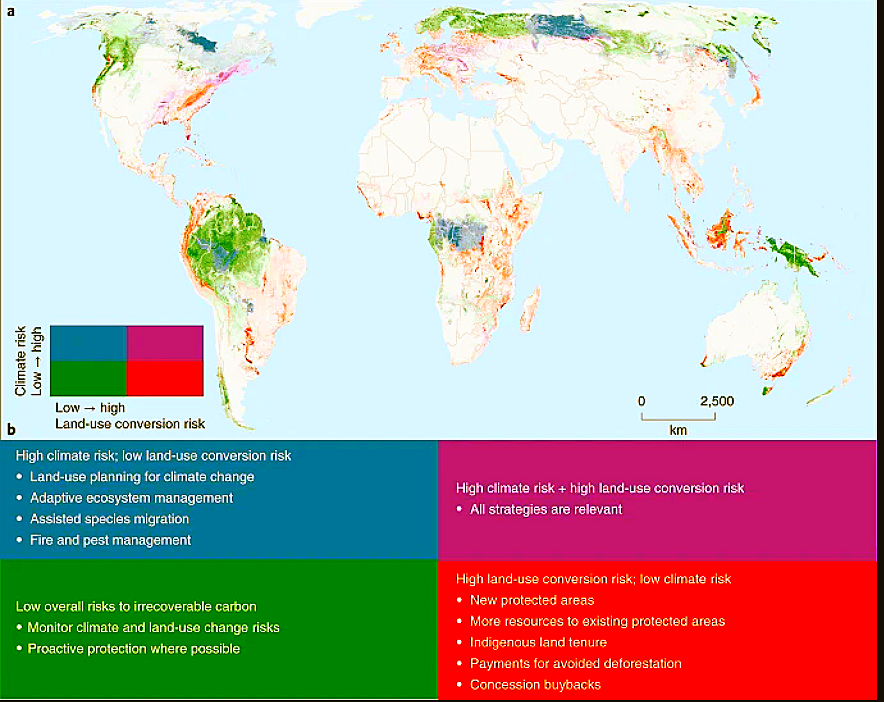
Climate and land-use conversion risks to irrecoverable carbon by ecoregion and strategies for risk mitigation.
ADVANCING SUSTAINABLE BIOENERGY DEVELOPMENT
New, advanced technologies make it possible to produce climate neutral fuels from non-forest and non-food energy crops. The benefits of cultivation and use of these energy crops for transport fuels and electricity goes beyond the benefits of reducing greenhouse gas emissions. Terrestrial energy crop cultivation and aquatic energy crop harvesting reverses land and water degradation, increases biodiversity and carbon sequestration and improves land fertility. We call this
Deep Green Biomass. Moreover, deploying these energy crops for the production of advanced biofuels will positively impact social-economic structures and energy independence and reduce the need for involuntary migration and deforestation: Deep Green Energy.
Deep Green Energy Partners works to accelerate deployment of deep green biomass for the production of advanced biofuels and biochemicals, to restore soil and water conditions and to optimize the overall ecological-economic effects of investments in the energy transition.
This implies that in the best case "'sustainable land use" scenario 90% of today's ecosystem services could be provided from 50% of the land surface. That surface corresponds more or less with the ~ 50% lands still covered by forests, wild grasses and scrubs that have been the least modified by land-use.
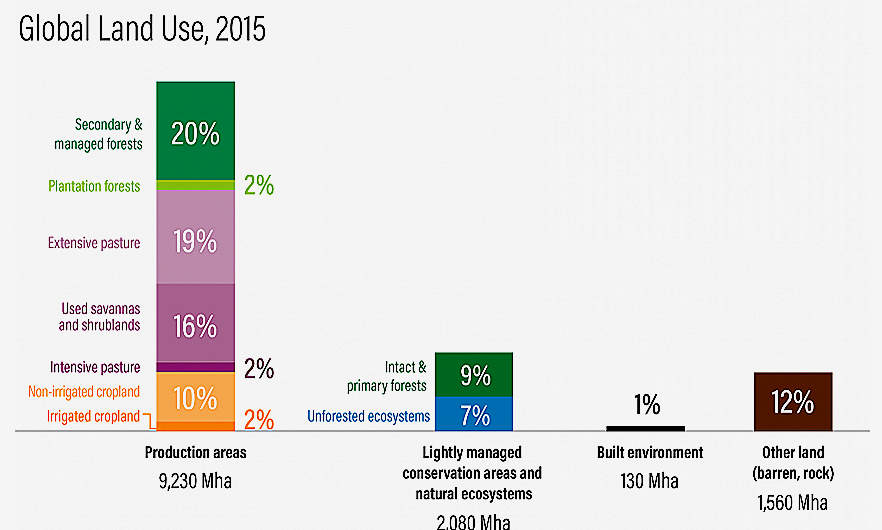
Meaning that all things equal, the provision of the remaining 10% of today's, and the additional 80% of food, forestry and mining products in 2050, as well as the additional carbon sequestration for limiting global warming to 2°C would have to come from a "production land area" equal to the other half of the arable land surface. Which almost equals the current land surface for food production.
Global land vegetation can sequester an extra of 13.74 GtC per year.
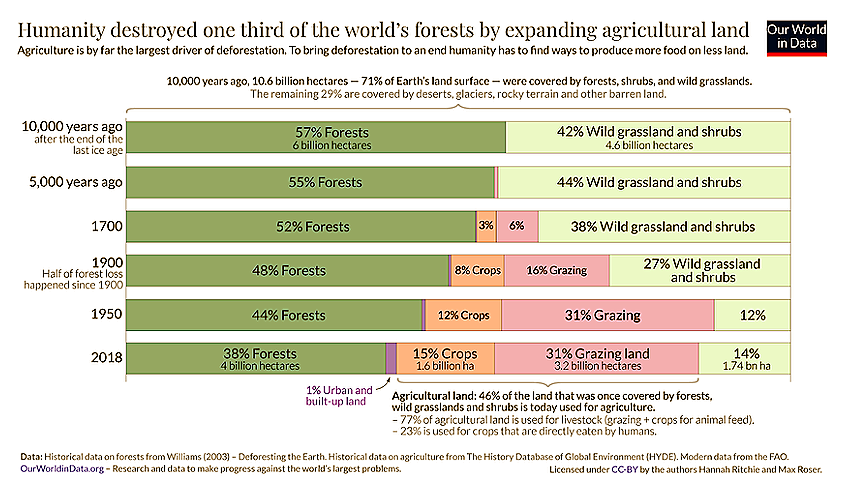
Global land-use 2015.
ADVANCING SUSTAINABLE BIOENERGY DEVELOPMENT
New, advanced technologies make it possible to produce climate neutral fuels from non-forest and non-food energy crops. The benefits of cultivation and use of these energy crops for transport fuels and electricity goes beyond the benefits of reducing greenhouse gas emissions. Terrestrial energy crop cultivation and aquatic energy crop harvesting reverses land and water degradation, increases biodiversity and carbon sequestration and improves land fertility. We call this
Deep Green Biomass. Moreover, deploying these energy crops for the production of advanced biofuels will positively impact social-economic structures and energy independence and reduce the need for involuntary migration and deforestation: Deep Green Energy.
Deep Green Energy Partners works to accelerate deployment of deep green biomass for the production of advanced biofuels and biochemicals, to restore soil and water conditions and to optimize the overall ecological-economic effects of investments in the energy transition.
Restoring the most ecologic relevant biomes outside the 50% conservation lands, i.e. wetlands, tropical forests and grasslands
could also sequester 299 gigatonnes of CO2 within 3 decades and would require less than
5% of the arable land surface. Thus if all carbon conservation and restoration efforts would be optimized and be successful, the additional annual sequestration through improved land-use on production land could be lowered from 30 GtCO2 to ~ 22,5 GtCO2, or from 1.2. to 0.9 GtCO2 year on year by 2050.
ADVANCING SUSTAINABLE BIOENERGY DEVELOPMENT
New, advanced technologies make it possible to produce climate neutral fuels from non-forest and non-food energy crops. The benefits of cultivation and use of these energy crops for transport fuels and electricity goes beyond the benefits of reducing greenhouse gas emissions. Terrestrial energy crop cultivation and aquatic energy crop harvesting reverses land and water degradation, increases biodiversity and carbon sequestration and improves land fertility. We call this
Deep Green Biomass. Moreover, deploying these energy crops for the production of advanced biofuels will positively impact social-economic structures and energy independence and reduce the need for involuntary migration and deforestation: Deep Green Energy.
Deep Green Energy Partners works to accelerate deployment of deep green biomass for the production of advanced biofuels and biochemicals, to restore soil and water conditions and to optimize the overall ecological-economic effects of investments in the energy transition.
Global extraction for biomass is set to grow by between 25 and 75% by 2050. This means that either the productivity of production lands has to increase by 35% (NPP increase), demand for their products has to stabilize (per capita demand decrease) or the conversion ratio of raw product input (biomass) to end product output (food, energy, materials) has to practically double (efficiency increase) on the land currently used for agriculture. At the same time carbon sequestration or fossil carbon by biocarbon substitution should increase by 0.9 GtCO2 year on year upto 2050.
The plants and other organisms (soil microbes, fungi and algae) that perform the actual work are called primary producers or autotrophs. For making production compatible In order other words we have to solve a land puzzle
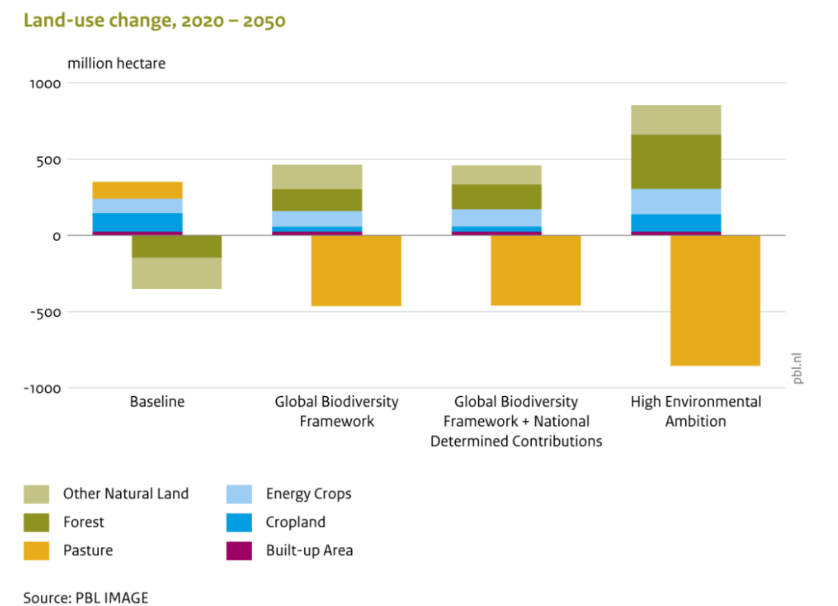
In the current policies, or business as usual scenarios forests and natural lands would decline with 350 Mha, global warming the most ambitious environmental scenario land-use change between 2020 and 2050
Carbon sequestration rate (tons CO2 ha/year) of plantation forests and woodlots groups.
Carbon sequestration perennial C4 grasses, Short rotation coppice (willow) and short rotation forests (Poplar)
ADVANCING SUSTAINABLE BIOENERGY DEVELOPMENT
New, advanced technologies make it possible to produce climate neutral fuels from non-forest and non-food energy crops. The benefits of cultivation and use of these energy crops for transport fuels and electricity goes beyond the benefits of reducing greenhouse gas emissions. Terrestrial energy crop cultivation and aquatic energy crop harvesting reverses land and water degradation, increases biodiversity and carbon sequestration and improves land fertility. We call this
Deep Green Biomass. Moreover, deploying these energy crops for the production of advanced biofuels will positively impact social-economic structures and energy independence and reduce the need for involuntary migration and deforestation: Deep Green Energy.
Deep Green Energy Partners works to accelerate deployment of deep green biomass for the production of advanced biofuels and biochemicals, to restore soil and water conditions and to optimize the overall ecological-economic effects of investments in the energy transition.
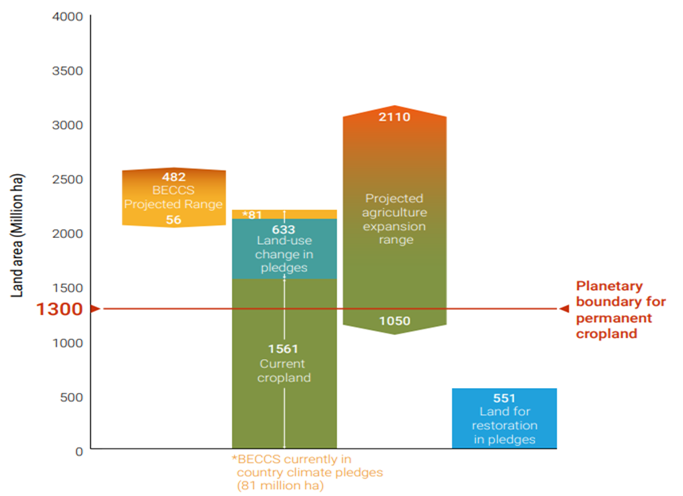
Under the present NDC's governments have reserved 1.2 billion ha (~ 10% of the arable land mass) for carbon sequestration by forest conservation and land restoration. As demand for forest wood and food are expected to grow by at least 30% government strategies aim to address the land-use puzzle by a mixture of three instruments: reforestation (planting forests where they once stood), afforestation (planting forests where they never stood before) and improving soil carbon sequestration on agricultural lands by more sustainable practices. Thus soil degradation and deforestation by food and forestry production should be avoided and partially reversed.
This seems a sensible strategy. Regretfully, it can impossibly achieve either objective.
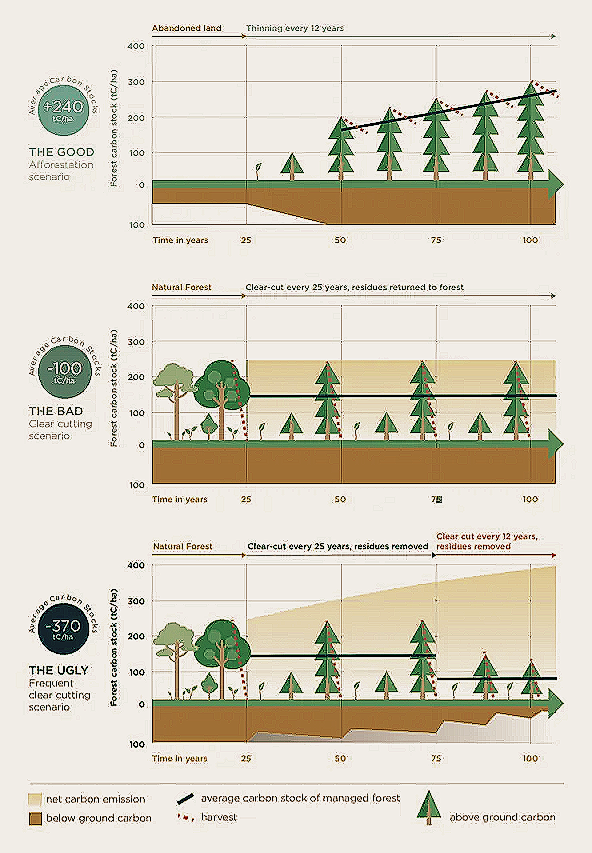
The potential of carbon sequestration by forest plantations.
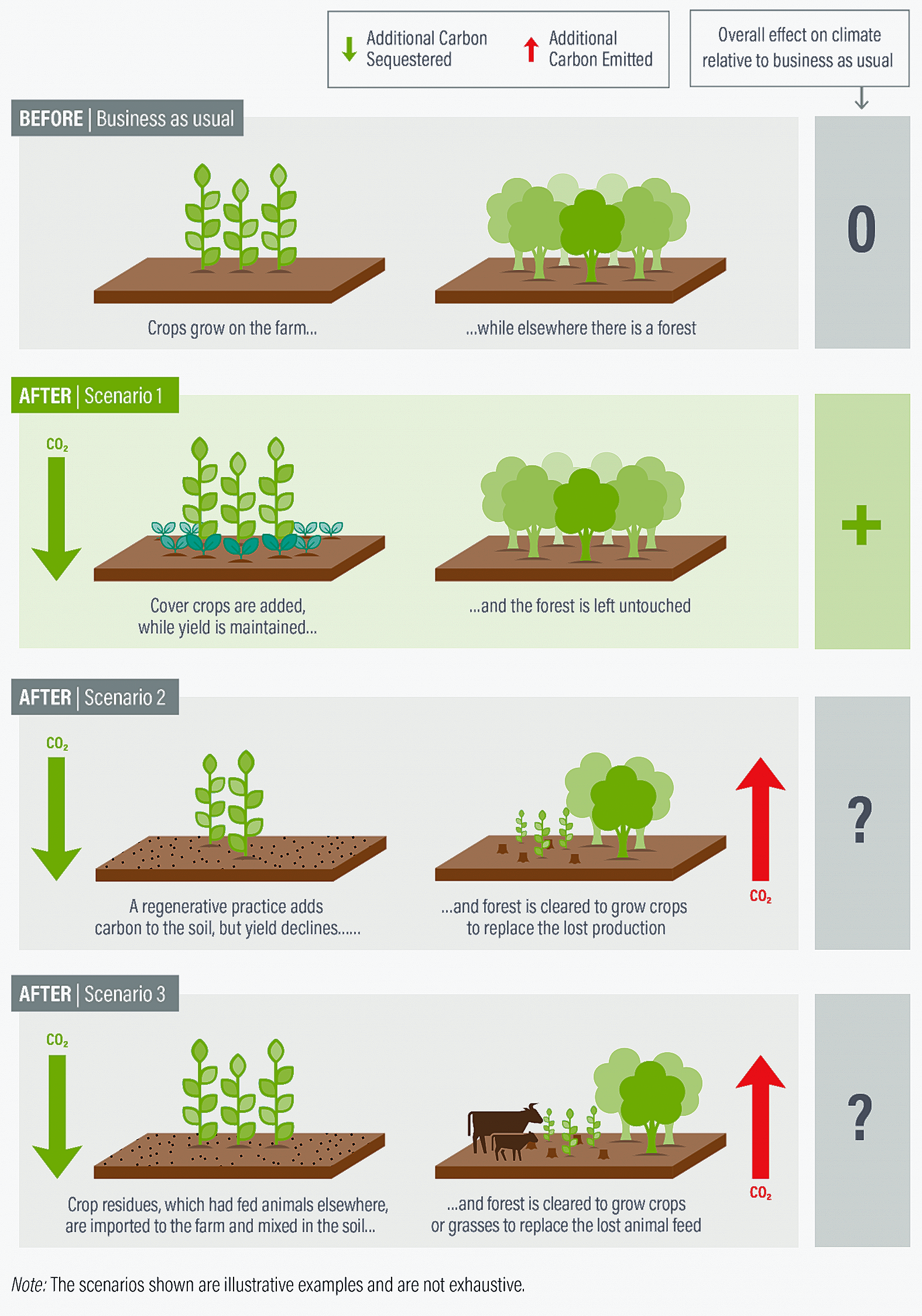
The potential of carbon sequestration by food and feed crops.
ADVANCING SUSTAINABLE BIOENERGY DEVELOPMENT
New, advanced technologies make it possible to produce climate neutral fuels from non-forest and non-food energy crops. The benefits of cultivation and use of these energy crops for transport fuels and electricity goes beyond the benefits of reducing greenhouse gas emissions. Terrestrial energy crop cultivation and aquatic energy crop harvesting reverses land and water degradation, increases biodiversity and carbon sequestration and improves land fertility. We call this
Deep Green Biomass. Moreover, deploying these energy crops for the production of advanced biofuels will positively impact social-economic structures and energy independence and reduce the need for involuntary migration and deforestation: Deep Green Energy.
Deep Green Energy Partners works to accelerate deployment of deep green biomass for the production of advanced biofuels and biochemicals, to restore soil and water conditions and to optimize the overall ecological-economic effects of investments in the energy transition.
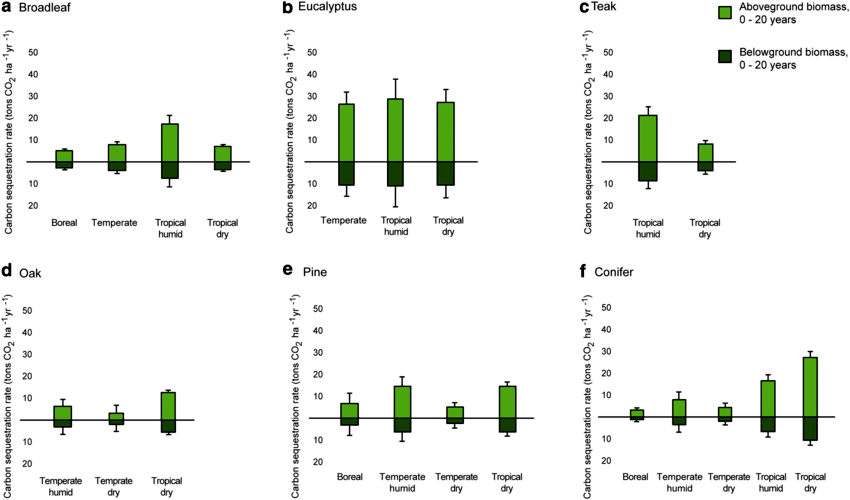
Carbon sequestration rate (tons CO2 ha/year) of plantation forests and woodlots groups.
Carbon sequestration perennial C4 grasses, Short rotation coppice (willow) and short rotation forests (Poplar)
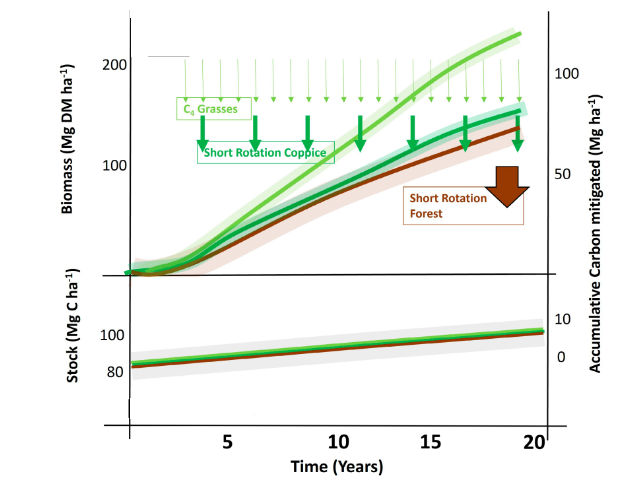
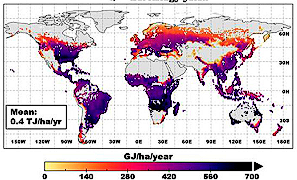
On most agricultural land C4 perennial grasses, or energy crops have the highest NPP potential
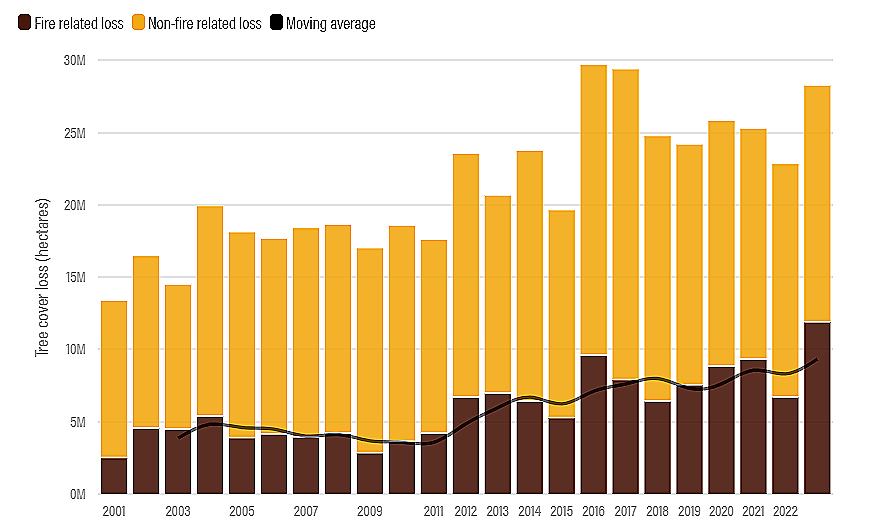
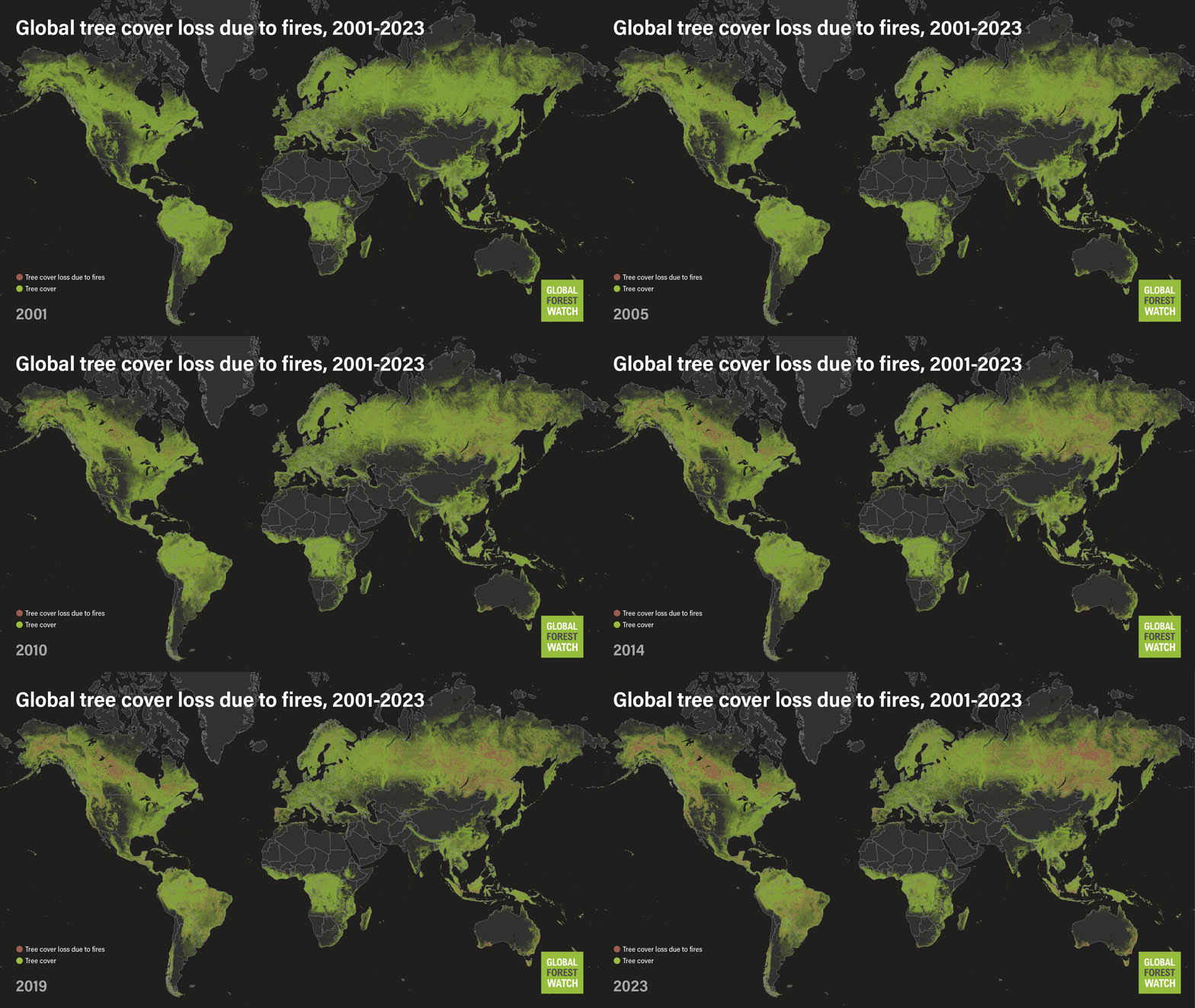
Tree cover loss due to fires compared to other drivers of loss, 2001-2023
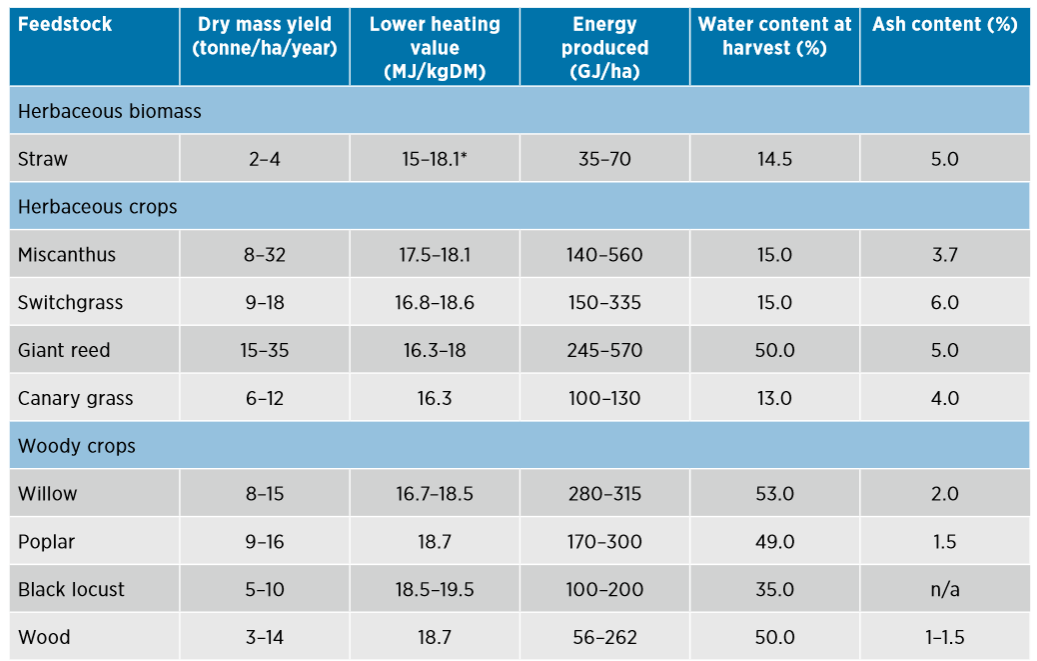
Mean yields of perennial grasses in different climate zones
Yields of perennial grasses, woody crops and wood in temperate climate zones.
Carbon sequestration rate (tons CO2 ha/year) of plantation forests and woodlots groups.
Tree cover loss due to fires compared to other drivers of loss, 2001-2023
ADVANCING SUSTAINABLE BIOENERGY DEVELOPMENT
New, advanced technologies make it possible to produce climate neutral fuels from non-forest and non-food energy crops. The benefits of cultivation and use of these energy crops for transport fuels and electricity goes beyond the benefits of reducing greenhouse gas emissions. Terrestrial energy crop cultivation and aquatic energy crop harvesting reverses land and water degradation, increases biodiversity and carbon sequestration and improves land fertility. We call this
Deep Green Biomass. Moreover, deploying these energy crops for the production of advanced biofuels will positively impact social-economic structures and energy independence and reduce the need for involuntary migration and deforestation: Deep Green Energy.
Deep Green Energy Partners works to accelerate deployment of deep green biomass for the production of advanced biofuels and biochemicals, to restore soil and water conditions and to optimize the overall ecological-economic effects of investments in the energy transition.
Global forest loss in 2023 was ~ 9 Mha, global wildfires generated approximately 2,170 GtCO2, i.e. 242 tCO2 per ha on average. mainly as a result of global warming. It takes tropical forests ~ 60 years to naturally regain carbon losses and temperate and boreal forests 80 years or more. New forests sequestre between 4.5 to 40.7 tCO2 per hectare/year in the first 20 years of growth in above and below ground biomass. Boreal forests are on the lower end and tropical on the higher. For all forests goes that most sequestration happens in the later years as tree canopies increase. It takes between 8 to 18 years for boreal and temperate forests to become a net carbon sink after clear cutting or wildfires by assisted generation, and 25-35 years and 35-45 years to sequester the lost carbon plus forlorn CO2 sequestration after clear cutting and forest fires respectively. Tropical forests can likely recover most carbon within 20-30 years.
The other ~ 65% is more or less evenly divided between deforestation and forest thinning for agriculture and forest harvest in mainly the tropics. About 47% of the world’s forests are at high risk for deforestation or degradation by 2030.
ADVANCING SUSTAINABLE BIOENERGY DEVELOPMENT
New, advanced technologies make it possible to produce climate neutral fuels from non-forest and non-food energy crops. The benefits of cultivation and use of these energy crops for transport fuels and electricity goes beyond the benefits of reducing greenhouse gas emissions. Terrestrial energy crop cultivation and aquatic energy crop harvesting reverses land and water degradation, increases biodiversity and carbon sequestration and improves land fertility. We call this
Deep Green Biomass. Moreover, deploying these energy crops for the production of advanced biofuels will positively impact social-economic structures and energy independence and reduce the need for involuntary migration and deforestation: Deep Green Energy.
Deep Green Energy Partners works to accelerate deployment of deep green biomass for the production of advanced biofuels and biochemicals, to restore soil and water conditions and to optimize the overall ecological-economic effects of investments in the energy transition.
about 30% of all N the Global extraction for biomass is set to grow by between 25 and 75% by 2050.
The longer regeneration takes the less the chance it will happen as the more climatic and soil conditions will have changed, and the higher the chance that carbon stocks and carbon sequestration capacity becomes irrecoverable.
, this means that either the productivity of production lands has to practically double (increased NPP), demand for their products has to half (demand decrease) or the conversion ratio of raw product input to end product output has to double (efficiency increase) on the land currently used for agriculture.
As global extraction for biomass is set to grow by between 25 -75% by 2050,
further have to make a subdivision of the last category based on the time needed for regeneration. Grasses and food/feed crops can naturally regenerate carbon after harvest in months or years. From alone a carbon perspective with a 25 year time horizon Depending on forestry system, thinning or clear cutting, boreal and temperate forests plantations and managed forests can recover carbon stocks in ~ 3 decades or never. In general wetlands and unmanaged temperate and boreal forests take over a century to recover carbon losses. This means that only grasses and food crops can ......
ADVANCING SUSTAINABLE BIOENERGY DEVELOPMENT
New, advanced technologies make it possible to produce climate neutral fuels from non-forest and non-food energy crops. The benefits of cultivation and use of these energy crops for transport fuels and electricity goes beyond the benefits of reducing greenhouse gas emissions. Terrestrial energy crop cultivation and aquatic energy crop harvesting reverses land and water degradation, increases biodiversity and carbon sequestration and improves land fertility. We call this
Deep Green Biomass. Moreover, deploying these energy crops for the production of advanced biofuels will positively impact social-economic structures and energy independence and reduce the need for involuntary migration and deforestation: Deep Green Energy.
Deep Green Energy Partners works to accelerate deployment of deep green biomass for the production of advanced biofuels and biochemicals, to restore soil and water conditions and to optimize the overall ecological-economic effects of investments in the energy transition.
In the hypothetical absence of land use and climate change, vegetation would store around 916 gigatonnes carbon (GtC) instead of today's 450 GtC under current climate conditions. Unfortunately land-use, and more in particular agriculture has not only cut vegetation and carbon sequestration capacity by half, but also degraded more than half of the land and soils. Which caused soil carbon (SOC) and nutrient losses and set of the process of desertification. As a result a third, 1.600 Mha, of agricultural lands is already showing persistent decline in productivity.
Reversing land and soil degradation by (re)conversion of cropland or grazing land to forest or grassland may increase SOC content from 25 to 60% depending on the degree of SOC depletion, climate and soil type. The world's soils hold ~2.500 GtC organic carbon ~5 times as much carbon as its vegetation. As carbon sequestration and storage starts with photosynthesis we have to consider the optimal vegetation for conserving and increasing both above and below ground carbon sequestration, reverse land and soil degradation and produce the sustainable carbon on the land surface currently used for agriculture in the next 25 years.
Feedback loops between land degradation, climate change, and biodiversity loss
Carbon stocks in soils, plants and animals in various biomes.
ADVANCING SUSTAINABLE BIOENERGY DEVELOPMENT
New, advanced technologies make it possible to produce climate neutral fuels from non-forest and non-food energy crops. The benefits of cultivation and use of these energy crops for transport fuels and electricity goes beyond the benefits of reducing greenhouse gas emissions. Terrestrial energy crop cultivation and aquatic energy crop harvesting reverses land and water degradation, increases biodiversity and carbon sequestration and improves land fertility. We call this
Deep Green Biomass. Moreover, deploying these energy crops for the production of advanced biofuels will positively impact social-economic structures and energy independence and reduce the need for involuntary migration and deforestation: Deep Green Energy.
Deep Green Energy Partners works to accelerate deployment of deep green biomass for the production of advanced biofuels and biochemicals, to restore soil and water conditions and to optimize the overall ecological-economic effects of investments in the energy transition.
However, reaching a new equilibrium of SOC stock (soil carbon sequestration minus soil respiration) by assisted restoration of initial vegetation may take up to 80 years after land-use change occurred.
We are currently losing net 5 Mha of forests annually, demand for forest products as well as forest fires are set to increase. The land area burned by forest fires has been increasing annually by 5.4% in the last 20 years. Global wildfires generated approximately 2,170 GtCO2 in 2023 on about 12 Mha. Globally, a net average decrease of about 60 metric tons of carbon per km2 per year has been reported with a total loss of 3.1 billion (B) tons of carbon from an area of 2 Mkm2 over about 25 years.
Climate change induced droughts and pests have been the driving force of forest fires increases in boreal regions (tall, primary or old growth forests in Canada and Siberia) In recent years these effects also became manifest in temperate and sub-tropical climate zones (often secondary, managed forests in the EU, US and AUS). Though fires are responsible for less than 10% of all tree cover loss in the tropics, more common drivers like commodity-driven deforestation and shifting agriculture make tropical forests also less resilient and more susceptible to fires.
Since 2001 the land area burned by forest fires increased by 5.4% annually
Tree cover loss due to fires compared to other drivers of loss, 2001-2023
ADVANCING SUSTAINABLE BIOENERGY DEVELOPMENT
New, advanced technologies make it possible to produce climate neutral fuels from non-forest and non-food energy crops. The benefits of cultivation and use of these energy crops for transport fuels and electricity goes beyond the benefits of reducing greenhouse gas emissions. Terrestrial energy crop cultivation and aquatic energy crop harvesting reverses land and water degradation, increases biodiversity and carbon sequestration and improves land fertility. We call this
Deep Green Biomass. Moreover, deploying these energy crops for the production of advanced biofuels will positively impact social-economic structures and energy independence and reduce the need for involuntary migration and deforestation: Deep Green Energy.
Deep Green Energy Partners works to accelerate deployment of deep green biomass for the production of advanced biofuels and biochemicals, to restore soil and water conditions and to optimize the overall ecological-economic effects of investments in the energy transition.
Thus, the terrestrial biosphere can technically sequester more than sufficient carbon to limit global warming to 2C. The key question is how we are going to sequestre an additional 0.9 - 1.2 GtCO2eq annually on ~ 40% of the total land mass (4.8 billion ha) for the next decades, and provide all our bio-based needs from that land surface as well, when that land is now used for food production. In other words: we have to solve the land-use and NPP puzzle.
ADVANCING SUSTAINABLE BIOENERGY DEVELOPMENT
New, advanced technologies make it possible to produce climate neutral fuels from non-forest and non-food energy crops. The benefits of cultivation and use of these energy crops for transport fuels and electricity goes beyond the benefits of reducing greenhouse gas emissions. Terrestrial energy crop cultivation and aquatic energy crop harvesting reverses land and water degradation, increases biodiversity and carbon sequestration and improves land fertility. We call this
Deep Green Biomass. Moreover, deploying these energy crops for the production of advanced biofuels will positively impact social-economic structures and energy independence and reduce the need for involuntary migration and deforestation: Deep Green Energy.
Deep Green Energy Partners works to accelerate deployment of deep green biomass for the production of advanced biofuels and biochemicals, to restore soil and water conditions and to optimize the overall ecological-economic effects of investments in the energy transition.
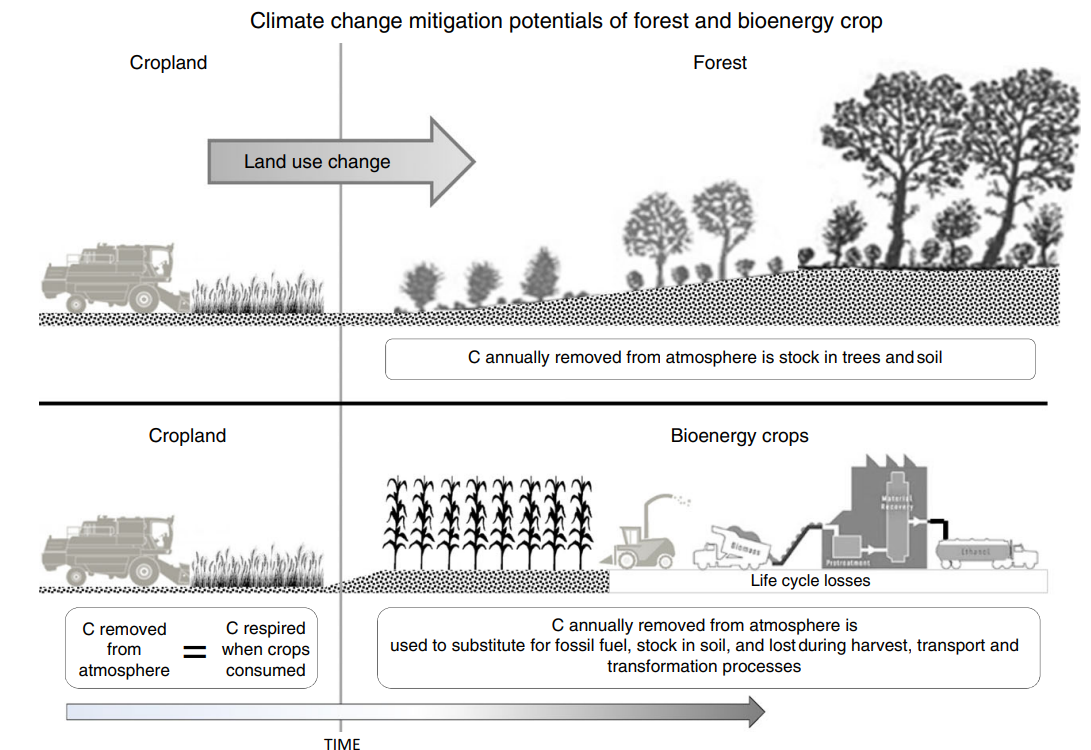
Under the present NDC's governments have reserved 1.2 billion ha (~ 10% of the arable land mass) for carbon sequestration by forest conservation and land restoration. As demand for forest wood and food are expected to grow by at least 30% government strategies aim to address the land-use puzzle by a mixture of three instruments: reforestation (planting forests where they once stood), afforestation (planting forests where they never stood before) and improving soil carbon sequestration on agricultural lands by more sustainable practices. Thus soil degradation and deforestation by food and forestry production should be avoided and partially reversed.
This seems a sensible strategy. Regretfully, it can impossibly achieve either objective. New forests outside the (sub)tropics will take more than three decades to become effective for increased carbon sequestration and food and feed crop cultivation could technically remove carbon and become more sustainable but not without decreasing yields which will cause more deforestation and thus less sequestration.
The potential of carbon sequestration by forest plantations.
The potential of carbon sequestration by food and feed crops.
ADVANCING SUSTAINABLE BIOENERGY DEVELOPMENT
New, advanced technologies make it possible to produce climate neutral fuels from non-forest and non-food energy crops. The benefits of cultivation and use of these energy crops for transport fuels and electricity goes beyond the benefits of reducing greenhouse gas emissions. Terrestrial energy crop cultivation and aquatic energy crop harvesting reverses land and water degradation, increases biodiversity and carbon sequestration and improves land fertility. We call this
Deep Green Biomass. Moreover, deploying these energy crops for the production of advanced biofuels will positively impact social-economic structures and energy independence and reduce the need for involuntary migration and deforestation: Deep Green Energy.
Deep Green Energy Partners works to accelerate deployment of deep green biomass for the production of advanced biofuels and biochemicals, to restore soil and water conditions and to optimize the overall ecological-economic effects of investments in the energy transition.
Carbon sequestration rate (tons CO2 ha/year) of plantation forests and woodlots groups.
Tree cover loss due to fires compared to other drivers of loss, 2001-2023
ADVANCING SUSTAINABLE BIOENERGY DEVELOPMENT
New, advanced technologies make it possible to produce climate neutral fuels from non-forest and non-food energy crops. The benefits of cultivation and use of these energy crops for transport fuels and electricity goes beyond the benefits of reducing greenhouse gas emissions. Terrestrial energy crop cultivation and aquatic energy crop harvesting reverses land and water degradation, increases biodiversity and carbon sequestration and improves land fertility. We call this
Deep Green Biomass. Moreover, deploying these energy crops for the production of advanced biofuels will positively impact social-economic structures and energy independence and reduce the need for involuntary migration and deforestation: Deep Green Energy.
Deep Green Energy Partners works to accelerate deployment of deep green biomass for the production of advanced biofuels and biochemicals, to restore soil and water conditions and to optimize the overall ecological-economic effects of investments in the energy transition.
Land-use change in baseline scenarios,
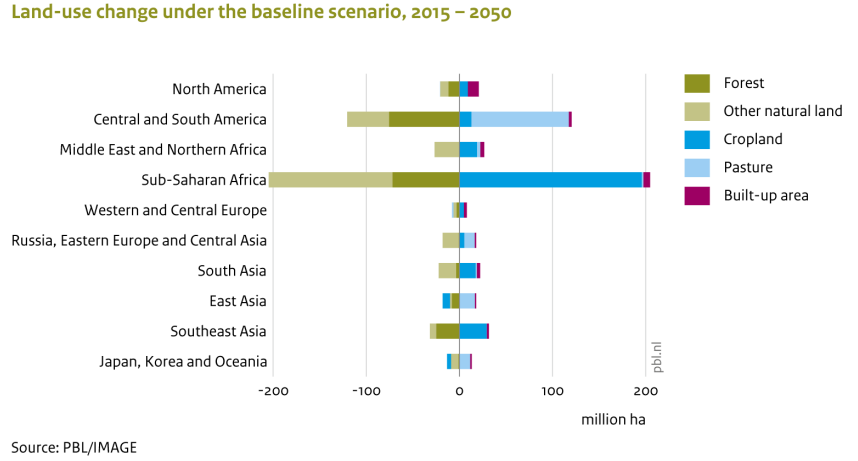
Climate change will gradually limit food production in parts of the world
ADVANCING SUSTAINABLE BIOENERGY DEVELOPMENT
New, advanced technologies make it possible to produce climate neutral fuels from non-forest and non-food energy crops. The benefits of cultivation and use of these energy crops for transport fuels and electricity goes beyond the benefits of reducing greenhouse gas emissions. Terrestrial energy crop cultivation and aquatic energy crop harvesting reverses land and water degradation, increases biodiversity and carbon sequestration and improves land fertility. We call this
Deep Green Biomass. Moreover, deploying these energy crops for the production of advanced biofuels will positively impact social-economic structures and energy independence and reduce the need for involuntary migration and deforestation: Deep Green Energy.
Deep Green Energy Partners works to accelerate deployment of deep green biomass for the production of advanced biofuels and biochemicals, to restore soil and water conditions and to optimize the overall ecological-economic effects of investments in the energy transition.
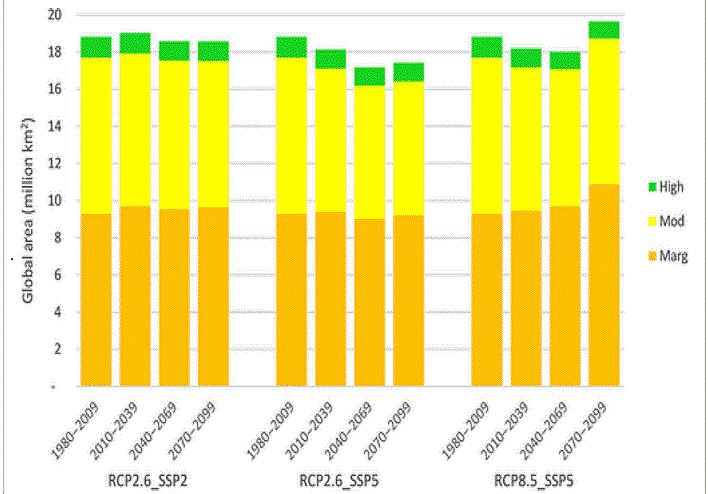
On most agricultural land C4 perennial grasses, or energy crops have the highest NPP potential
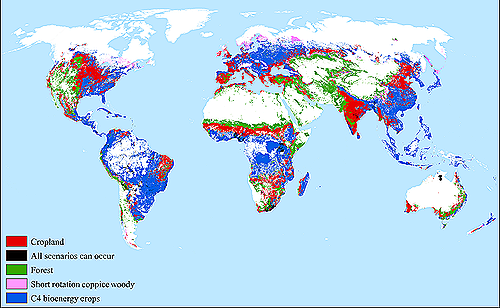
Global area suitable for C4 perennial grasses in different climate scenarios.
ADVANCING SUSTAINABLE BIOENERGY DEVELOPMENT
New, advanced technologies make it possible to produce climate neutral fuels from non-forest and non-food energy crops. The benefits of cultivation and use of these energy crops for transport fuels and electricity goes beyond the benefits of reducing greenhouse gas emissions. Terrestrial energy crop cultivation and aquatic energy crop harvesting reverses land and water degradation, increases biodiversity and carbon sequestration and improves land fertility. We call this
Deep Green Biomass. Moreover, deploying these energy crops for the production of advanced biofuels will positively impact social-economic structures and energy independence and reduce the need for involuntary migration and deforestation: Deep Green Energy.
Deep Green Energy Partners works to accelerate deployment of deep green biomass for the production of advanced biofuels and biochemicals, to restore soil and water conditions and to optimize the overall ecological-economic effects of investments in the energy transition.
Mean yields of perennial grasses in different climate zones
Yields of perennial grasses, woody crops and wood in temperate climate zones.
ADVANCING SUSTAINABLE BIOENERGY DEVELOPMENT
New, advanced technologies make it possible to produce climate neutral fuels from non-forest and non-food energy crops. The benefits of cultivation and use of these energy crops for transport fuels and electricity goes beyond the benefits of reducing greenhouse gas emissions. Terrestrial energy crop cultivation and aquatic energy crop harvesting reverses land and water degradation, increases biodiversity and carbon sequestration and improves land fertility. We call this
Deep Green Biomass. Moreover, deploying these energy crops for the production of advanced biofuels will positively impact social-economic structures and energy independence and reduce the need for involuntary migration and deforestation: Deep Green Energy.
Deep Green Energy Partners works to accelerate deployment of deep green biomass for the production of advanced biofuels and biochemicals, to restore soil and water conditions and to optimize the overall ecological-economic effects of investments in the energy transition.
On most agricultural land C4 perennial grasses, or energy crops have the highest NPP potential
ADVANCING SUSTAINABLE BIOENERGY DEVELOPMENT
New, advanced technologies make it possible to produce climate neutral fuels from non-forest and non-food energy crops. The benefits of cultivation and use of these energy crops for transport fuels and electricity goes beyond the benefits of reducing greenhouse gas emissions. Terrestrial energy crop cultivation and aquatic energy crop harvesting reverses land and water degradation, increases biodiversity and carbon sequestration and improves land fertility. We call this
Deep Green Biomass. Moreover, deploying these energy crops for the production of advanced biofuels will positively impact social-economic structures and energy independence and reduce the need for involuntary migration and deforestation: Deep Green Energy.
Deep Green Energy Partners works to accelerate deployment of deep green biomass for the production of advanced biofuels and biochemicals, to restore soil and water conditions and to optimize the overall ecological-economic effects of investments in the energy transition.
New forests sequestre between 4.5 to 40.7 tCO2per hectare/year in the first 20 years of growth, boreal forests are on the lower end and tropical on the higher. For all forests goes that most sequestration happens in the later years as tree canopies increase.
ADVANCING SUSTAINABLE BIOENERGY DEVELOPMENT
New, advanced technologies make it possible to produce climate neutral fuels from non-forest and non-food energy crops. The benefits of cultivation and use of these energy crops for transport fuels and electricity goes beyond the benefits of reducing greenhouse gas emissions. Terrestrial energy crop cultivation and aquatic energy crop harvesting reverses land and water degradation, increases biodiversity and carbon sequestration and improves land fertility. We call this
Deep Green Biomass. Moreover, deploying these energy crops for the production of advanced biofuels will positively impact social-economic structures and energy independence and reduce the need for involuntary migration and deforestation: Deep Green Energy.
Deep Green Energy Partners works to accelerate deployment of deep green biomass for the production of advanced biofuels and biochemicals, to restore soil and water conditions and to optimize the overall ecological-economic effects of investments in the energy transition.
Indoor food production requires energy, CO2 and nutrients just like open field agriculture. More concentrated open field agriculture will require more fertilizers. All of these can be produced from the new biomass planted on abandoned agricultural lands. Thus, provided that we can scale-up sustainable biomass within the boundaries of available land and scale-up biotechnology facilities fast enough we can avoid ecological collapse and supply deficits in our food, energy and material needs. To provide a sustainable and sufficient supply of carbon, fibre and nutrients yields per hectare will have to be optimized, which is done by carbon and energy farming.
ADVANCING SUSTAINABLE BIOENERGY DEVELOPMENT
New, advanced technologies make it possible to produce climate neutral fuels from non-forest and non-food energy crops. The benefits of cultivation and use of these energy crops for transport fuels and electricity goes beyond the benefits of reducing greenhouse gas emissions. Terrestrial energy crop cultivation and aquatic energy crop harvesting reverses land and water degradation, increases biodiversity and carbon sequestration and improves land fertility. We call this
Deep Green Biomass. Moreover, deploying these energy crops for the production of advanced biofuels will positively impact social-economic structures and energy independence and reduce the need for involuntary migration and deforestation: Deep Green Energy.
Deep Green Energy Partners works to accelerate deployment of deep green biomass for the production of advanced biofuels and biochemicals, to restore soil and water conditions and to optimize the overall ecological-economic effects of investments in the energy transition.
Global land vegetation can sequester an extra of 13.74 GtC per year, by optimizing land management practices. Half of that extra can come from ~15% of the global vegetated area.
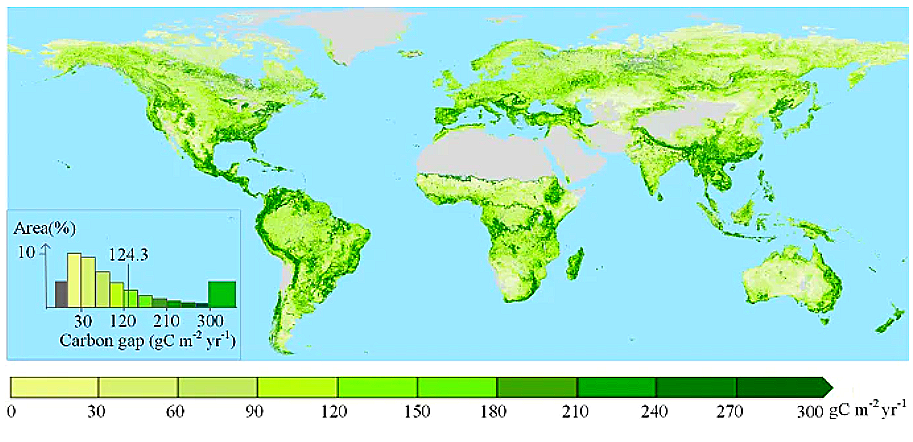
Global area suitable for C4 perennial grasses in different climate scenarios.
ADVANCING SUSTAINABLE BIOENERGY DEVELOPMENT
New, advanced technologies make it possible to produce climate neutral fuels from non-forest and non-food energy crops. The benefits of cultivation and use of these energy crops for transport fuels and electricity goes beyond the benefits of reducing greenhouse gas emissions. Terrestrial energy crop cultivation and aquatic energy crop harvesting reverses land and water degradation, increases biodiversity and carbon sequestration and improves land fertility. We call this
Deep Green Biomass. Moreover, deploying these energy crops for the production of advanced biofuels will positively impact social-economic structures and energy independence and reduce the need for involuntary migration and deforestation: Deep Green Energy.
Deep Green Energy Partners works to accelerate deployment of deep green biomass for the production of advanced biofuels and biochemicals, to restore soil and water conditions and to optimize the overall ecological-economic effects of investments in the energy transition.
CARBON AND ENERGY FARMING
ADVANCING SUSTAINABLE BIOENERGY DEVELOPMENT
New, advanced technologies make it possible to produce climate neutral fuels from non-forest and non-food energy crops. The benefits of cultivation and use of these energy crops for transport fuels and electricity goes beyond the benefits of reducing greenhouse gas emissions. Terrestrial energy crop cultivation and aquatic energy crop harvesting reverses land and water degradation, increases biodiversity and carbon sequestration and improves land fertility. We call this
Deep Green Biomass. Moreover, deploying these energy crops for the production of advanced biofuels will positively impact social-economic structures and energy independence and reduce the need for involuntary migration and deforestation: Deep Green Energy.
Deep Green Energy Partners works to accelerate deployment of deep green biomass for the production of advanced biofuels and biochemicals, to restore soil and water conditions and to optimize the overall ecological-economic effects of investments in the energy transition.
ENERGY CROPS
ADVANCING SUSTAINABLE BIOENERGY DEVELOPMENT
New, advanced technologies make it possible to produce climate neutral fuels from non-forest and non-food energy crops. The benefits of cultivation and use of these energy crops for transport fuels and electricity goes beyond the benefits of reducing greenhouse gas emissions. Terrestrial energy crop cultivation and aquatic energy crop harvesting reverses land and water degradation, increases biodiversity and carbon sequestration and improves land fertility. We call this
Deep Green Biomass. Moreover, deploying these energy crops for the production of advanced biofuels will positively impact social-economic structures and energy independence and reduce the need for involuntary migration and deforestation: Deep Green Energy.
Deep Green Energy Partners works to accelerate deployment of deep green biomass for the production of advanced biofuels and biochemicals, to restore soil and water conditions and to optimize the overall ecological-economic effects of investments in the energy transition.
ADVANCING SUSTAINABLE BIOENERGY DEVELOPMENT
New, advanced technologies make it possible to produce climate neutral fuels from non-forest and non-food energy crops. The benefits of cultivation and use of these energy crops for transport fuels and electricity goes beyond the benefits of reducing greenhouse gas emissions. Terrestrial energy crop cultivation and aquatic energy crop harvesting reverses land and water degradation, increases biodiversity and carbon sequestration and improves land fertility. We call this
Deep Green Biomass. Moreover, deploying these energy crops for the production of advanced biofuels will positively impact social-economic structures and energy independence and reduce the need for involuntary migration and deforestation: Deep Green Energy.
Deep Green Energy Partners works to accelerate deployment of deep green biomass for the production of advanced biofuels and biochemicals, to restore soil and water conditions and to optimize the overall ecological-economic effects of investments in the energy transition.
CARBON SEQUESTRATION POTENTIAL ENERGY CROPS
ADVANCING SUSTAINABLE BIOENERGY DEVELOPMENT
New, advanced technologies make it possible to produce climate neutral fuels from non-forest and non-food energy crops. The benefits of cultivation and use of these energy crops for transport fuels and electricity goes beyond the benefits of reducing greenhouse gas emissions. Terrestrial energy crop cultivation and aquatic energy crop harvesting reverses land and water degradation, increases biodiversity and carbon sequestration and improves land fertility. We call this
Deep Green Biomass. Moreover, deploying these energy crops for the production of advanced biofuels will positively impact social-economic structures and energy independence and reduce the need for involuntary migration and deforestation: Deep Green Energy.
Deep Green Energy Partners works to accelerate deployment of deep green biomass for the production of advanced biofuels and biochemicals, to restore soil and water conditions and to optimize the overall ecological-economic effects of investments in the energy transition.
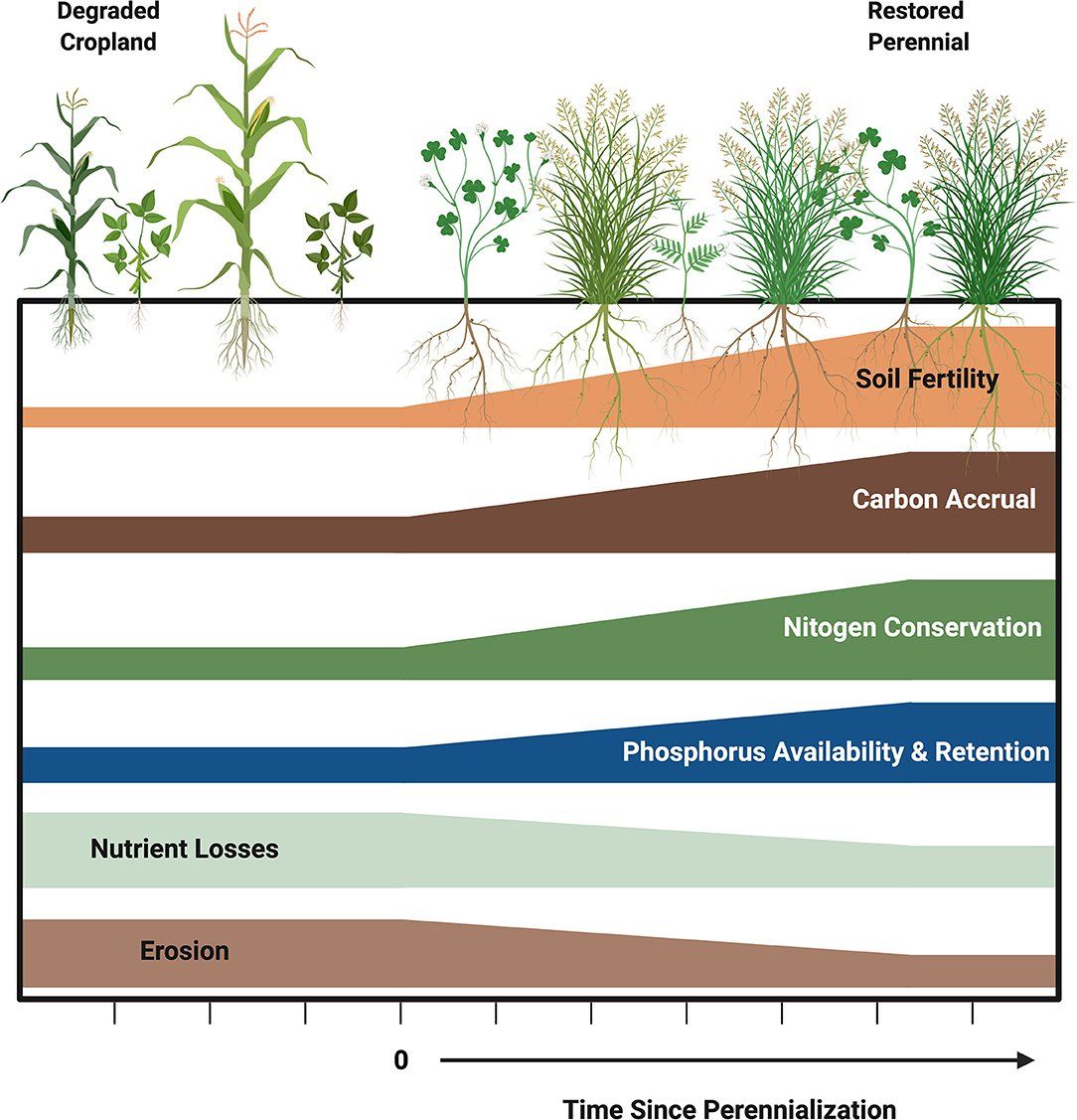
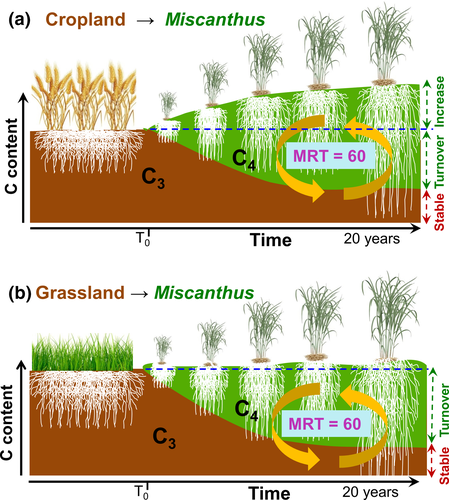
The below ground storage is show on the right for miscanthus. From a below ground carbon sequestration perspective Miscanthus is outperforming cropland substantially, and grassland marginally. as shown on the left. The green color of soil organic C represents the contribution of Miscanthus-derived C4-C, and the brown color represents the C derived from C3 cropland or grassland. The yellow circle shows the mean resident time of soil organic matter under Miscanthus, which was around 60 years. T0
represents the starting point of land-use change to Miscanthus. Globally, growing Miscanthus on C-poor soils (e.g., degraded cropland an grazing land) will provide immediate soil organic matter (carbon) sequestration. In general: the lower the soil carbon content the higher the soil sequestration rate. Soil carbon however reaches a saturation point at some point in time, and as soil carbon gives a good impression of overall soil health the maximum soil restoration by natural means is by then completed. The average annual net soil sequestration, the result of littering and root system soil carbon increase and decrease by respiration, is 1-2 tonnes per hectare but it can be considerably higher depending on climatic conditions.
ADVANCING SUSTAINABLE BIOENERGY DEVELOPMENT
New, advanced technologies make it possible to produce climate neutral fuels from non-forest and non-food energy crops. The benefits of cultivation and use of these energy crops for transport fuels and electricity goes beyond the benefits of reducing greenhouse gas emissions. Terrestrial energy crop cultivation and aquatic energy crop harvesting reverses land and water degradation, increases biodiversity and carbon sequestration and improves land fertility. We call this
Deep Green Biomass. Moreover, deploying these energy crops for the production of advanced biofuels will positively impact social-economic structures and energy independence and reduce the need for involuntary migration and deforestation: Deep Green Energy.
Deep Green Energy Partners works to accelerate deployment of deep green biomass for the production of advanced biofuels and biochemicals, to restore soil and water conditions and to optimize the overall ecological-economic effects of investments in the energy transition.
ABOVE GROUND CARBON SEQUESTRATION
ADVANCING SUSTAINABLE BIOENERGY DEVELOPMENT
New, advanced technologies make it possible to produce climate neutral fuels from non-forest and non-food energy crops. The benefits of cultivation and use of these energy crops for transport fuels and electricity goes beyond the benefits of reducing greenhouse gas emissions. Terrestrial energy crop cultivation and aquatic energy crop harvesting reverses land and water degradation, increases biodiversity and carbon sequestration and improves land fertility. We call this
Deep Green Biomass. Moreover, deploying these energy crops for the production of advanced biofuels will positively impact social-economic structures and energy independence and reduce the need for involuntary migration and deforestation: Deep Green Energy.
Deep Green Energy Partners works to accelerate deployment of deep green biomass for the production of advanced biofuels and biochemicals, to restore soil and water conditions and to optimize the overall ecological-economic effects of investments in the energy transition.
Energy crops are the most efficient option to increase soil carbon stocks, restore store overgrazed grasslands and depleted croplands and/or to replace grass or crops when, due to climatic or economic circumstances crop and livestock cultivation is no longer viable. Due to their carbon sequestration efficiency energy crops are also the most efficient plants to increase aboveground carbon stocks.
ADVANCING SUSTAINABLE BIOENERGY DEVELOPMENT
New, advanced technologies make it possible to produce climate neutral fuels from non-forest and non-food energy crops. The benefits of cultivation and use of these energy crops for transport fuels and electricity goes beyond the benefits of reducing greenhouse gas emissions. Terrestrial energy crop cultivation and aquatic energy crop harvesting reverses land and water degradation, increases biodiversity and carbon sequestration and improves land fertility. We call this
Deep Green Biomass. Moreover, deploying these energy crops for the production of advanced biofuels will positively impact social-economic structures and energy independence and reduce the need for involuntary migration and deforestation: Deep Green Energy.
Deep Green Energy Partners works to accelerate deployment of deep green biomass for the production of advanced biofuels and biochemicals, to restore soil and water conditions and to optimize the overall ecological-economic effects of investments in the energy transition.
Above ground carbon mass is easier to asses as it can be measured after cutting and drying the cane. The cane consists of 48% carbon, assuming an average of 16.3 tonnes of dry matter per hectare/year (DM/ha/y) (see below) this means about 8 tonnes of carbon are sequestered in above ground biomass per hectare. Above ground biomass can be locked up in products such as construction materials, animal bedding, textiles, and plastics or it and can be used for energy: for food, using indoor farming techniques, or for fuels (advanced biofuels) and electricity. Miscanthus sequesters at least twice the carbon per hectare as trees do, as shown in the table on the right.
ADVANCING SUSTAINABLE BIOENERGY DEVELOPMENT
New, advanced technologies make it possible to produce climate neutral fuels from non-forest and non-food energy crops. The benefits of cultivation and use of these energy crops for transport fuels and electricity goes beyond the benefits of reducing greenhouse gas emissions. Terrestrial energy crop cultivation and aquatic energy crop harvesting reverses land and water degradation, increases biodiversity and carbon sequestration and improves land fertility. We call this
Deep Green Biomass. Moreover, deploying these energy crops for the production of advanced biofuels will positively impact social-economic structures and energy independence and reduce the need for involuntary migration and deforestation: Deep Green Energy.
Deep Green Energy Partners works to accelerate deployment of deep green biomass for the production of advanced biofuels and biochemicals, to restore soil and water conditions and to optimize the overall ecological-economic effects of investments in the energy transition.
GLOBAL CARBON SEQUESTRATION POTENTIAL ENERGY CROPS
ADVANCING SUSTAINABLE BIOENERGY DEVELOPMENT
New, advanced technologies make it possible to produce climate neutral fuels from non-forest and non-food energy crops. The benefits of cultivation and use of these energy crops for transport fuels and electricity goes beyond the benefits of reducing greenhouse gas emissions. Terrestrial energy crop cultivation and aquatic energy crop harvesting reverses land and water degradation, increases biodiversity and carbon sequestration and improves land fertility. We call this
Deep Green Biomass. Moreover, deploying these energy crops for the production of advanced biofuels will positively impact social-economic structures and energy independence and reduce the need for involuntary migration and deforestation: Deep Green Energy.
Deep Green Energy Partners works to accelerate deployment of deep green biomass for the production of advanced biofuels and biochemicals, to restore soil and water conditions and to optimize the overall ecological-economic effects of investments in the energy transition.
Energy crops are the most efficient option to increase soil carbon stocks, restore store overgrazed grasslands and depleted croplands and/or to replace grass or crops when, due to climatic or economic circumstances crop and livestock cultivation is no longer viable. Due to their carbon sequestration efficiency energy crops are also the most efficient plants to increase aboveground carbon stocks.
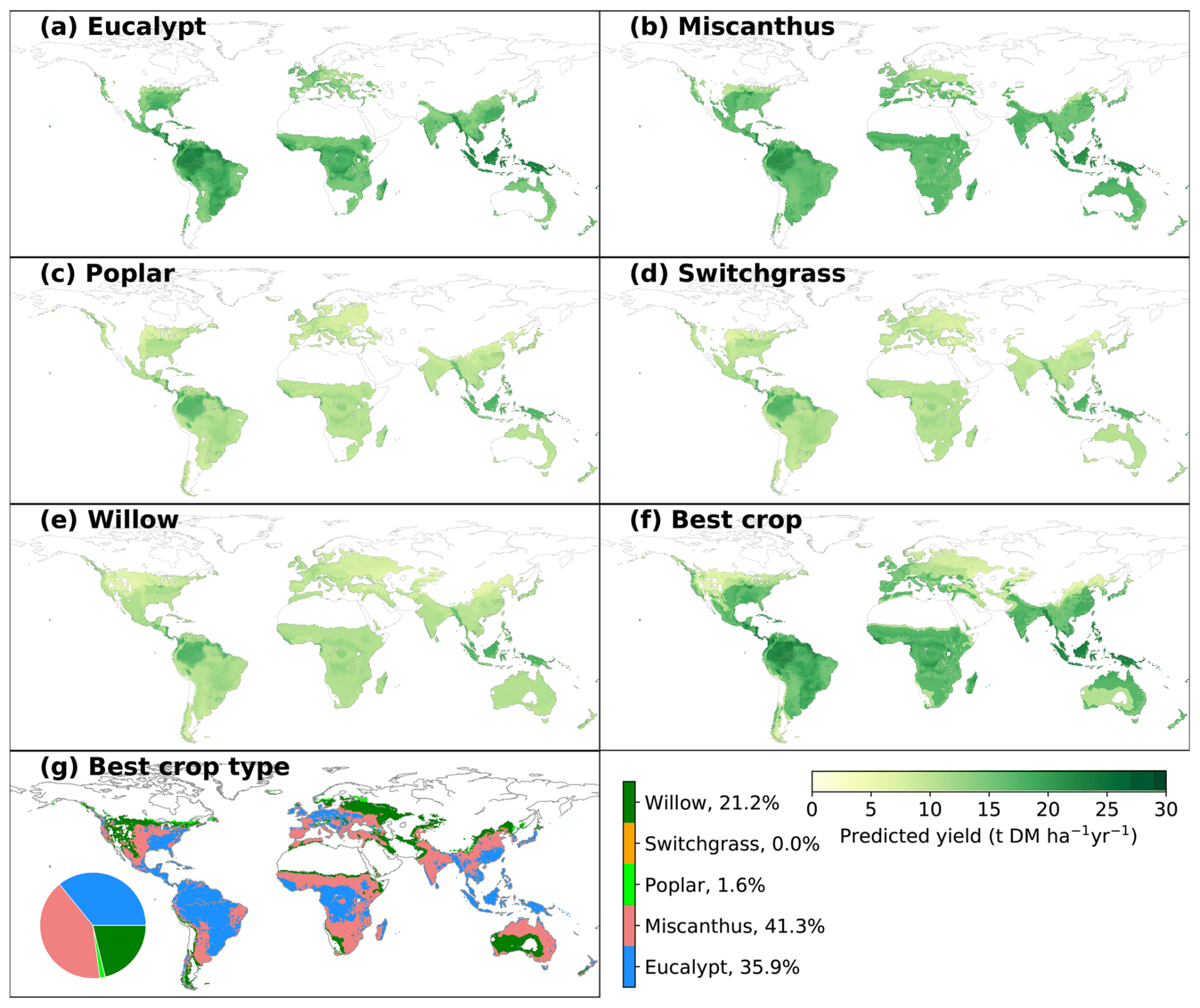
As there are many variaties in energy crops, soil conditions the above yield ranges depend on any particular combination of soil and climatic conditions and crop species. The maps on the left show the spatial distribution of predicted yields for five well known energy crops and the average best crop per region and overall.
Overall, water-related and temperature-related variables are the most important variables and soil conditions may have little impact on the bioenergy crop yields. The global median yield of the best energy crop is 16.3 tonnes dry matter year (DM/ha/y). Consistent with the high yields of Miscanthus and Eucalyptus representing almost 80% of the main compositions of the best crop globally. Corresponding to the yields ranges in the above table, yields for all species can be 50% lower or 100% higher than the median yields.
ADVANCING SUSTAINABLE BIOENERGY DEVELOPMENT
New, advanced technologies make it possible to produce climate neutral fuels from non-forest and non-food energy crops. The benefits of cultivation and use of these energy crops for transport fuels and electricity goes beyond the benefits of reducing greenhouse gas emissions. Terrestrial energy crop cultivation and aquatic energy crop harvesting reverses land and water degradation, increases biodiversity and carbon sequestration and improves land fertility. We call this
Deep Green Biomass. Moreover, deploying these energy crops for the production of advanced biofuels will positively impact social-economic structures and energy independence and reduce the need for involuntary migration and deforestation: Deep Green Energy.
Deep Green Energy Partners works to accelerate deployment of deep green biomass for the production of advanced biofuels and biochemicals, to restore soil and water conditions and to optimize the overall ecological-economic effects of investments in the energy transition.
Continuing using Miscanthus as example the annual average carbon sequestration per hectare is: 2 ton below ground and 7.8 tonnes above ground, equal to 43 tonnes CO2eq. Assuming 10% of the aboveground carbon is needed on for harvesting etc. the average net carbon sequestration per hectare would be 10t carbon, or 36.7 tCO2eq per hectare.
ADVANCING SUSTAINABLE BIOENERGY DEVELOPMENT
New, advanced technologies make it possible to produce climate neutral fuels from non-forest and non-food energy crops. The benefits of cultivation and use of these energy crops for transport fuels and electricity goes beyond the benefits of reducing greenhouse gas emissions. Terrestrial energy crop cultivation and aquatic energy crop harvesting reverses land and water degradation, increases biodiversity and carbon sequestration and improves land fertility. We call this
Deep Green Biomass. Moreover, deploying these energy crops for the production of advanced biofuels will positively impact social-economic structures and energy independence and reduce the need for involuntary migration and deforestation: Deep Green Energy.
Deep Green Energy Partners works to accelerate deployment of deep green biomass for the production of advanced biofuels and biochemicals, to restore soil and water conditions and to optimize the overall ecological-economic effects of investments in the energy transition.
GLOBAL LAND AREA FOR ENERGY CROPS
ADVANCING SUSTAINABLE BIOENERGY DEVELOPMENT
New, advanced technologies make it possible to produce climate neutral fuels from non-forest and non-food energy crops. The benefits of cultivation and use of these energy crops for transport fuels and electricity goes beyond the benefits of reducing greenhouse gas emissions. Terrestrial energy crop cultivation and aquatic energy crop harvesting reverses land and water degradation, increases biodiversity and carbon sequestration and improves land fertility. We call this
Deep Green Biomass. Moreover, deploying these energy crops for the production of advanced biofuels will positively impact social-economic structures and energy independence and reduce the need for involuntary migration and deforestation: Deep Green Energy.
Deep Green Energy Partners works to accelerate deployment of deep green biomass for the production of advanced biofuels and biochemicals, to restore soil and water conditions and to optimize the overall ecological-economic effects of investments in the energy transition.
The total global area suitable, and potentially available today for energy crops is approximately 1.8 billion hectares
(18.8 million km2). Half of it, 0.95 billion hectares is highly or moderately suitable and the rest is just marginally suitable. When all urban areas, food agricultural land, forests and protected zones are excluded and potential overlaps with degrading agriculture lands are eliminated about 0.5-0.6 billion hectares are available today.
ADVANCING SUSTAINABLE BIOENERGY DEVELOPMENT
New, advanced technologies make it possible to produce climate neutral fuels from non-forest and non-food energy crops. The benefits of cultivation and use of these energy crops for transport fuels and electricity goes beyond the benefits of reducing greenhouse gas emissions. Terrestrial energy crop cultivation and aquatic energy crop harvesting reverses land and water degradation, increases biodiversity and carbon sequestration and improves land fertility. We call this
Deep Green Biomass. Moreover, deploying these energy crops for the production of advanced biofuels will positively impact social-economic structures and energy independence and reduce the need for involuntary migration and deforestation: Deep Green Energy.
Deep Green Energy Partners works to accelerate deployment of deep green biomass for the production of advanced biofuels and biochemicals, to restore soil and water conditions and to optimize the overall ecological-economic effects of investments in the energy transition.
In a business as usual scenario food production will be gradually moved indoors due to climate conditions and soil nutriant depletion. The total moderate and high suitable land available for energy crops will reach the above maximum of around 1 billion hectares in the next decades when land is abandoned due to productivity decreases. Depending on the pace of food migration and the scale up of cultivated and microbial food production
more land will become available. Planting the current available 0.5 billion hectares using the median global best average performing of Miscanthus would annually remove about 2 Gt carbon from te atmosphere of which 0.5 Gt would be stored in soils. As marginally suited lands are excluded, average yields an sequestration will likely be higher.
Global areas suitable and available for energy crops to the end of the century, Land suitability for energy crops under scenarios of climate change and land-use
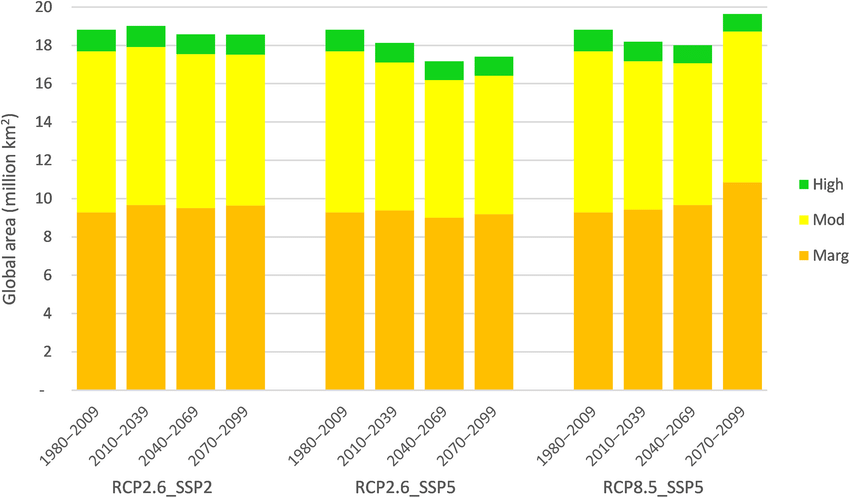
ADVANCING SUSTAINABLE BIOENERGY DEVELOPMENT
New, advanced technologies make it possible to produce climate neutral fuels from non-forest and non-food energy crops. The benefits of cultivation and use of these energy crops for transport fuels and electricity goes beyond the benefits of reducing greenhouse gas emissions. Terrestrial energy crop cultivation and aquatic energy crop harvesting reverses land and water degradation, increases biodiversity and carbon sequestration and improves land fertility. We call this
Deep Green Biomass. Moreover, deploying these energy crops for the production of advanced biofuels will positively impact social-economic structures and energy independence and reduce the need for involuntary migration and deforestation: Deep Green Energy.
Deep Green Energy Partners works to accelerate deployment of deep green biomass for the production of advanced biofuels and biochemicals, to restore soil and water conditions and to optimize the overall ecological-economic effects of investments in the energy transition.
Planting the lands that are marginal suitable and likely to be abandoned in the next decades will at least double the sequestration rate and so would net overall carbon removal (8 Gt) and soil sequestration (2Gt) = 1 billion ha. Doing so would also reduce the emissions agriculture and soil erosion bringing the total sequestration close to 90% of all current emissions. Changing the use of a billion hectares in a few decades might seem a big task but an estimated 17% of the Earth’s land surface has changed at least once from 1960 to 2019. When summing all of the individual change events (including areas of multiple change), the total land change extent is 43 million km² or 4.3 billion hectares, which is almost a third of the global land surface. So technically we could even off-set all current emissions, but we have to harvest and deploy that harvest either to substitute fossil fuels, chemicals, food, feed or materials.
ADVANCING SUSTAINABLE BIOENERGY DEVELOPMENT
New, advanced technologies make it possible to produce climate neutral fuels from non-forest and non-food energy crops. The benefits of cultivation and use of these energy crops for transport fuels and electricity goes beyond the benefits of reducing greenhouse gas emissions. Terrestrial energy crop cultivation and aquatic energy crop harvesting reverses land and water degradation, increases biodiversity and carbon sequestration and improves land fertility. We call this
Deep Green Biomass. Moreover, deploying these energy crops for the production of advanced biofuels will positively impact social-economic structures and energy independence and reduce the need for involuntary migration and deforestation: Deep Green Energy.
Deep Green Energy Partners works to accelerate deployment of deep green biomass for the production of advanced biofuels and biochemicals, to restore soil and water conditions and to optimize the overall ecological-economic effects of investments in the energy transition.
ENERGY CROPS DEPLOYMENT
ADVANCING SUSTAINABLE BIOENERGY DEVELOPMENT
New, advanced technologies make it possible to produce climate neutral fuels from non-forest and non-food energy crops. The benefits of cultivation and use of these energy crops for transport fuels and electricity goes beyond the benefits of reducing greenhouse gas emissions. Terrestrial energy crop cultivation and aquatic energy crop harvesting reverses land and water degradation, increases biodiversity and carbon sequestration and improves land fertility. We call this
Deep Green Biomass. Moreover, deploying these energy crops for the production of advanced biofuels will positively impact social-economic structures and energy independence and reduce the need for involuntary migration and deforestation: Deep Green Energy.
Deep Green Energy Partners works to accelerate deployment of deep green biomass for the production of advanced biofuels and biochemicals, to restore soil and water conditions and to optimize the overall ecological-economic effects of investments in the energy transition.
Monetized internal and external costs and benefits - Best Case
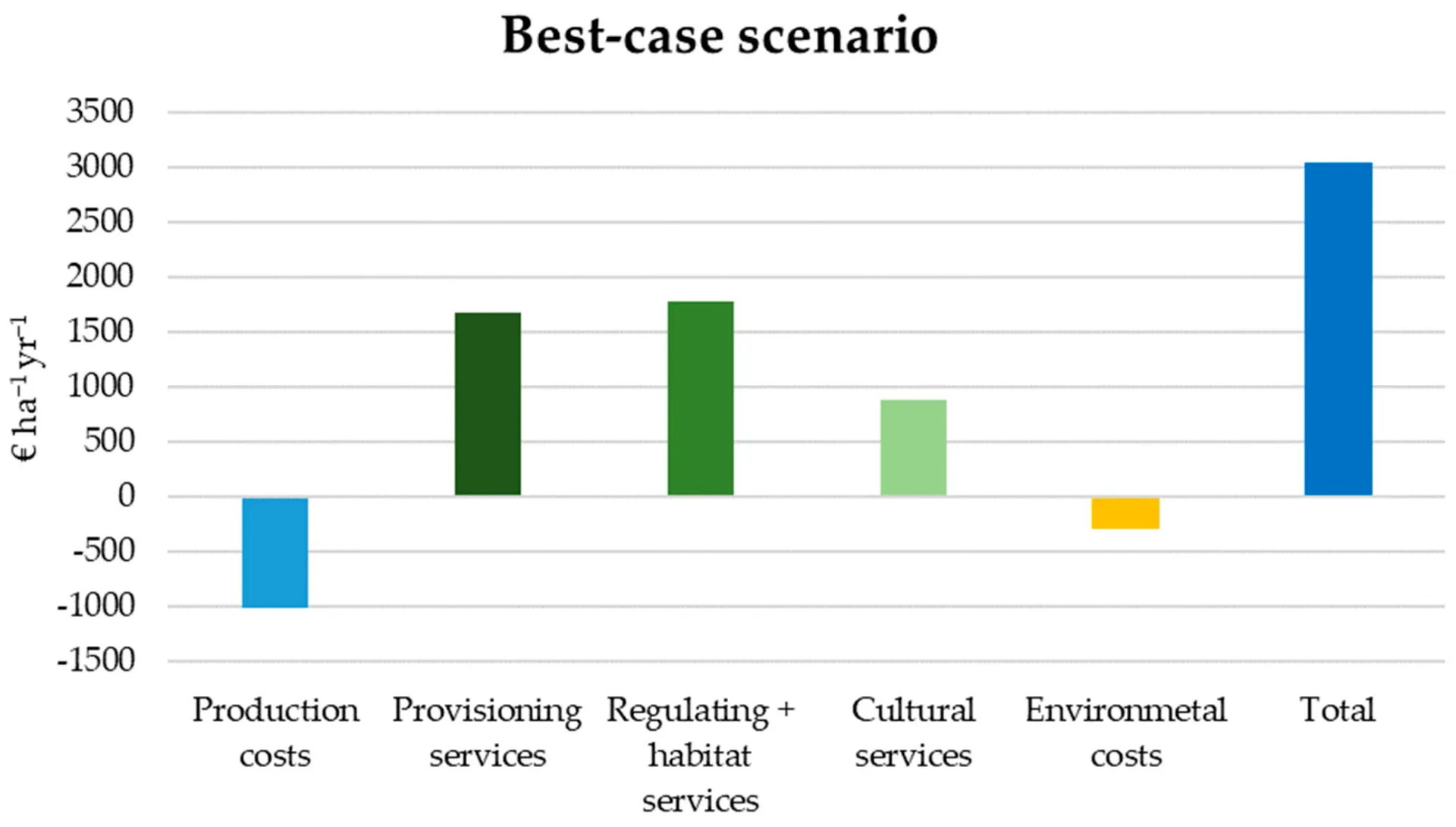
Monetized internal and external costs and benefits - Worst Case